
研究成纤维细胞激活蛋白 α 阳性癌相关成纤维细胞与肿瘤微环境在癌症免疫治疗中的复杂相互作用。
Investigating the complex interplay between fibroblast activation protein α-positive cancer associated fibroblasts and the tumor microenvironment in the context of cancer immunotherapy.
机构信息
Roche Pharma Research and Early Development, Oncology, Roche Innovation Center Basel, F. Hoffmann-La Roche Ltd., Basel, Switzerland.
Roche Pharma Research and Early Development, Data and Analytics, Roche Innovation Center Munich, Roche Diagnostics GmbH, Penzberg, Germany.
出版信息
Front Immunol. 2024 Jul 5;15:1352632. doi: 10.3389/fimmu.2024.1352632. eCollection 2024.
INTRODUCTION
This study investigates the role of Fibroblast Activation Protein (FAP)-positive cancer-associated fibroblasts (FAP+CAF) in shaping the tumor immune microenvironment, focusing on its association with immune cell functionality and cytokine expression patterns.
METHODS
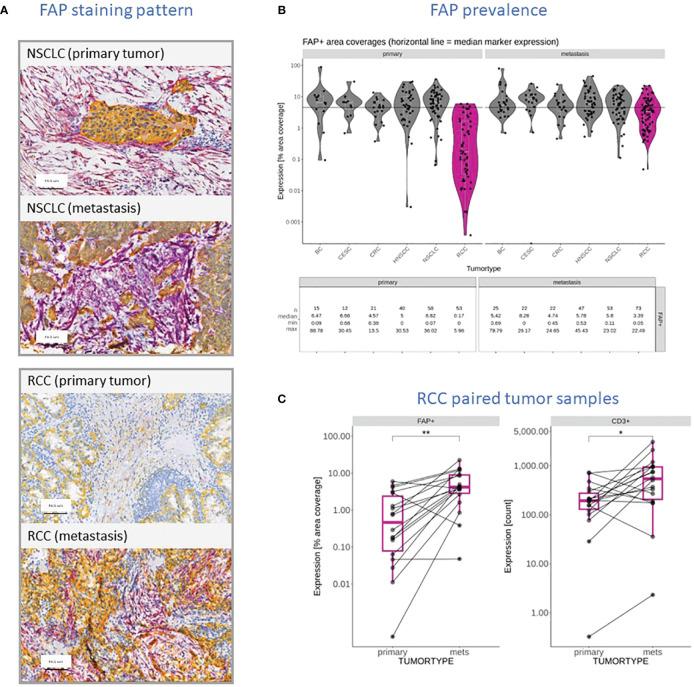
Utilizing immunohistochemistry, we observed elevated FAP+CAF density in metastatic versus primary renal cell carcinoma (RCC) tumors, with higher FAP+CAF correlating with increased T cell infiltration in RCC, a unique phenomenon illustrating the complex interplay between tumor progression, FAP+CAF density, and immune response.
RESULTS
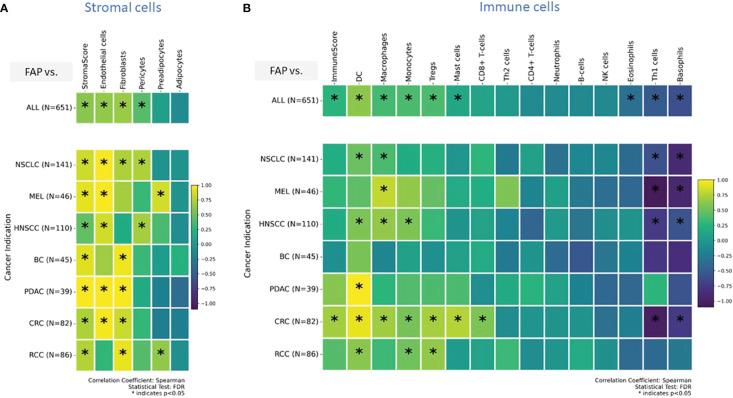
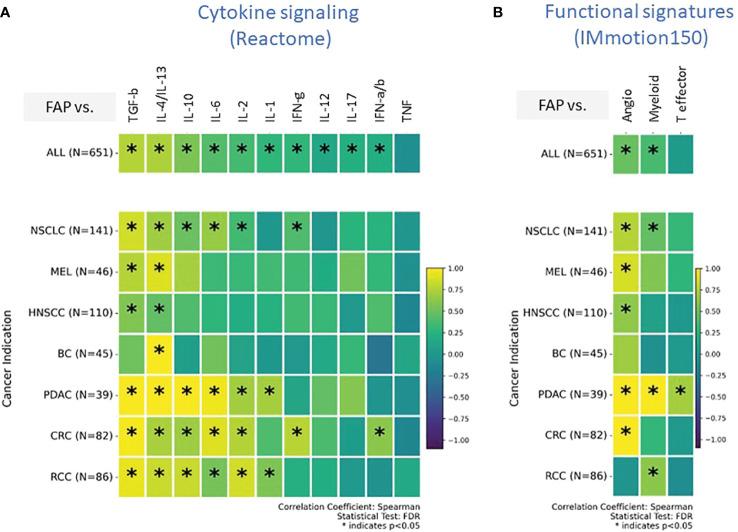
Analysis of immune cell subsets in FAP+CAF-rich stromal areas further revealed significant correlations between FAP+ stroma and various T cell types, particularly in RCC and non-small cell lung cancer (NSCLC). This was complemented by transcriptomic analyses, expanding the range of stromal and immune cell subsets interrogated, as well as to additional tumor types. This enabled evaluating the association of these subsets with tumor infiltration, tumor vascularization and other components of the tumor microenvironment. Our comprehensive study also encompassed cytokine, angiogenesis, and inflammation gene signatures across different cancer types, revealing heterogeneous cellular composition, cytokine expressions and angiogenic profiles. Through cytokine pathway profiling, we explored the relationship between FAP+CAF density and immune cell states, uncovering potential immunosuppressive circuits that limit anti-tumor activity in tumor-resident immune cells.
CONCLUSIONS
These findings underscore the complexity of tumor biology and the necessity for personalized therapeutic and patient enrichment approaches. The insights gathered from FAP+CAF prevalence, immune infiltration, and gene signatures provide valuable perspectives on tumor microenvironments, aiding in future research and clinical strategy development.
简介
本研究探讨了成纤维细胞激活蛋白(FAP)阳性癌相关成纤维细胞(FAP+CAF)在塑造肿瘤免疫微环境中的作用,重点研究其与免疫细胞功能和细胞因子表达模式的关联。
方法
利用免疫组织化学方法,我们观察到转移性肾细胞癌(RCC)肿瘤中的 FAP+CAF 密度高于原发性肿瘤,且 FAP+CAF 密度越高,RCC 中的 T 细胞浸润越多,这一独特现象说明了肿瘤进展、FAP+CAF 密度和免疫反应之间的复杂相互作用。
结果
对 FAP+CAF 丰富的基质区域中免疫细胞亚群的分析进一步显示,FAP+基质与各种 T 细胞类型之间存在显著相关性,尤其是在 RCC 和非小细胞肺癌(NSCLC)中。转录组分析补充了这一结果,扩大了所研究的基质和免疫细胞亚群的范围,并涵盖了其他肿瘤类型。这使得评估这些亚群与肿瘤浸润、肿瘤血管生成和肿瘤微环境的其他成分之间的关联成为可能。我们的综合研究还涵盖了不同癌症类型的细胞因子、血管生成和炎症基因特征,揭示了不同细胞组成、细胞因子表达和血管生成特征的异质性。通过细胞因子通路分析,我们研究了 FAP+CAF 密度与免疫细胞状态之间的关系,揭示了潜在的抑制性免疫循环,这些循环限制了肿瘤驻留免疫细胞的抗肿瘤活性。
结论
这些发现强调了肿瘤生物学的复杂性,以及需要个性化的治疗和患者富集方法。从 FAP+CAF 的流行程度、免疫浸润和基因特征中获得的见解为肿瘤微环境提供了有价值的视角,有助于未来的研究和临床策略的制定。


 Zotero 插件