
母鸡补充桑叶黄酮可改善雏鸡后代骨骼肌的发育。
Maternal supplementation with mulberry-leaf flavonoids improves the development of skeletal muscle in the offspring of chickens.
作者信息
Huang Zhenwu, Dai Hongjian, Li Simeng, Wang Zhe, Wei Quanwei, Ning Zhonghua, Guo Yuming, Shi Fangxiong, Lv Zengpeng
机构信息
College of Animal Science and Technology, Nanjing Agricultural University, Nanjing, 210095, China.
State Key Laboratory of Animal Nutrition and Feeding, Institute of Animal Sciences, Chinese Academy of Agricultural Sciences, Beijing, 100193, China.
出版信息
Anim Nutr. 2024 Apr 17;18:72-83. doi: 10.1016/j.aninu.2024.04.005. eCollection 2024 Sep.
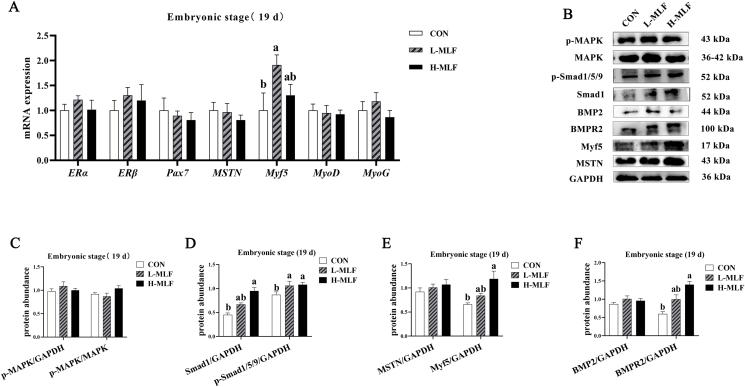
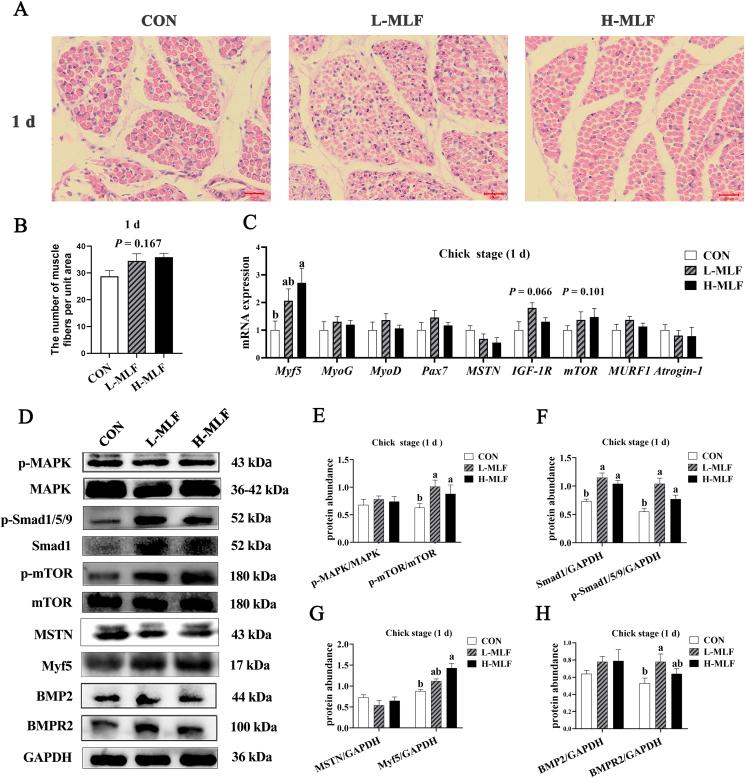
The development of skeletal muscle is a crucial factor in determining the meat yield and economic benefits of broiler production. Recent research has shown that mulberry leaves and their extracts can be used to significantly improve the growth performance of livestock and poultry. The present study aims to elucidate the mechanisms involved in the regulation of skeletal muscle development in broiler offspring by dietary mulberry-leaf flavonoids (MLF) supplementation from the perspective of maternal effect theory. A total of 270 Qiling broiler breeder hens were randomly assigned to 3 treatments with different doses of MLF (0, 30, 60 mg/kg) for 8 weeks before collecting their fertilized eggs. The chicken offspring at 13 and 19 d of embryonic stage, and from 1 to 28 d old after hatching were included in this study. The results showed that maternal supplementation increased the breast muscle weight and body weight of the offspring at the embryo and chick stages ( < 0.05). This was followed by increased cross-sectional area of pectoral muscle fibres at 14 d ( < 0.05). Further determination revealed a tendency towards increased serum levels of insulin-like growth factor 1 (IGF-1) ( = 0.092) and muscle fibre count ( = 0.167) at 1 d post-hatching following maternal MLF treatment, while serum uric acid (UA) was decreased at 14 d after hatching ( < 0.05). Moreover, maternal MLF supplementation significantly up-regulated the mRNA expression of the myogenic regulatory factor in skeletal muscle at the both embryonic and growth stages ( < 0.05). The relative abundance of the downstream protein of BMPR2, Smad1 and p-Smad1/5/9 in the TGFβ signalling pathway was significantly increased by maternal MLF treatment. Meanwhile, the increased expression of the target protein p-mTOR in the breast muscle of the offspring chicks is in accordance with the improved growth rate of the breast and the body. In conclusion, maternal MLF supplementation can promote muscle protein metabolism and muscle fibre development of chick embryos through upregulation of expression and BMP/p-Smad1/5/9 axis, thereby improving growth performance of slow growing broiler.
骨骼肌的发育是决定肉鸡生产中肉产量和经济效益的关键因素。最近的研究表明,桑叶及其提取物可用于显著提高畜禽的生长性能。本研究旨在从母体效应理论的角度阐明日粮添加桑叶黄酮(MLF)对肉鸡后代骨骼肌发育调控的机制。将270只麒麟肉鸡种母鸡随机分为3组,分别饲喂不同剂量(0、30、60 mg/kg)的MLF,持续8周,之后收集它们的受精蛋。本研究纳入了胚胎期13和19天以及孵化后1至28日龄的鸡后代。结果表明,母体补充MLF可增加胚胎期和雏鸡期后代的胸肌重量和体重(P<0.05)。随后在14日龄时胸肌纤维横截面积增加(P<0.05)。进一步测定发现,母体MLF处理后,孵化后1天血清胰岛素样生长因子1(IGF-1)水平有升高趋势(P=0.092),肌纤维数量也有增加趋势(P=0.167),而孵化后14天血清尿酸(UA)水平降低(P<0.05)。此外,母体补充MLF显著上调了胚胎期和生长阶段骨骼肌中肌源性调节因子的mRNA表达(P<0.05)。母体MLF处理显著增加了TGFβ信号通路中BMPR2下游蛋白Smad1和p-Smad1/5/9的相对丰度。同时,后代雏鸡胸肌中靶蛋白p-mTOR表达增加,这与胸肌和身体生长速度加快一致。总之,母体补充MLF可通过上调MyoD表达和BMP/p-Smad1/5/9轴促进雏鸡胚胎的肌肉蛋白质代谢和肌纤维发育,从而改善生长缓慢肉鸡的生长性能。


 Zotero 插件