
免疫球蛋白 G(IgG)对重组 Qβ展示的 MSP3 和 UB05 的特异性反应存在于生活在喀麦隆两个不同农业生态环境的无症状感染儿童的血浆中。
Immunoglobulin G (IgG) specific responses to recombinant Qβ displayed MSP3 and UB05 in plasma of asymptomatic -infected children living in two different agro-ecological settings of Cameroon.
机构信息
Laboratory of Vaccinology/Biobanking, Chantal Biya International Reference Center for Research on the Prevention and Management of HIV/AIDS, Yaounde, Cameroon.
Department of Biochemistry, Faculty of Sciences, University of Yaounde I, Yaounde, Cameroon.
出版信息
Pan Afr Med J. 2024 Apr 9;47:175. doi: 10.11604/pamj.2024.47.175.38169. eCollection 2024.
INTRODUCTION
in areas with intense perennial malaria transmission, limited data is available on the impact of environmental conditions especially rainfall on naturally acquired immunity against promising malaria vaccine candidates. For this reason, we have compared IgG antibody responses specific to Plasmodium spp. derived MSP3 and UB05 vaccine candidates, in plasma of children living in two areas of Cameroon differing in rainfall conditions.
METHODS
data about children less than 5 years old was collected during the years 2017 and 2018. Next malaria asymptomatic P. falciparum (Pf) infected children were selected following malaria test confirmation. MSP3 and UB05 specific IgG antibody responses were measured in participant´s plasma using enzyme-linked immunosorbent assay (ELISA).
RESULTS
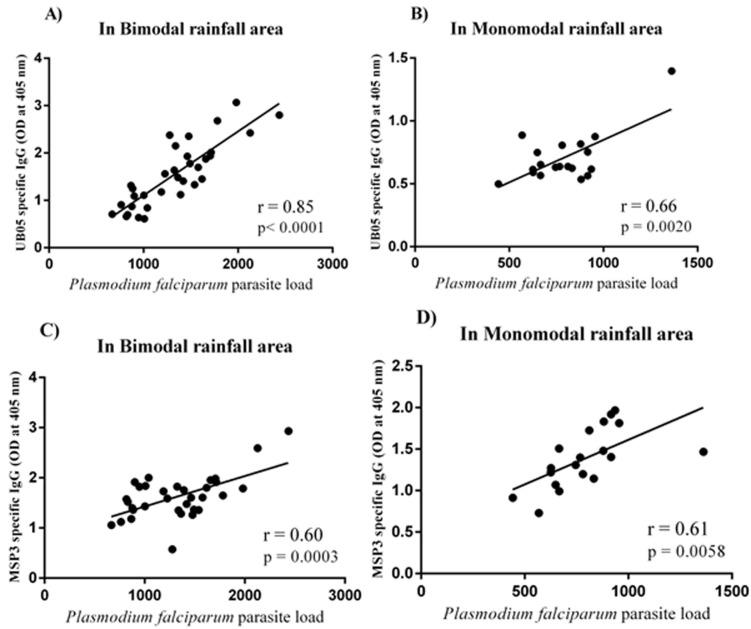
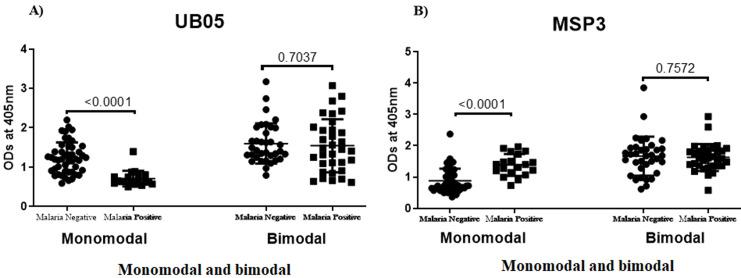
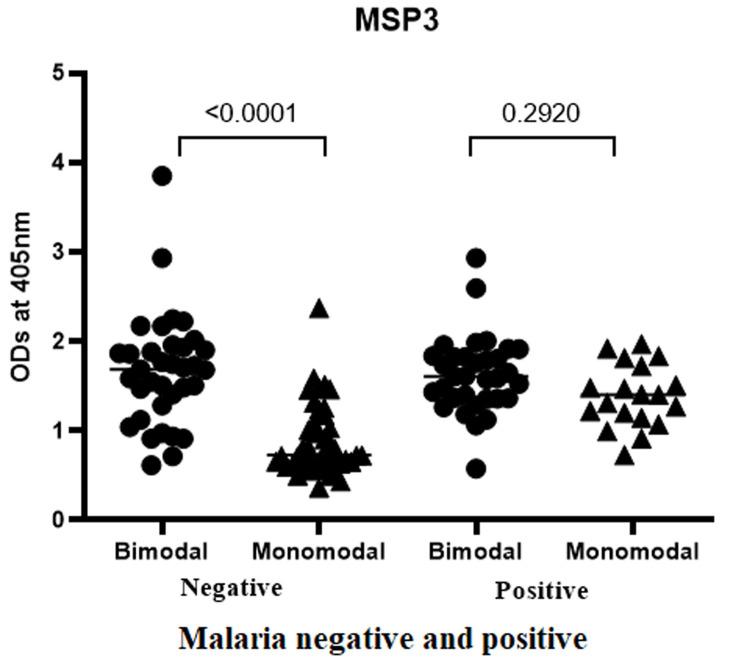
interestingly, IgG antibody responses specific to UB05 were significantly higher (p<0.0001) in Pf-negative children when compared to their asymptomatic Pf-infected counterparts living in monomodal rainfall areas. In contrast, a significantly higher (p<0.0001) IgG response to MSP3 was observed instead in asymptomatic Pf-infected children in the same population. In addition, IgG responses specific to UB05 remained significantly higher in bimodal when compared to monomodal rainfall areas irrespective of children´s Pf infection status (p<0.0055 for Pf-positive and p<0.0001 for negative children). On the contrary, IgG antibody responses specific to MSP3 were significantly higher in bimodal relative to monomodal rainfall areas (P<0.0001) just for Pf-negative children.
CONCLUSION
thus IgG antibody responses specific to UBO5 are a better correlate of naturally acquired immunity against malaria in Pf-negative Cameroonian children especially in monomodal rainfall areas.
简介
在疟疾常年高强度传播地区,有关环境条件(尤其是降雨量)对有前景的疟疾疫苗候选物所产生的天然获得性免疫影响的数据有限。出于这个原因,我们比较了居住在喀麦隆两个降雨条件不同地区的儿童的血浆中针对疟原虫 spp. 衍生的 MSP3 和 UB05 疫苗候选物的 IgG 抗体反应。
方法
在 2017 年和 2018 年期间收集了 5 岁以下儿童的数据。接下来,根据疟疾检测结果,选择无症状恶性疟原虫(Pf)感染的儿童。使用酶联免疫吸附试验(ELISA)测量参与者血浆中针对 MSP3 和 UB05 的特异性 IgG 抗体反应。
结果
有趣的是,与生活在单峰降雨区的无症状 Pf 感染儿童相比,UB05 特异性 IgG 抗体反应在 Pf 阴性儿童中显著更高(p<0.0001)。相反,在同一人群中,无症状 Pf 感染儿童的 MSP3 IgG 反应明显更高(p<0.0001)。此外,UB05 特异性 IgG 反应在双峰降雨区仍显著高于单峰降雨区,无论儿童的 Pf 感染状态如何(Pf 阳性儿童 p<0.0055,阴性儿童 p<0.0001)。相反,MSP3 特异性 IgG 抗体反应在双峰降雨区相对于单峰降雨区更高(p<0.0001),仅在 Pf 阴性儿童中如此。
结论
因此,UB05 特异性 IgG 抗体反应是 Pf 阴性喀麦隆儿童对疟疾天然获得性免疫的更好相关指标,尤其是在单峰降雨区。

 Zotero 插件