
中国肝癌诊断分期的差异。
Disparities in stage at diagnosis for liver cancer in China.
作者信息
Shan Tianhao, Ran Xianhui, Li Huizhang, Feng Guoshuang, Zhang Siwei, Zhang Xuehong, Zhang Lei, Lu Lingeng, An Lan, Fu Ruiying, Sun Kexin, Wang Shaoming, Chen Ru, Li Li, Chen Wanqing, Wei Wenqiang, Zeng Hongmei, He Jie
机构信息
National Central Cancer Registry, National Cancer Center/National Clinical Research Center for Cancer/Cancer Hospital, Chinese Academy of Medical Sciences and Peking Union Medical College, Beijing, China.
Cancer Hospital of University of Chinese Academy of Sciences/Zhejiang Cancer Hospital, Department of Cancer Prevention, Institute of Cancer Research and Basic Medical Sciences, Chinese Academy of Sciences, Hangzhou, China.
出版信息
J Natl Cancer Cent. 2023 Jan 3;3(1):7-13. doi: 10.1016/j.jncc.2022.12.002. eCollection 2023 Mar.
BACKGROUND
The stage at diagnosis is a major factor in making treatment strategies and cancer control policies. However, the stage distribution for liver cancer in China was not well studied. In this multi-center hospital-based study, we aimed to identify the distribution and factors associated with stage at diagnosis for liver cancer in China.
METHODS
We included patients diagnosed with primary liver cancer in 13 hospitals of 10 provinces covering various geographic and socioeconomic populations during 2016-2017 in China. The stage distribution overall, and by sex and age at diagnosis were analyzed. We used logistic regression to identify the factors associated with stage III-IV disease. We further compared these estimates with data from the USA.
RESULTS
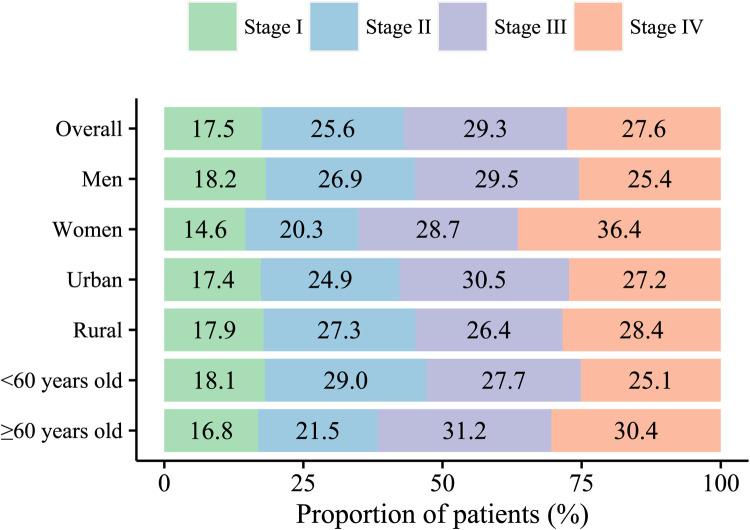
We included 2,991 patients with known stage at diagnosis in China. The proportion of patients diagnosed with stage I, II, III, and IV was 17.5%, 25.6%, 29.3%, and 27.6%, respectively. The proportion of stage III-IV cases was higher in women [65.1% vs 54.9%, adjusted odds ratio (OR) = 1.5, 95% CI: 1.2, 1.8] and those ≥ 60 years (61.6% vs 52.8%, OR = 1.4, 95% CI: 1.2, 1.6). We found an increased risk of stage III-IV among drinkers and those without a family history of cancer. Compared to the USA, our study population had a substantially higher proportion of stage III-IV cases (56.9% vs 45.6%).
CONCLUSION
The disparities in liver cancer stage at diagnosis among different populations within China, and between China and the USA, imply the necessity for improving cancer awareness and early detection for liver cancer in China.
背景
诊断时的分期是制定治疗策略和癌症控制政策的主要因素。然而,中国肝癌的分期分布情况尚未得到充分研究。在这项基于多中心医院的研究中,我们旨在确定中国肝癌诊断时的分期分布及其相关因素。
方法
我们纳入了2016年至2017年期间在中国10个省份的13家医院诊断为原发性肝癌的患者,这些医院覆盖了不同地理和社会经济人群。分析了总体分期分布情况,以及按诊断时的性别和年龄划分的分期分布情况。我们使用逻辑回归来确定与III-IV期疾病相关的因素。我们进一步将这些估计值与美国的数据进行了比较。
结果
我们纳入了中国2991例诊断时分期已知的患者。诊断为I期、II期、III期和IV期的患者比例分别为17.5%、25.6%、29.3%和27.6%。III-IV期病例的比例在女性中更高[65.1%对54.9%,调整后的优势比(OR)=1.5,95%置信区间(CI):1.2,1.8],在60岁及以上人群中也更高(61.6%对52.8%,OR =1.4,95%CI:1.2,1.6)。我们发现饮酒者和无癌症家族史者患III-IV期的风险增加。与美国相比,我们的研究人群中III-IV期病例的比例显著更高(56.9%对45.6%)。
结论
中国不同人群之间以及中国与美国之间肝癌诊断时分期的差异表明,中国有必要提高对肝癌的认识并加强早期检测。


 Zotero 插件