
2015年中国的癌症发病率和死亡率
Cancer incidence and mortality in China, 2015.
作者信息
Zhang Siwei, Sun Kexin, Zheng Rongshou, Zeng Hongmei, Wang Shaoming, Chen Ru, Wei Wenqiang, He Jie
机构信息
Office for Cancer Registry, National Cancer Center/National Clinical Research Center for Cancer/Cancer Hospital, Chinese Academy of Medical Sciences and Peking Union Medical College, Beijing, China.
Department of Thoracic Surgery, National Cancer Center/National Clinical Research Center for Cancer/Cancer Hospital, Chinese Academy of Medical Sciences and Peking Union Medical College, Beijing, China.
出版信息
J Natl Cancer Cent. 2020 Dec 17;1(1):2-11. doi: 10.1016/j.jncc.2020.12.001. eCollection 2021 Mar.
BACKGROUND
National Cancer Center (NCC) updated nationwide cancer statistics using population-based cancer registry data in 2015.
METHODS
501 cancer registries submitted data, among which 368 registries with high quality data were included in analysis. Numbers of nationwide new cancer cases and deaths were estimated using incidence and mortality rates and corresponding national population stratified by area, sex, age group and cancer site. The world Segi's population was applied for the calculation of age-standardized rates.
RESULTS
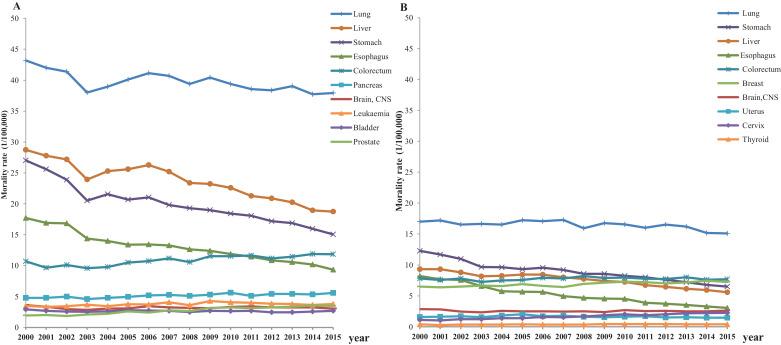
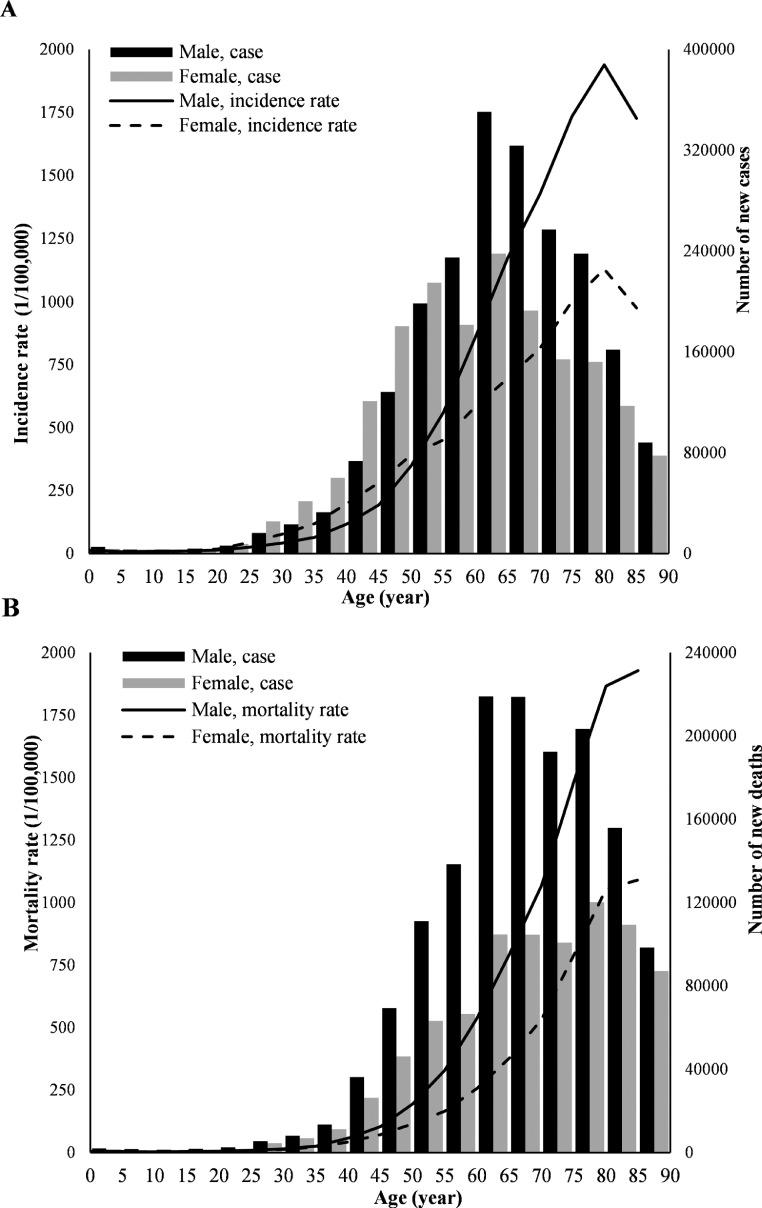
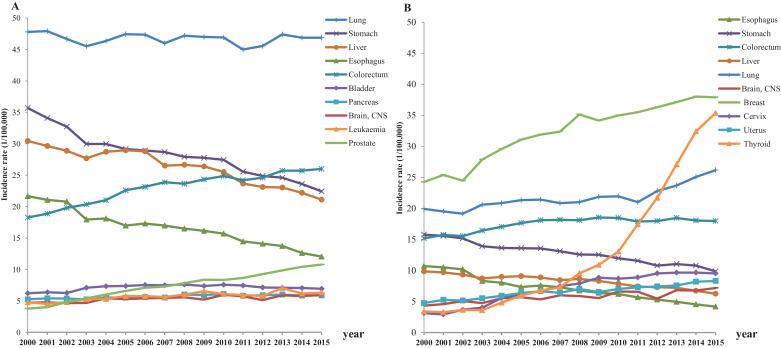
About 3,929,000 new cancer cases were diagnosed. The crude incidence rate was 285.83/100,000 and the age-standardized incidence rate by world standard population (ASIRW) was 186.39/100,000. ASIRW was higher in urban areas than in rural areas. South China had the highest ASIRW while Southwest China had the lowest ASIRW. Age-specific incidence rate was higher in males for population younger than 20 years or over 49 years. From 2000 to 2015, the ASIRWs for esophageal cancer, gastric cancer and liver cancer decreased significantly. The ASIRWs for colorectal cancer in whole population and for lung cancer, breast cancer, cervix cancer, uterus cancer and thyroid cancer in females increased significantly. 2,338,000 cancer deaths were reported. The crude mortality rate was 170.05/100,000 and the age standardized mortality rate by world standard population (ASMRW) was 105.84/100,000. ASMRW was higher in rural areas than in urban areas. Central China had the highest ASMRW while North China had the lowest ASMRW. Age-specific mortality rates in males were higher than that in females in every age group. From 2000 to 2015, the ASMRWs for esophageal cancer, gastric cancer, liver cancer and lung cancer decreased significantly. The ASMRWs for colorectal cancer, pancreas cancer and prostate cancer in males and for breast cancer, cervix cancer and thyroid cancer in females increased significantly.
CONCLUSIONS
Cancer has become a major life-threatening disease in China. Disease burdens differed across areas. Disease burdens for esophageal cancer, gastric cancer and liver cancer have decreased, while disease burdens for colorectal cancer, female breast cancer, cervix cancer and thyroid cancer have increased over the last 15 years. National and regional initiative for cancer prevention and control should be prioritized.
背景
国家癌症中心(NCC)于2015年利用基于人群的癌症登记数据更新了全国癌症统计数据。
方法
501个癌症登记处提交了数据,其中368个高质量数据登记处纳入分析。采用发病率和死亡率以及按地区、性别、年龄组和癌症部位分层的相应全国人口来估计全国新发癌症病例数和死亡数。应用世界Segi人口计算年龄标准化率。
结果
约392.9万例新发癌症病例被诊断。粗发病率为285.83/10万,世界标准人口年龄标准化发病率(ASIRW)为186.39/10万。ASIRW在城市地区高于农村地区。中国南方ASIRW最高,中国西南地区ASIRW最低。20岁以下或49岁以上人群中男性的年龄别发病率较高。2000年至2015年,食管癌、胃癌和肝癌的ASIRW显著下降。全人群中结直肠癌以及女性肺癌、乳腺癌、宫颈癌、子宫癌和甲状腺癌的ASIRW显著上升。报告了233.8万例癌症死亡。粗死亡率为170.05/10万,世界标准人口年龄标准化死亡率(ASMRW)为105.84/10万。ASMRW在农村地区高于城市地区。中国中部ASMRW最高,中国华北地区ASMRW最低。各年龄组男性的年龄别死亡率均高于女性。2000年至2015年,食管癌、胃癌、肝癌和肺癌的ASMRW显著下降。男性结直肠癌、胰腺癌和前列腺癌以及女性乳腺癌、宫颈癌和甲状腺癌的ASMRW显著上升。
结论
癌症已成为中国主要的威胁生命的疾病。不同地区的疾病负担有所不同。过去15年中,食管癌、胃癌和肝癌的疾病负担有所下降,而结直肠癌、女性乳腺癌、宫颈癌和甲状腺癌的疾病负担有所上升。应优先开展国家和地区癌症防控行动。

 Zotero 插件