
量化直肠癌患者放射性小肠毒性的社会负担。
Quantifying societal burden of radiation-induced small bowel toxicity in patients with rectal cancer.
作者信息
Kimpe Eva, Parmentier Riet, Busschaert Sara-Lise, De Mey Johan, Barbé Kurt, De Ridder Mark, Putman Koen
机构信息
Interuniversity Centre for Health Economics Research (I-CHER), Department of Public Health, Vrije Universiteit Brussel, Brussels, Belgium.
Department of Radiology, Universitair Ziekenhuis Brussel, Vrije Universiteit Brussel, Brussels, Belgium.
出版信息
Front Oncol. 2024 Jul 8;14:1340081. doi: 10.3389/fonc.2024.1340081. eCollection 2024.
INTRODUCTION
Advancements in rectal cancer (RC) treatment not only led to an increase in lives saved but also improved quality of life (QoL). Notwithstanding these benefits, RC treatment comes at the price of gastrointestinal morbidity in many patients. Health economic modelling poses an opportunity to explore the societal burden of such side-effects. This study aims to quantify radiation-induced late small bowel (SB) toxicity in survivors of RC for Three-Dimensional Conformal Radiation Therapy (3D-CRT), Intensity Modulated Radiation Therapy (IMRT) and Intensity Modulated Radiation Therapy - Image Guided Radiation Therapy (IMRT/IGRT).
MATERIALS AND METHODS
Materials and A model-based health economic evaluation was performed. The theoretical cohort consists of a case-mix of survivors of RC aged 25-99 years according to Belgian age-specific incidence rates. A societal perspective was adopted. The base case analysis was complemented with one-way deterministic analyses, deterministic scenario analyses and probabilistic sensitivity analysis (1,000 iterations). Results were presented as mean lifetime incremental cost (€) and utility (QALYs) per patient.
RESULTS
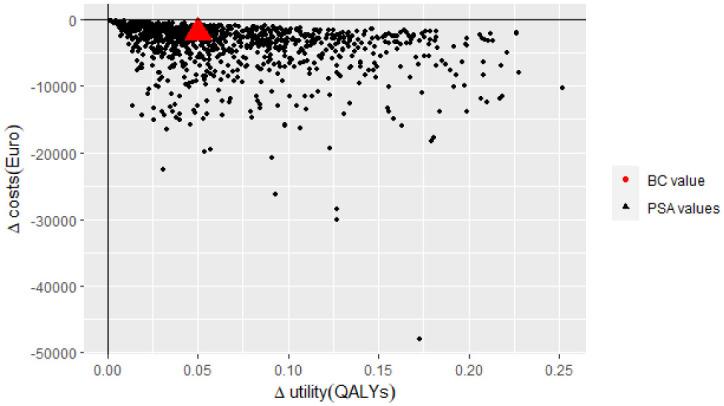
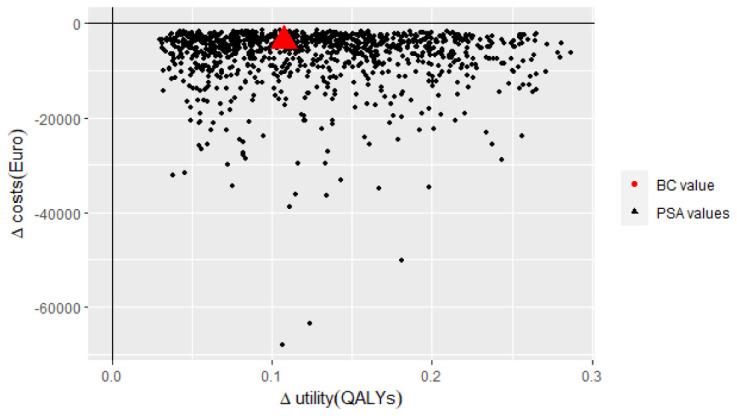
The analyses showed that the use of innovative radiotherapy (RT) improves lifetime QoL in survivors of RC by 0.11 QALYs and 0.05 QALYs by preferring IMRT/IGRT and IMRT over 3D-CRT, respectively. The use of IMRT/IGRT and IMRT results in an incremental cost-saving of €3,820 and €1,863 per patient, solely by radiation-induced SB toxicity, compared to 3D-CRT.
DISCUSSION AND CONCLUSION
It is important to consider late toxicity effects in decisions regarding investments and reimbursement as our analysis highlighted the potential long-term cost-savings and improved QoL of novel RT techniques in patients with rectal cancer.
引言
直肠癌(RC)治疗的进展不仅使挽救的生命数量增加,还提高了生活质量(QoL)。尽管有这些益处,但许多患者的RC治疗是以胃肠道发病为代价的。卫生经济建模为探索此类副作用的社会负担提供了契机。本研究旨在量化三维适形放射治疗(3D-CRT)、调强放射治疗(IMRT)和调强放射治疗 - 图像引导放射治疗(IMRT/IGRT)的RC幸存者中放射性晚期小肠(SB)毒性。
材料与方法
进行了基于模型的卫生经济评估。理论队列由根据比利时特定年龄发病率的25至99岁RC幸存者的病例组合组成。采用社会视角。基础病例分析辅以单向确定性分析、确定性情景分析和概率敏感性分析(1000次迭代)。结果以每位患者的平均终身增量成本(€)和效用(QALYs)表示。
结果
分析表明,使用创新放射治疗(RT)可使RC幸存者的终身QoL分别提高0.11 QALYs和0.05 QALYs,通过优先选择IMRT/IGRT和IMRT而非3D-CRT。与3D-CRT相比,仅因放射性SB毒性,使用IMRT/IGRT和IMRT分别使每位患者的增量成本节省3820€和1863€。
讨论与结论
在有关投资和报销的决策中考虑晚期毒性效应很重要,因为我们的分析强调了新型RT技术在直肠癌患者中潜在的长期成本节省和QoL改善。
 Zotero 插件