
择期行大型腹部手术患者的术中及术后相对血管紧张素 II 缺乏。
Intra- and postoperative relative angiotensin II deficiency in patients undergoing elective major abdominal surgery.
机构信息
Department of Anesthesia, General Intensive Care and Pain Medicine, Medical University of Vienna, Vienna, Austria.
Attoquant Diagnostics GmbH, Vienna, Austria.
出版信息
Front Endocrinol (Lausanne). 2024 Jul 8;15:1375409. doi: 10.3389/fendo.2024.1375409. eCollection 2024.
INTRODUCTION
The classical axis of the renin-angiotensin system (RAS) makes an important contribution to blood pressure regulation under general anesthesia via the vasopressor angiotensin II (Ang II). As part of the alternative RAS, angiotensin-converting enzyme 2 (ACE2) modulates the pro-inflammatory and fibrotic effects of Ang II by processing it into the organ-protective Ang 1-7, which is cleaved to Ang 1-5 by ACE. Although the levels of ACE2 may be associated with postoperative complications, alternative RAS metabolites have never been studied perioperatively. This study was designed to investigate the perioperative kinetics and balance of both RAS axes around major abdominal surgery.
METHODS
In this observational cohort study, 35 patients undergoing elective major abdominal surgery were included. Blood sampling was performed before and after induction of anesthesia, at 1 h after skin incision, at the end of surgery, and on postoperative days (POD) 1, 3, and 7. The equilibrium concentrations of Ang I-IV, Ang 1-7, and Ang 1-5 in plasma were quantified using mass spectrometry. The plasma protein levels of ACE and ACE2 were measured with ELISA.
RESULTS
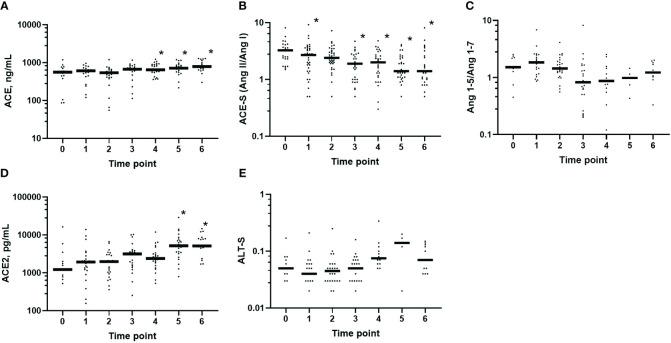
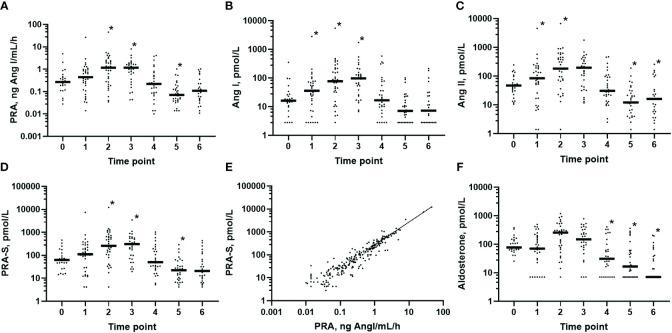
Surgery caused a rapid, transient, and primarily renin-dependent activation of both RAS axes that returned to baseline on POD 1, followed by suppression. After induction, the Ang II/Ang I ratio persistently decreased, while the ACE levels started to increase on POD 1 (all < 0.01 before anesthesia). Conversely, the ACE2 levels increased on POD 3 and 7 (both < 0.001 before anesthesia), when the median Ang 1-7 concentrations were unquantifiably low.
DISCUSSION
The postoperative elevation of ACE2 may prolong the decrease of the Ang II/Ang I ratio through the increased processing of Ang II. Further clarification of the intraoperative factors leading to relative Ang II deficiency and the sources of postoperatively elevated ACE2 is warranted.
简介
经典的肾素-血管紧张素系统(RAS)轴通过血管加压素血管紧张素 II(Ang II)对全身麻醉下的血压调节起着重要作用。作为替代 RAS 的一部分,血管紧张素转换酶 2(ACE2)通过将其加工成具有器官保护作用的 Ang 1-7 来调节 Ang II 的促炎和纤维化作用,而 Ang 1-7 则被 ACE 切割成 Ang 1-5。尽管 ACE2 的水平可能与术后并发症有关,但替代 RAS 代谢物在围手术期从未被研究过。本研究旨在研究主要腹部手术后两个 RAS 轴的围手术期动力学和平衡。
方法
在这项观察性队列研究中,纳入了 35 名接受择期大型腹部手术的患者。在麻醉诱导前、皮肤切开后 1 小时、手术结束时以及术后第 1、3 和 7 天进行采血。使用质谱法定量检测血浆中 Ang I-IV、Ang 1-7 和 Ang 1-5 的平衡浓度。使用 ELISA 测量血浆 ACE 和 ACE2 的蛋白水平。
结果
手术引起了两个 RAS 轴的快速、短暂和主要依赖肾素的激活,这些轴在术后第 1 天恢复到基线,随后被抑制。诱导后,Ang II/Ang I 比值持续下降,而 ACE 水平在术后第 1 天开始升高(麻醉前均 < 0.01)。相反,ACE2 水平在术后第 3 天和第 7 天升高(麻醉前均 < 0.001),此时中位 Ang 1-7 浓度无法检测到。
讨论
术后 ACE2 的升高可能通过增加 Ang II 的处理延长 Ang II/Ang I 比值的下降。有必要进一步阐明导致术中相对 Ang II 缺乏的因素以及术后 ACE2 升高的来源。



 Zotero 插件