
在 COVID-19 气道中的炎症是由于 SARS-CoV-2 刺突蛋白抑制 CFTR 信号通路引起的。
Inflammation in the COVID-19 airway is due to inhibition of CFTR signaling by the SARS-CoV-2 spike protein.
机构信息
Department of Anatomy, Physiology and Genetics, Uniformed Services University School of Medicine, Uniformed Services University of the Health Sciences, Bethesda, MD, 20814, USA.
Collaborative Health Initiative Research Program (CHIRP), Uniformed Services University of the Health Sciences, Bethesda, MD, 20814, USA.
出版信息
Sci Rep. 2024 Jul 23;14(1):16895. doi: 10.1038/s41598-024-66473-4.
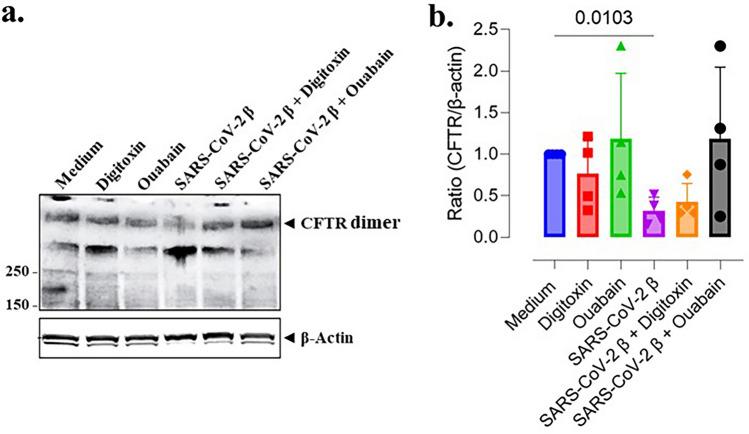
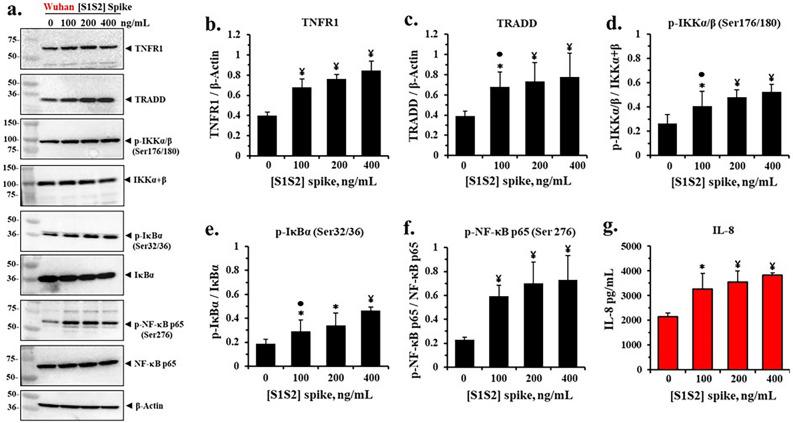
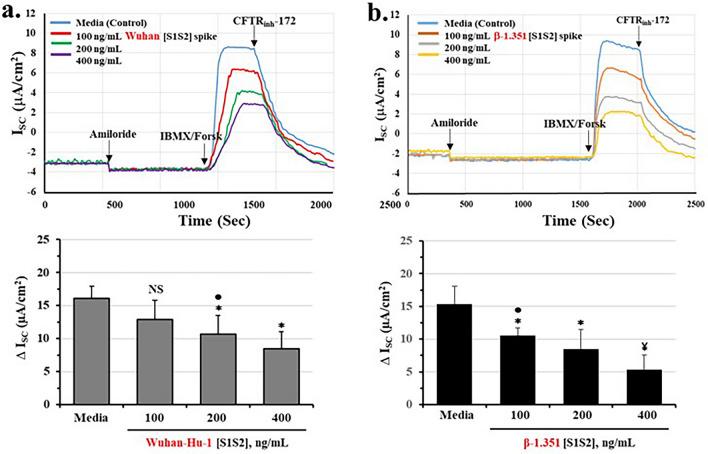
SARS-CoV-2-contributes to sickness and death in COVID-19 patients partly by inducing a hyper-proinflammatory immune response in the host airway. This hyper-proinflammatory state involves activation of signaling by NFκB, and unexpectedly, ENaC, the epithelial sodium channel. Post-infection inflammation may also contribute to "Long COVID"/PASC. Enhanced signaling by NFκB and ENaC also marks the airway of patients suffering from cystic fibrosis, a life-limiting proinflammatory genetic disease due to inactivating mutations in the CFTR gene. We therefore hypothesized that inflammation in the COVID-19 airway might similarly be due to inhibition of CFTR signaling by SARS-CoV-2 spike protein, and therefore activation of both NFκB and ENaC signaling. We used western blot and electrophysiological techniques, and an organoid model of normal airway epithelia, differentiated on an air-liquid-interface (ALI). We found that CFTR protein expression and CFTR cAMP-activated chloride channel activity were lost when the model epithelium was exposed to SARS-CoV-2 spike proteins. As hypothesized, the absence of CFTR led to activation of both TNFα/NFκB signaling and α and γ ENaC. We had previously shown that the cardiac glycoside drugs digoxin, digitoxin and ouabain blocked interaction of spike protein and ACE2. Consistently, addition of 30 nM concentrations of the cardiac glycoside drugs, prevented loss of both CFTR protein and CFTR channel activity. ACE2 and CFTR were found to co-immunoprecipitate in both basal cells and differentiated epithelia. Thus spike-dependent CFTR loss might involve ACE2 as a bridge between Spike and CFTR. In addition, spike exposure to the epithelia resulted in failure of endosomal recycling to return CFTR to the plasma membrane. Thus, failure of CFTR recovery from endosomal recycling might be a mechanism for spike-dependent loss of CFTR. Finally, we found that authentic SARS-CoV-2 virus infection induced loss of CFTR protein, which was rescued by the cardiac glycoside drugs digitoxin and ouabain. Based on experiments with this organoid model of small airway epithelia, and comparisons with 16HBE14o- and other cell types expressing normal CFTR, we predict that inflammation in the COVID-19 airway may be mediated by inhibition of CFTR signaling by the SARS-CoV-2 spike protein, thus inducing a cystic fibrosis-like clinical phenotype. To our knowledge this is the first time COVID-19 airway inflammation has been experimentally traced in normal subjects to a contribution from SARS-CoV-2 spike-dependent inhibition of CFTR signaling.
SARS-CoV-2 通过在宿主气道中诱导过度促炎免疫反应,导致 COVID-19 患者患病和死亡。这种过度促炎状态涉及 NFκB 和出人意料的 ENaC(上皮钠离子通道)信号的激活。感染后炎症也可能导致“长新冠”/PASC。NFκB 和 ENaC 的信号增强也标志着患有囊性纤维化的患者的气道,这是一种由于 CFTR 基因失活突变导致的限制生命的炎症性遗传疾病。因此,我们假设 COVID-19 气道中的炎症可能同样是由于 SARS-CoV-2 刺突蛋白抑制 CFTR 信号,从而激活 NFκB 和 ENaC 信号。我们使用了 Western blot 和电生理技术,以及在气液界面(ALI)上分化的正常气道上皮的类器官模型。我们发现,当模型上皮暴露于 SARS-CoV-2 刺突蛋白时,CFTR 蛋白表达和 CFTR cAMP 激活的氯离子通道活性丧失。正如假设的那样,CFTR 的缺失导致 TNFα/NFκB 信号和 α 和 γ ENaC 的激活。我们之前曾表明,强心苷类药物地高辛、毛花苷丙和哇巴因可阻止刺突蛋白与 ACE2 的相互作用。一致地,添加 30 nM 浓度的强心苷类药物可防止 CFTR 蛋白和 CFTR 通道活性的丧失。在基底细胞和分化的上皮中均发现 ACE2 和 CFTR 共免疫沉淀。因此,依赖于刺突的 CFTR 丢失可能涉及 ACE2 作为刺突和 CFTR 之间的桥梁。此外,刺突暴露于上皮会导致内体再循环失败,无法使 CFTR 回到质膜。因此,内体再循环中 CFTR 恢复的失败可能是依赖于刺突的 CFTR 丢失的机制。最后,我们发现,真正的 SARS-CoV-2 病毒感染诱导 CFTR 蛋白丢失,该丢失可被强心苷类药物地高辛和哇巴因挽救。基于对这种小气道上皮类器官模型的实验和与表达正常 CFTR 的 16HBE14o-和其他细胞类型的比较,我们预测 COVID-19 气道中的炎症可能是由 SARS-CoV-2 刺突蛋白抑制 CFTR 信号引起的,从而诱导类似于囊性纤维化的临床表型。据我们所知,这是首次将 COVID-19 气道炎症在正常受试者中通过实验追踪到 SARS-CoV-2 刺突依赖性抑制 CFTR 信号的贡献。


 Zotero 插件