
种族差异对结肠镜检查随访和质量对结直肠癌结果的影响。
Impact of racial disparities in follow-up and quality of colonoscopy on colorectal cancer outcomes.
机构信息
Department of Industrial & Systems Engineering, University of Wisconsin-Madison, Madison, WI, USA.
Department of Medicine, University of California Los Angeles (UCLA) Health and UCLA Kaiser Permanente Center for Health Equity, Los Angeles, CA, USA.
出版信息
J Natl Cancer Inst. 2024 Nov 1;116(11):1807-1816. doi: 10.1093/jnci/djae140.
BACKGROUND
The benefits of colorectal cancer (CRC) screening programs rely on completing follow-up colonoscopy when a noncolonoscopy test is abnormal and on quality of colonoscopy screening as measured by the endoscopists' adenoma detection rate. Existing data demonstrate substantially lower follow-up colonoscopy rates and adenoma detection rate for Black Americans than White Americans. However, the contributions of racial differences in follow-up colonoscopy and adenoma detection rate on CRC outcomes have not been rigorously evaluated.
METHODS
We used established and validated CRC-Adenoma Incidence and Mortality (CRC-AIM) model as our analysis platform, with inputs from published literature that report lower follow-up colonoscopy rates and adenoma detection rate in Black adults compared with White adults (15% and 10% lower, respectively). We simulated screening with annual fecal immunochemical test, triennial multitarget stool DNA, and colonoscopy every 10 years between ages 45 and 75 years using real-world utilization of the screening modalities vs no screening. We reported lifetime outcomes per 1000 Black adults.
RESULTS
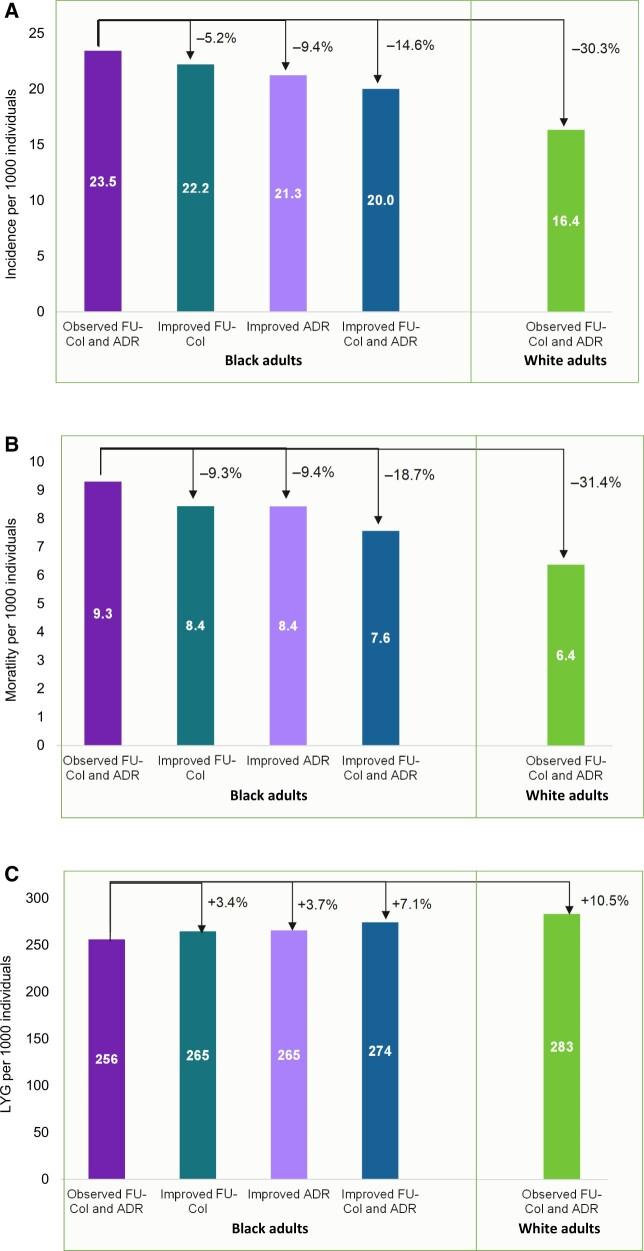
Elimination of Black-White disparities in follow-up colonoscopy rates would reduce CRC incidence and mortality by 5.2% and 9.3%, respectively, and improve life-years gained with screening by 3.4%. Elimination of Black-White disparities in endoscopists' adenoma detection rate would reduce CRC incidence and mortality by 9.4% and improve life-years gained by 3.7%. Elimination of both disparities would reduce CRC incidence and mortality by 14.6% and 18.7%, respectively, and improve life-years gained by 7.1%.
CONCLUSIONS
This modeling study predicts eliminating racial differences in follow-up colonoscopy rates, and quality of screening colonoscopy would substantially reduce Black-White disparities in CRC incidence and mortality.
背景
结直肠癌(CRC)筛查计划的益处依赖于在非结肠镜检查异常时完成后续结肠镜检查,以及通过内镜医师的腺瘤检出率来衡量结肠镜检查筛查的质量。现有数据表明,黑人群体接受后续结肠镜检查和腺瘤检出率明显低于白人群体。然而,尚未严格评估黑人群体在后续结肠镜检查和腺瘤检出率方面的种族差异对 CRC 结果的影响。
方法
我们使用已建立和经过验证的 CRC-腺瘤发生率和死亡率(CRC-AIM)模型作为我们的分析平台,该模型的输入来自已发表的文献,这些文献报告黑人群体与白人群体相比,接受后续结肠镜检查的比例较低(分别低 15%和 10%),腺瘤检出率也较低。我们模拟了在 45 岁至 75 岁之间每年进行粪便免疫化学检测、每三年进行多重靶标粪便 DNA 检测以及每 10 年进行一次结肠镜检查的筛查,同时还模拟了真实情况下和不进行筛查时这些筛查方法的使用情况。我们报告了每 1000 名黑人群体的终生结果。
结果
消除黑人群体与白人群体在后续结肠镜检查率方面的差异,可分别降低 CRC 发病率和死亡率 5.2%和 9.3%,并使筛查带来的获益生命年增加 3.4%。消除黑人群体与白人群体在内镜医师腺瘤检出率方面的差异,可降低 CRC 发病率和死亡率 9.4%,并使获益生命年增加 3.7%。消除这两个差异,可降低 CRC 发病率和死亡率 14.6%和 18.7%,并使获益生命年增加 7.1%。
结论
本研究通过模型预测,消除后续结肠镜检查率方面的种族差异,以及提高筛查结肠镜检查的质量,将大大降低黑人群体与白人群体之间 CRC 发病率和死亡率的差异。


 Zotero 插件