
SJPedPanel:用于儿童恶性肿瘤的泛癌种基因panel,以增强癌症监测和早期检测。
SJPedPanel: A Pan-Cancer Gene Panel for Childhood Malignancies to Enhance Cancer Monitoring and Early Detection.
机构信息
Department of Computational Biology, St. Jude Children's Research Hospital, Memphis, Tennessee.
Department of Pathology, St. Jude Children's Research Hospital, Memphis, Tennessee.
出版信息
Clin Cancer Res. 2024 Sep 13;30(18):4100-4114. doi: 10.1158/1078-0432.CCR-24-1063.
PURPOSE
The purpose of the study was to design a pan-cancer gene panel for childhood malignancies and validate it using clinically characterized patient samples.
EXPERIMENTAL DESIGN
In addition to 5,275 coding exons, SJPedPanel also covers 297 introns for fusions/structural variations and 7,590 polymorphic sites for copy-number alterations. Capture uniformity and limit of detection are determined by targeted sequencing of cell lines using dilution experiment. We validate its coverage by in silico analysis of an established real-time clinical genomics (RTCG) cohort of 253 patients. We further validate its performance by targeted resequencing of 113 patient samples from the RTCG cohort. We demonstrate its power in analyzing low tumor burden specimens using morphologic remission and monitoring samples.
RESULTS
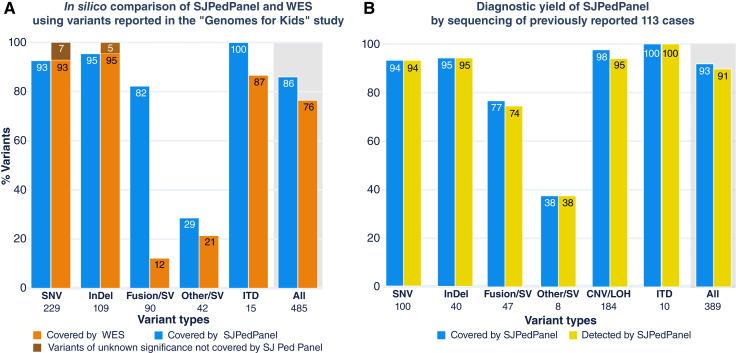
Among the 485 pathogenic variants reported in RTCG cohort, SJPedPanel covered 86% of variants, including 82% of 90 rearrangements responsible for fusion oncoproteins. In our targeted resequencing cohort, 91% of 389 pathogenic variants are detected. The gene panel enabled us to detect ∼95% of variants at allele fraction (AF) 0.5%, whereas the detection rate is ∼80% at AF 0.2%. The panel detected low-frequency driver alterations from morphologic leukemia remission samples and relapse-enriched alterations from monitoring samples, demonstrating its power for cancer monitoring and early detection.
CONCLUSIONS
SJPedPanel enables the cost-effective detection of clinically relevant genetic alterations including rearrangements responsible for subtype-defining fusions by targeted sequencing of ∼0.15% of human genome for childhood malignancies. It will enhance the analysis of specimens with low tumor burdens for cancer monitoring and early detection.
目的
本研究旨在设计一个泛癌种儿童恶性肿瘤基因panel,并使用经临床特征描述的患者样本对其进行验证。
实验设计
除了 5275 个编码外显子,SJPedPanel 还涵盖了 297 个用于融合/结构变异的内含子和 7590 个用于拷贝数改变的多态性位点。通过使用稀释实验对细胞系进行靶向测序来确定捕获的均匀性和检测限。我们通过对 253 例已建立的实时临床基因组学(RTCG)队列的计算机分析来验证其覆盖度。我们还通过对来自 RTCG 队列的 113 例患者样本进行靶向重测序来验证其性能。我们通过形态学缓解和监测样本展示了其在分析低肿瘤负荷标本中的效能。
结果
在 RTCG 队列报告的 485 个致病性变异中,SJPedPanel 覆盖了 86%的变异,包括 82%负责融合致癌蛋白的 90 个重排。在我们的靶向重测序队列中,91%的 389 个致病性变异被检测到。该基因 panel 使我们能够检测到等位基因分数(AF)为 0.5%的约 95%的变异,而在 AF 为 0.2%时的检测率约为 80%。该 panel 从形态学白血病缓解样本中检测到低频驱动改变,从监测样本中检测到复发富集改变,证明了其在癌症监测和早期检测中的效能。
结论
SJPedPanel 通过靶向测序约人类基因组的 0.15%,实现了针对儿童恶性肿瘤的具有成本效益的临床相关遗传改变的检测,包括负责定义亚型的融合的重排。它将增强对低肿瘤负荷标本的分析,以进行癌症监测和早期检测。


 Zotero 插件