
聚酯废料回收中的解聚机理与闭环评估
Depolymerization mechanisms and closed-loop assessment in polyester waste recycling.
作者信息
Cao Jingjing, Liang Huaxing, Yang Jie, Zhu Zhiyang, Deng Jin, Li Xiaodong, Elimelech Menachem, Lu Xinglin
机构信息
CAS Key Laboratory of Urban Pollutant Conversion, Department of Environmental Science and Engineering, National Synchrotron Radiation Laboratory, University of Science and Technology of China, Hefei, China.
CAS Key Laboratory of Urban Pollutant Conversion, Anhui Province Key Laboratory of Biomass Clean Energy, Department of Applied Chemistry, University of Science and Technology of China, Hefei, China.
出版信息
Nat Commun. 2024 Jul 25;15(1):6266. doi: 10.1038/s41467-024-50702-5.
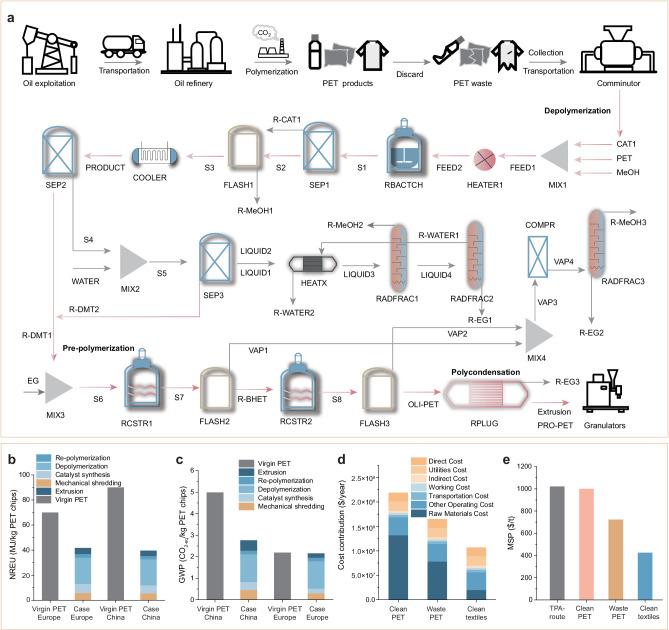
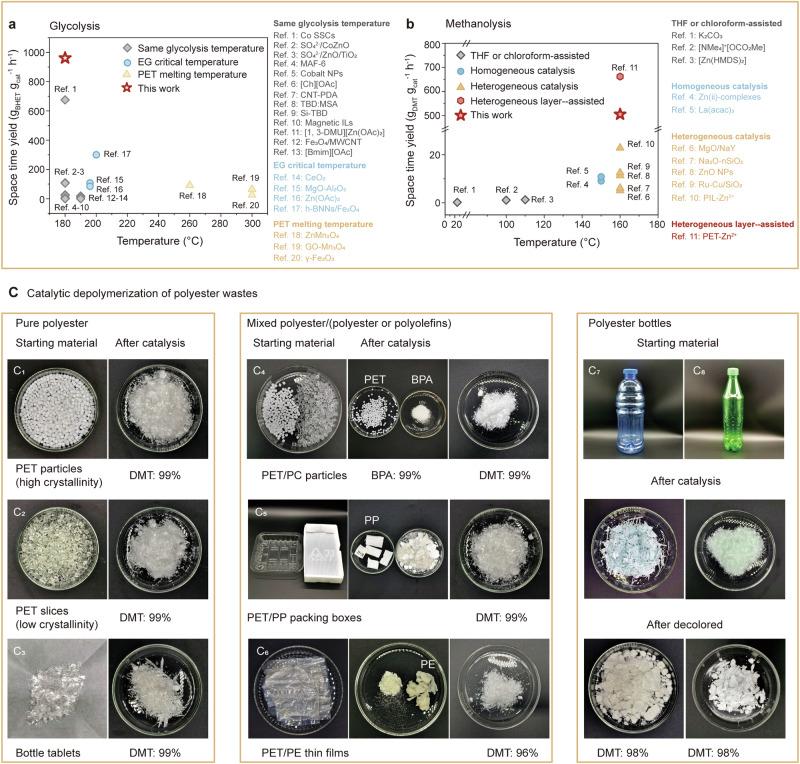
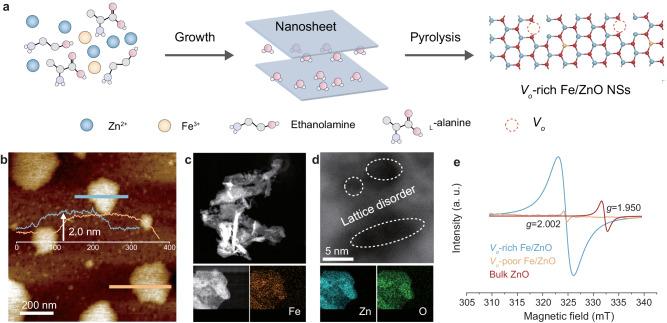
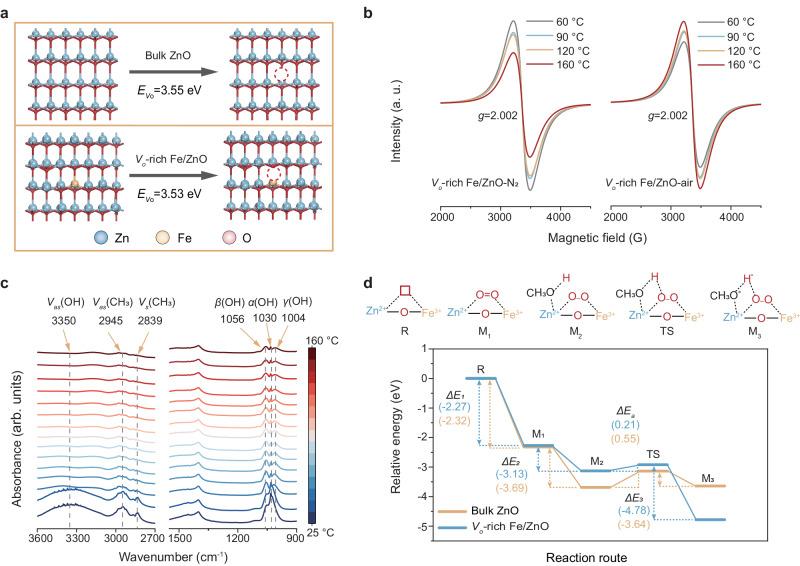
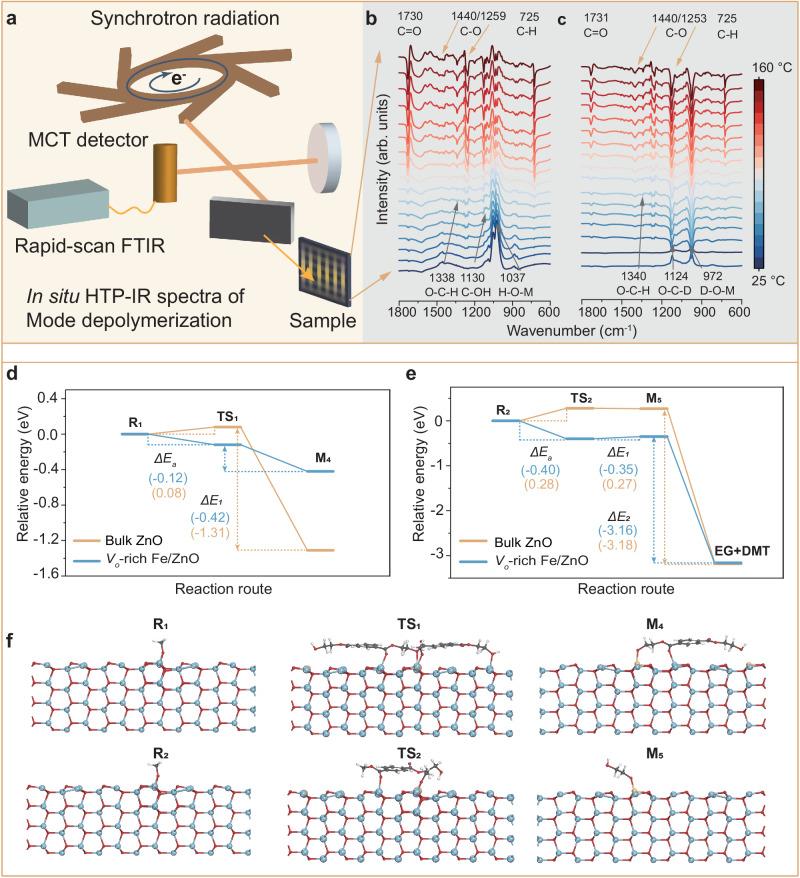
Alcoholysis of poly(ethylene terephthalate) (PET) waste to produce monomers, including methanolysis to yield dimethyl terephthalate (DMT) and glycolysis to generate bis-2-hydroxyethyl terephthalate (BHET), is a promising strategy in PET waste management. Here, we introduce an efficient PET-alcoholysis approach utilizing an oxygen-vacancy (V)-rich catalyst under air, achieving space time yield (STY) of 505.2 g·g·h and 957.1 g·g·h, these results represent 51-fold and 28-fold performance enhancements compared to reactions conducted under N. In situ spectroscopy, in combination with density functional theory calculations, elucidates the reaction pathways of PET depolymerization. The process involves O-assisted activation of CHOH to form CHOH and OOH species at V-Zn-O-Fe sites, highlighting the critical role of V-Zn-O-Fe sites in ester bond activation and C-O bond cleavage. Moreover, a life cycle assessment demonstrates the viability of our approach in closed-loop recycling, achieving 56.0% energy savings and 44.5% reduction in greenhouse-gas emissions. Notably, utilizing PET textile scrap further leads to 58.4% reduction in initial total operating costs. This research offers a sustainable solution to the challenge of PET waste accumulation.
将聚对苯二甲酸乙二酯(PET)废料进行醇解以生产单体,包括甲醇解生成对苯二甲酸二甲酯(DMT)和乙二醇解生成对苯二甲酸双(2-羟乙基)酯(BHET),是PET废料管理中一种很有前景的策略。在此,我们介绍一种高效的PET醇解方法,该方法在空气中使用富含氧空位(V)的催化剂,时空产率(STY)分别达到505.2 g·g⁻¹·h⁻¹和957.1 g·g⁻¹·h⁻¹,与在氮气气氛下进行的反应相比,这些结果分别代表了51倍和28倍的性能提升。原位光谱结合密度泛函理论计算阐明了PET解聚的反应途径。该过程涉及在V-Zn-O-Fe位点上O辅助激活CH₂OH以形成CH₂OH和OOH物种,突出了V-Zn-O-Fe位点在酯键活化和C-O键断裂中的关键作用。此外,生命周期评估证明了我们的方法在闭环回收中的可行性,实现了56.0%的节能和44.5%的温室气体排放减少。值得注意的是,使用PET纺织废料进一步使初始总运营成本降低了58.4%。这项研究为PET废料积累的挑战提供了一个可持续的解决方案。

 Zotero 插件