
以西班牙裔为主的边境人群中HPV疫苗系列接种完成的障碍:一项混合方法评估
Barriers to HPV vaccine series completion among a predominantly hispanic border population: a mixed method evaluation.
作者信息
Hernandez Amir, Calderón-Mora Jessica, Lara Hatty, Drury Nicole, Molokwu Jennifer
机构信息
College of Health Science, University of Texas at El Paso, El Paso, Texas, USA.
Department of Population Health, Dell Medical School, University of Texas at Austin, Austin, Texas, USA.
出版信息
Arch Public Health. 2024 Jul 24;82(1):112. doi: 10.1186/s13690-024-01344-y.
BACKGROUND
Human Papillomavirus (HPV) infections are the most common sexually transmitted infections in the United States. The HPV vaccine is a vital tool to prevent against several cancers, namely cervical cancer. Unfortunately, the uptake of the HPV vaccine among Hispanics is relatively low. Some barriers to uptake include language barriers, cultural taboos, and cost.
PURPOSE
This study aims to explore barriers to HPV vaccination in a predominantly Hispanic US-Mexico border county between June 2015 and March 2018.
METHODS
A mixed-method approach was used to analyze covariates associated with HPV vaccine uptake and to evaluate barriers to HPV vaccination from participant follow-up calls or reminder notes.
RESULTS
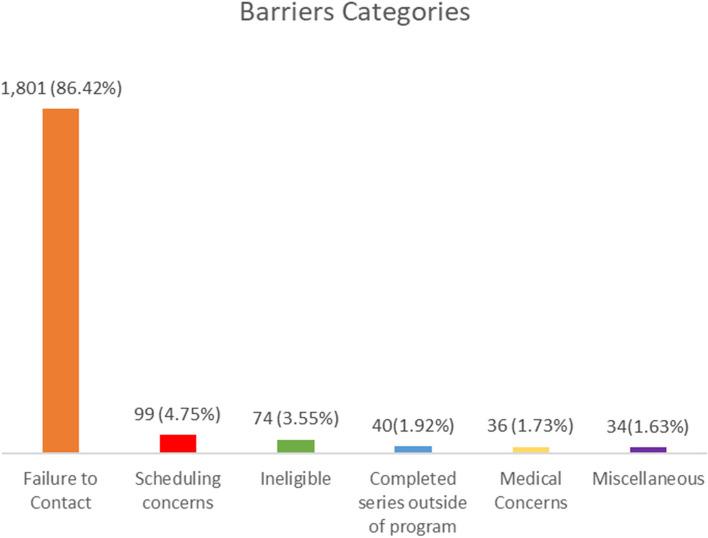
The total number of participants was 1,787. Young adults were less likely to complete the vaccination series than those aged 9-17, while individuals born in Mexico were more likely to do so. Failure to contact was the most common barrier (n=1,801, 86.42%), followed by scheduling concerns (n=99, 4.5%), being ineligible (74, 3.55%), completing series outside of the program (40, 1.92%), having medical concerns (36, 1.73%), and other reasons (34, 1.63%).
CONCLUSION
We predominantly identified structural barriers and various health-related determinants regarding healthcare access and quality.
背景
人乳头瘤病毒(HPV)感染是美国最常见的性传播感染。HPV疫苗是预防多种癌症(尤其是宫颈癌)的重要工具。不幸的是,西班牙裔人群中HPV疫苗的接种率相对较低。接种的一些障碍包括语言障碍、文化禁忌和费用。
目的
本研究旨在探讨2015年6月至2018年3月期间,美国与墨西哥边境一个以西班牙裔为主的县中HPV疫苗接种的障碍。
方法
采用混合方法分析与HPV疫苗接种相关的协变量,并通过参与者随访电话或提醒记录评估HPV疫苗接种的障碍。
结果
参与者总数为1787人。与9至17岁的人群相比,年轻人完成疫苗接种系列的可能性较小,而在墨西哥出生的人完成接种的可能性更大。无法联系是最常见的障碍(n = 1801,86.42%),其次是日程安排问题(n = 99,4.5%)、不符合条件(74,3.55%)、在项目外完成接种系列(40,1.92%)、有医疗顾虑(36,1.73%)以及其他原因(34,1.63%)。
结论
我们主要确定了与医疗保健可及性和质量相关的结构性障碍及各种健康相关决定因素。
 Zotero 插件