
药物污染改变了淡水群落的结构,并阻碍了它们从鱼类捕食者的影响中恢复。
Pharmaceutical Pollution Alters the Structure of Freshwater Communities and Hinders Their Recovery from a Fish Predator.
机构信息
School of Environment and Science, Griffith University, Nathan 4111, Australia.
Department of Wildlife, Fish and Environmental Studies, Swedish University of Agricultural Sciences, Umeå 901 83, Sweden.
出版信息
Environ Sci Technol. 2024 Aug 6;58(31):13904-13917. doi: 10.1021/acs.est.4c02807. Epub 2024 Jul 24.
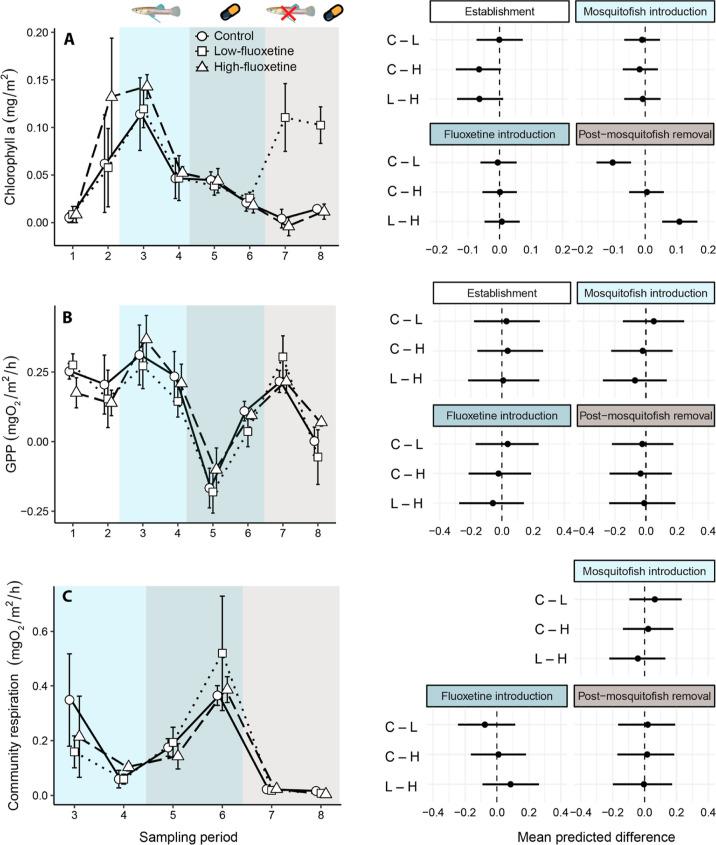
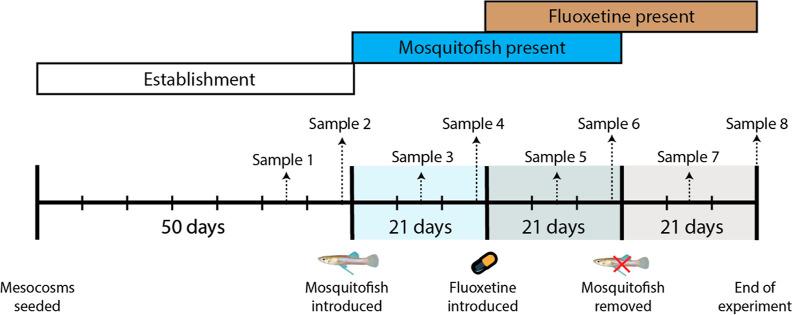
Freshwater ecosystems are under threat from rising pharmaceutical pollution. While such pollutants are known to elicit biological effects on organisms, we have limited knowledge on how these effects might cascade through food-webs, disrupt ecological processes, and shape freshwater communities. In this study, we used a mesocosm experiment to explore how the community impacts of a top-order predator, the eastern mosquitofish (), are mediated by exposure to environmentally relevant low (measured concentration: ∼10 ng/L) and high concentrations (∼110 ng/L) of the pervasive pharmaceutical pollutant fluoxetine. We found no evidence that exposure to fluoxetine altered the consumptive effects of mosquitofish on zooplankton. However, once mosquitofish were removed from the mesocosms, zooplankton abundance recovered to a greater extent in control mesocosms compared to both low and high fluoxetine-exposed mesocosms. By the end of the experiment, this resulted in fundamental differences in community structure between the control and fluoxetine-treated mesocosms. Specifically, the control mesocosms were characterized by higher zooplankton abundances and lower algal biomass, whereas mesocosms exposed to either low or high concentrations of fluoxetine had lower zooplankton abundances and higher algal biomass. Our results suggest that fluoxetine, even at very low concentrations, can alter aquatic communities and hinder their recovery from disturbances.
淡水生态系统正受到上升的药物污染威胁。虽然这些污染物已知会对生物产生生物效应,但我们对这些效应如何通过食物链级联、干扰生态过程和塑造淡水群落知之甚少。在这项研究中,我们使用中观实验来探索一种顶级捕食者,即东部食蚊鱼(Gambusia holbrooki),在暴露于环境相关的低(测量浓度:约 10ng/L)和高浓度(约 110ng/L)普遍存在的药物污染物氟西汀的情况下,对群落的影响是如何被调节的。我们没有发现暴露于氟西汀会改变食蚊鱼对浮游动物的消耗作用的证据。然而,一旦食蚊鱼从中观实验中被移除,浮游动物的丰度在对照中观实验中比在低浓度和高浓度氟西汀暴露的中观实验中恢复得更多。到实验结束时,这导致了对照和氟西汀处理的中观实验之间群落结构的根本差异。具体而言,对照中观实验的浮游动物丰度较高,藻类生物量较低,而暴露于低浓度或高浓度氟西汀的中观实验的浮游动物丰度较低,藻类生物量较高。我们的结果表明,氟西汀,即使在非常低的浓度下,也可以改变水生群落,并阻碍它们从干扰中恢复。


 Zotero 插件