
放射性碘难治性分化型甲状腺癌的研究进展。
Current Advances in Radioactive Iodine-Refractory Differentiated Thyroid Cancer.
机构信息
Department of Advanced Biomedical Sciences, University of Naples "Federico II", 80138 Naples, Italy.
出版信息
Curr Oncol. 2024 Jul 3;31(7):3870-3884. doi: 10.3390/curroncol31070286.
BACKGROUND
Differentiated thyroid cancer (DTC) patients have an outstanding overall long-term survival rate, and certain subsets of DTC patients have a very high likelihood of disease recurrence. Radioactive iodine (RAI) therapy is a cornerstone in DTC management, but cancer cells can eventually develop resistance to RAI. Radioactive iodine-refractory DTC (RAIR-DTC) is a condition defined by ATA 2015 guidelines when DTC cannot concentrate RAI ab initio or loses RAI uptake ability after the initial therapy. The RAIR condition implies that RAI cannot reveal new met-astatic foci, so RAIR-DTC metabolic imaging needs new tracers. F-FDG PET/CT has been widely used and has demonstrated prognostic value, but F-FDG DTC avidity may remain low. Fibroblast activation protein inhibitors (FA-Pi)s, prostatic-specific membrane antigen (PSMA), and somatostatin receptor (SSTR) tracers have been proposed as theragnostic agents in experimental settings and Arg-Gly-Asp (RGD) peptides in the diagnostic trial field. Multi-targeted tyrosine kinase inhibitors are relatively new drugs approved in RAIR-DTC therapy. Despite the promising targeted setting, they relate to frequent adverse-event onset. Sorafenib and trametinib have been included in re-differentiation protocols aimed at re-inducing RAI accumulation in DTC cells. Results appear promising, but not excellent.
CONCLUSIONS
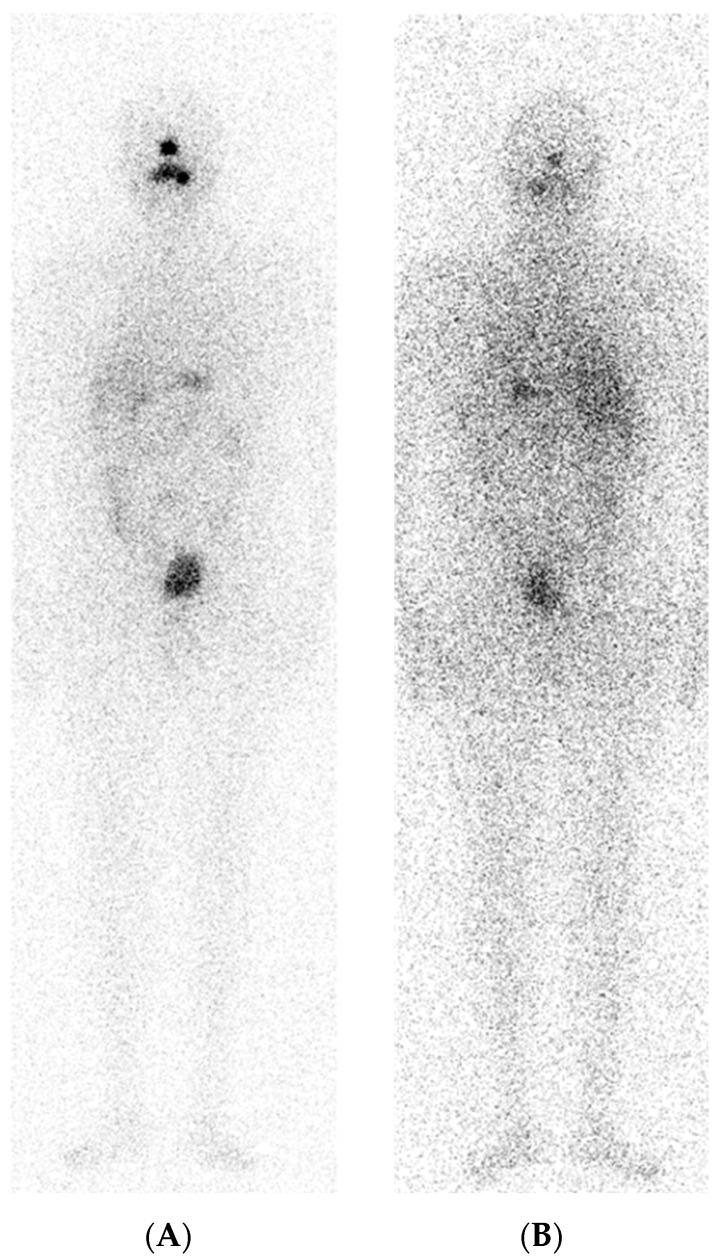
RAIR-DTC remains a challenging nosological entity. There are still controversies on RAIR-DTC definition and post-RAI therapy evaluation, with post-therapy whole-body scan (PT-WBS) the only validated criterion of response. The recent introduction of multiple diagnostic and therapeutic agents obliges physicians to pursue a multidisciplinary approach aiming to correct drug introduction and timing choice.
背景
分化型甲状腺癌(DTC)患者的总体长期生存率很高,某些 DTC 患者亚群疾病复发的可能性非常高。放射性碘(RAI)治疗是 DTC 管理的基石,但癌细胞最终可能对 RAI 产生耐药性。放射性碘难治性 DTC(RAIR-DTC)是 2015 年 ATA 指南定义的一种疾病,当 DTC 最初不能集中摄取 RAI 或在初始治疗后丧失摄取 RAI 的能力时,即可诊断为 RAIR-DTC。RAIR 状态意味着 RAI 无法揭示新的转移性病灶,因此 RAIR-DTC 代谢成像需要新的示踪剂。F-FDG PET/CT 已广泛应用并具有预后价值,但 F-FDG DTC 摄取可能仍然较低。纤维母细胞激活蛋白抑制剂(FA-Pi)、前列腺特异性膜抗原(PSMA)和生长抑素受体(SSTR)示踪剂已在实验环境中被提议作为治疗药物,Arg-Gly-Asp(RGD)肽在诊断试验领域也有应用。多靶点酪氨酸激酶抑制剂是批准用于 RAIR-DTC 治疗的新型药物。尽管靶向治疗前景广阔,但它们与频繁的不良事件发生有关。索拉非尼和曲美替尼已被纳入旨在重新诱导 DTC 细胞中 RAI 积累的再分化方案中。结果似乎有希望,但并不理想。
结论
RAIR-DTC 仍然是一个具有挑战性的疾病实体。RAIR-DTC 的定义和 RAI 治疗后评估仍存在争议,治疗后全身扫描(PT-WBS)是唯一经过验证的反应标准。最近引入的多种诊断和治疗药物要求医生采用多学科方法,旨在正确选择药物的引入和使用时机。


 Zotero 插件