
奥希替尼治疗真实世界环境中EGFR突变型非小细胞肺癌进展后的分析
Post-Progression Analysis of -Mutant NSCLC Following Osimertinib Therapy in Real-World Settings.
作者信息
Attili Ilaria, Corvaja Carla, Spitaleri Gianluca, Trillo Aliaga Pamela, Del Signore Ester, Passaro Antonio, de Marinis Filippo
机构信息
Division of Thoracic Oncology, European Institute of Oncology, IRCCS, 20141 Milan, Italy.
出版信息
Cancers (Basel). 2024 Jul 19;16(14):2589. doi: 10.3390/cancers16142589.
BACKGROUND
Platinum-based chemotherapy is the current standard treatment option in patients with -mutant non-small-cell lung cancer (NSCLC) who progress on osimertinib. However, outcomes with chemotherapy are dismal, and the treatment of central nervous system (CNS) disease is an unmet need in this setting.
METHODS
Patients with -mutant NSCLC who were candidates to receive osimertinib in the metastatic setting at our Center from 2015 to 2022 were retrospectively evaluated to identify patients who received standard platinum-based chemotherapy post-osimertinib. Data were collected on treatment outcomes, with a focus on brain metastases and progression patterns.
RESULTS
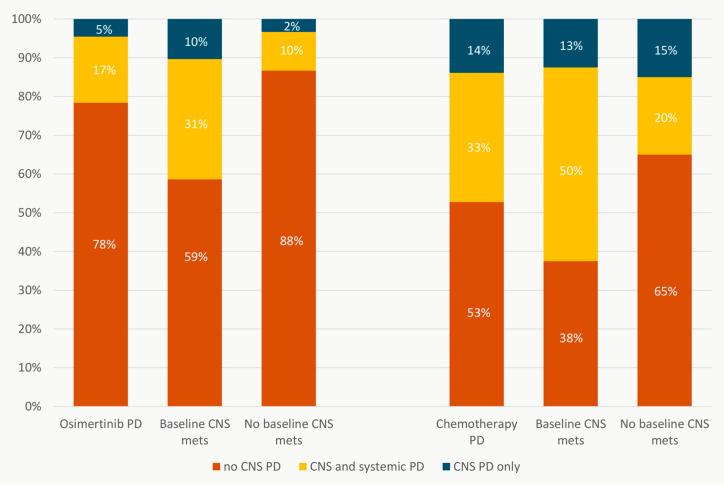
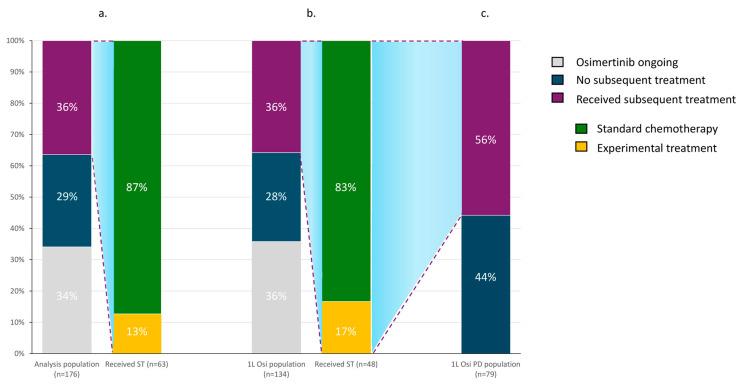
A total of 220 patients received indication for osimertinib in the study period; = 176 had adequate follow-up data. Overall, = 117 patients experienced disease progression on osimertinib. The median time to osimertinib progressive disease (PD) was 15 months (95% confidence interval CI 13-18). Of them, 51 patients (45%) had no access to further treatments. Of the remaining patients, = 8 received experimental treatments, and = 55 received standard platinum-based chemotherapy and were considered for this study. Median duration of chemotherapy was 3 months (95% CI 2-5); the best responses among 53 evaluable patients were observed as follows: 15% partial response/complete response (PR/CR), 40% stable disease (SD), 45% PD. Median progression-free survival (PFS) and overall survival (OS) were 3 (95% CI 2-5) and 10 (95% CI 6-15) months, respectively. All patients had baseline and follow-up brain radiologic assessments, and n = 23 had brain metastases at the start of chemotherapy. With a median follow-up of 13 months, intracranial PD occurred in 47% patients, being the first site of PD in 59% of cases. The median time for intracranial (IC) PD was 2 months (95% CI 2-7). IC PD occurred as oligometastatic in 29%, whereas in 71% of cases, it was associated with systemic PD.
CONCLUSIONS
Access to subsequent treatments and CNS progression are confirmed unmet needs in -mutant NSCLC patients. Clinical and CNS-specific outcomes in patients receiving standard chemotherapy after the failure of osimertinib are dismal. Novel upfront treatment options with demonstrated prolonged PFS and better CNS outcomes may help address this important issue.
背景
对于在奥希替尼治疗后进展的表皮生长因子受体(EGFR)突变型非小细胞肺癌(NSCLC)患者,铂类化疗是当前的标准治疗选择。然而,化疗的疗效不佳,在这种情况下,中枢神经系统(CNS)疾病的治疗需求尚未得到满足。
方法
对2015年至2022年期间在我们中心符合转移性疾病情况下接受奥希替尼治疗条件的EGFR突变型NSCLC患者进行回顾性评估,以确定在奥希替尼治疗后接受标准铂类化疗的患者。收集治疗结果数据,重点关注脑转移和疾病进展模式。
结果
在研究期间,共有220例患者获得奥希替尼治疗指征;176例有充分的随访数据。总体而言,117例患者在奥希替尼治疗期间出现疾病进展。奥希替尼治疗进展性疾病(PD)的中位时间为15个月(95%置信区间CI 13 - 18)。其中,51例患者(45%)无法接受进一步治疗。在其余患者中,8例接受了实验性治疗,55例接受了标准铂类化疗并纳入本研究。化疗的中位持续时间为3个月(95%CI 2 - 5);在53例可评估患者中观察到的最佳反应如下:15%部分缓解/完全缓解(PR/CR),40%疾病稳定(SD),45%疾病进展(PD)。中位无进展生存期(PFS)和总生存期(OS)分别为3个月(95%CI 2 - 5)和10个月(95%CI 6 - 15)。所有患者均进行了基线和随访脑影像学评估,23例患者在化疗开始时存在脑转移。中位随访13个月,47%的患者发生颅内PD,59%的病例中颅内PD是首个发生PD的部位。颅内(IC)PD的中位时间为2个月(95%CI 2 - 7)。29%的IC PD表现为寡转移,而71%的病例与全身PD相关。
结论
对于EGFR突变型NSCLC患者,后续治疗的可及性和CNS进展是尚未满足的需求。奥希替尼治疗失败后接受标准化疗的患者的临床和CNS特异性结果不佳。具有延长PFS和更好CNS结果的新型一线治疗选择可能有助于解决这一重要问题。

 Zotero 插件