
关于……免疫逃逸的研究进展
Research Progress on Immune Evasion of .
作者信息
Jiang Bin, Zhang Ying, Li Gaojian, Quan Yanping, Shu Jianhong, Feng Huapeng, He Yulong
机构信息
Department of Biopharmacy, College of Life Sciences and Medicine, Zhejiang Sci-Tech University, Hangzhou 310018, China.
出版信息
Microorganisms. 2024 Jul 16;12(7):1439. doi: 10.3390/microorganisms12071439.
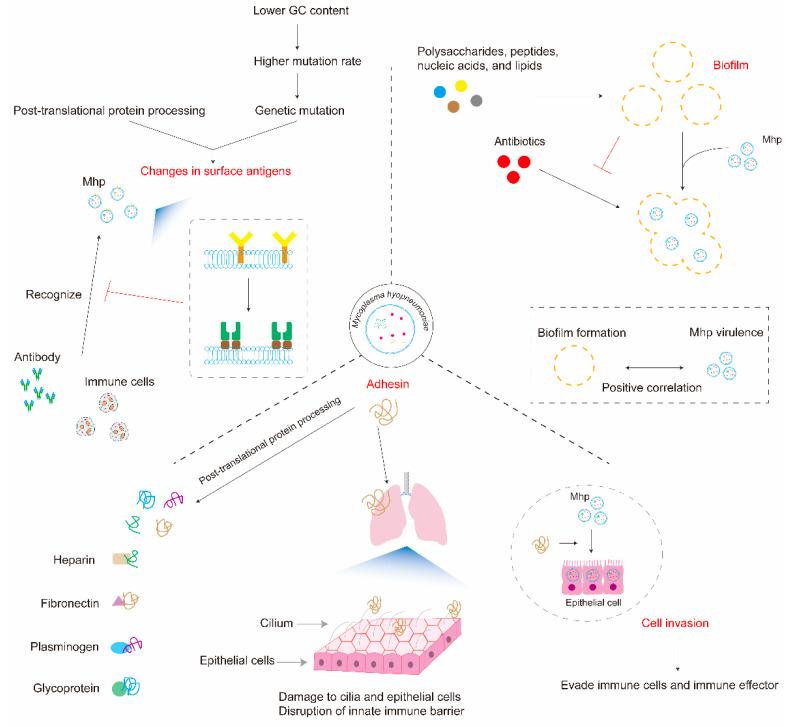
As the main pathogen associated with enzootic pneumonia (EP), (Mhp) is globally prevalent and inflicts huge financial losses on the worldwide swine industry each year. However, the pathogenicity of Mhp has not been fully explained to date. Mhp invasion usually leads to long-term chronic infection and persistent lung colonization, suggesting that Mhp has developed effective immune evasion strategies. In this review, we offer more detailed information than was previously available about its immune evasion mechanisms through a systematic summary of the extant findings. Genetic mutation and post-translational protein processing confer Mhp the ability to alter its surface antigens. With the help of adhesins, Mhp can achieve cell invasion. And Mhp can modulate the host immune system through the induction of inflammation, incomplete autophagy, apoptosis, and the suppression of immune cell or immune effector activity. Furthermore, we offer the latest views on how we may treat Mhp infections and develop novel vaccines.
作为与地方性肺炎(EP)相关的主要病原体,猪肺炎支原体(Mhp)在全球范围内普遍存在,每年给全球养猪业造成巨大经济损失。然而,迄今为止,Mhp的致病性尚未得到充分解释。Mhp入侵通常会导致长期慢性感染和肺部持续定植,这表明Mhp已形成有效的免疫逃避策略。在本综述中,我们通过系统总结现有研究结果,提供了比以往更详细的关于其免疫逃避机制的信息。基因突变和蛋白质翻译后加工赋予Mhp改变其表面抗原的能力。借助黏附素,Mhp能够实现细胞入侵。并且Mhp可以通过诱导炎症、不完全自噬、凋亡以及抑制免疫细胞或免疫效应活性来调节宿主免疫系统。此外,我们还提供了关于如何治疗Mhp感染和开发新型疫苗的最新观点。


 Zotero 插件