
度洛西汀与其他治疗方式对糖尿病性神经病理性疼痛患者的疗效:一项系统评价与Meta分析
Effectiveness of Duloxetine versus Other Therapeutic Modalities in Patients with Diabetic Neuropathic Pain: A Systematic Review and Meta-Analysis.
作者信息
Valenzuela-Fuenzalida Juan José, López-Chaparro Michelle, Barahona-Vásquez Marisol, Campos-Valdes Javiera, Cordero Gonzalez Javiera, Nova-Baeza Pablo, Orellana-Donoso Mathias, Suazo-Santibañez Alejandra, Oyanedel-Amaro Gustavo, Gutiérrez Espinoza Héctor
机构信息
Departamento de Morfología, Facultad de Medicina, Universidad Andrés Bello, Santiago 8370146, Chile.
Departamento de Ciencias Química y Biológicas, Facultad de Ciencias de la Salud, Universidad Bernardo O'Higgins, Santiago 8370993, Chile.
出版信息
Pharmaceuticals (Basel). 2024 Jun 28;17(7):856. doi: 10.3390/ph17070856.
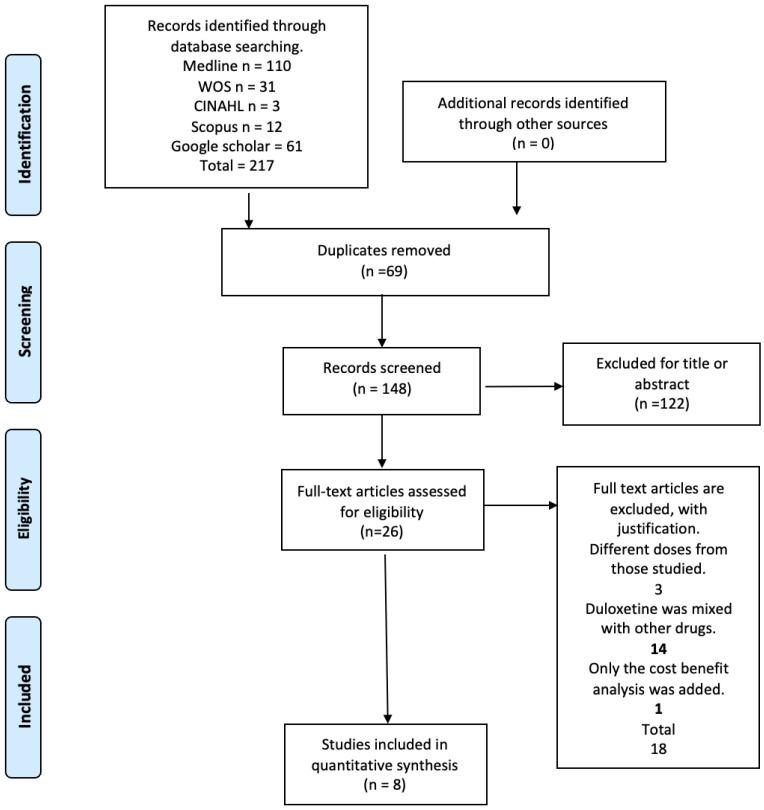
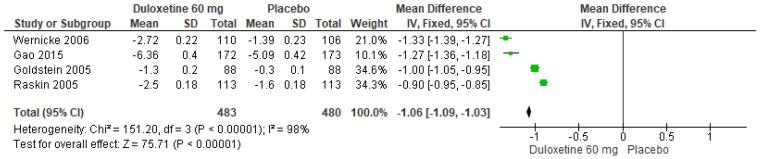
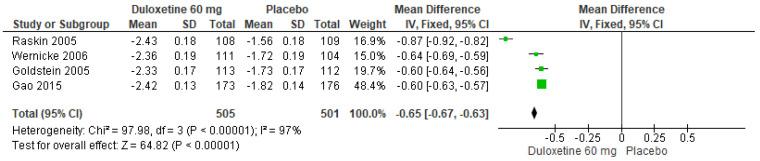
Diabetic peripheral neuropathy (DPN) is a chronic complication of diabetes mellitus (DM) with symptoms like intense pain and impaired quality of life. This condition has no treatment; instead, the pain is managed with various antidepressants, including duloxetine. The aim of this study is to analyze the evidence on the efficacy of duloxetine in the management of DPN. A systematic search in different databases was conducted using the keywords "diabetic neuropathy", "duloxetine therapy", "neuropathic pain", and "Diabetes Mellitus". Finally, eight studies were included in this meta-analysis. All articles comparing duloxetine at different doses vs. a placebo reported significant differences in favor of duloxetine on pain scales like 24 h Average Pain Severity (standardized mean difference [SMD] = -1.06, confidence interval [CI] = -1.09 to -1.03, and < 0.00001) and BPI Severity (SMD = -0.70, CI = -0.72 to -0.68, and < 0.00001), among others. A total of 75% of the meta-analyses of studies comparing duloxetine at different doses showed a tendency in favor of the 120 mg/d dose. There were significant differences in favor of duloxetine when compared to routine care on the Euro Quality of Life (SMD = -0.04, CI = -0.04 to -0.03, and < 0.00001) and SF-36 Survey (SMD = -5.86, CI = -6.28 to -5.44, and < 0.00001) scales. There were no significant differences on the visual analog scale (VAS) when comparing duloxetine and gabapentin. Duloxetine appears to be effective in the management of DPN in different pain, symptom improvement, and quality of life scales.
糖尿病性周围神经病变(DPN)是糖尿病(DM)的一种慢性并发症,症状包括剧痛和生活质量受损。这种疾病尚无治疗方法;相反,疼痛通过包括度洛西汀在内的各种抗抑郁药进行控制。本研究的目的是分析度洛西汀治疗DPN疗效的证据。使用关键词“糖尿病性神经病变”、“度洛西汀治疗”、“神经性疼痛”和“糖尿病”在不同数据库中进行了系统检索。最终,八项研究被纳入该荟萃分析。所有比较不同剂量度洛西汀与安慰剂的文章均报告,在24小时平均疼痛严重程度(标准化均值差[SMD]= -1.06,置信区间[CI]= -1.09至-1.03,P<0.00001)和简明疼痛量表严重程度(SMD = -0.70,CI = -0.72至-0.68,P<0.00001)等疼痛量表上,度洛西汀具有显著优势。在比较不同剂量度洛西汀的研究中,共有75%的荟萃分析显示倾向于120毫克/天的剂量。与常规护理相比,在欧洲生活质量量表(SMD = -0.04,CI = -0.04至-0.03,P<0.00001)和SF-36调查问卷量表(SMD = -5.86,CI = -6.28至-5.44,P<0.00001)上,度洛西汀具有显著优势。比较度洛西汀和加巴喷丁时,视觉模拟量表(VAS)上无显著差异。度洛西汀在不同疼痛、症状改善和生活质量量表上似乎对DPN有效。





















 Zotero 插件