
新辅助放化疗后局部晚期食管癌患者的间隔期转移:一项多中心观察性队列研究。
Interval Metastases After Neoadjuvant Chemoradiotherapy for Patients with Locally Advanced Esophageal Cancer: A Multicenter Observational Cohort Study.
机构信息
Department of Surgery, Erasmus MC Cancer Institute, Erasmus University Medical Center, Rotterdam, The Netherlands.
Department of Medical Oncology, Erasmus MC Cancer Institute, Rotterdam, The Netherlands.
出版信息
Ann Surg Oncol. 2024 Nov;31(12):7759-7766. doi: 10.1245/s10434-024-15890-w. Epub 2024 Jul 27.
BACKGROUND
Despite trimodality treatment, 10% to 20% of patients with esophageal cancer experience interval metastases after surgery. Restaging may identify patients who should not proceed to surgery, as well as a subgroup with limited metastases for whom long-term disease-control can be obtained. This study aimed to determine the proportion of patients with interval metastases after neoadjuvant chemoradiotherapy (nCRT) and to evaluate treatment and survival.
METHODS
Patients who had cT2-4aN0-3M0 esophageal cancer treated with nCRT were identified from a trial database. Metastases detected up to 14 weeks after nCRT on F-FDG-PET/CT or during surgery were categorized as oligometastases (≤3 lesions located in one single organ or one extra-regional lymph node station) or as non-oligometastases. The primary outcome was the proportion of patients with metastases after nCRT. The secondary outcomes were overall survival (OS) and the site and treatment of metastases.
RESULTS
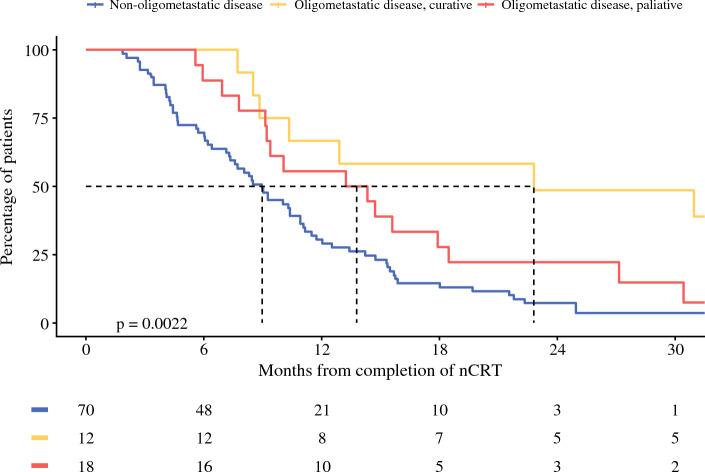
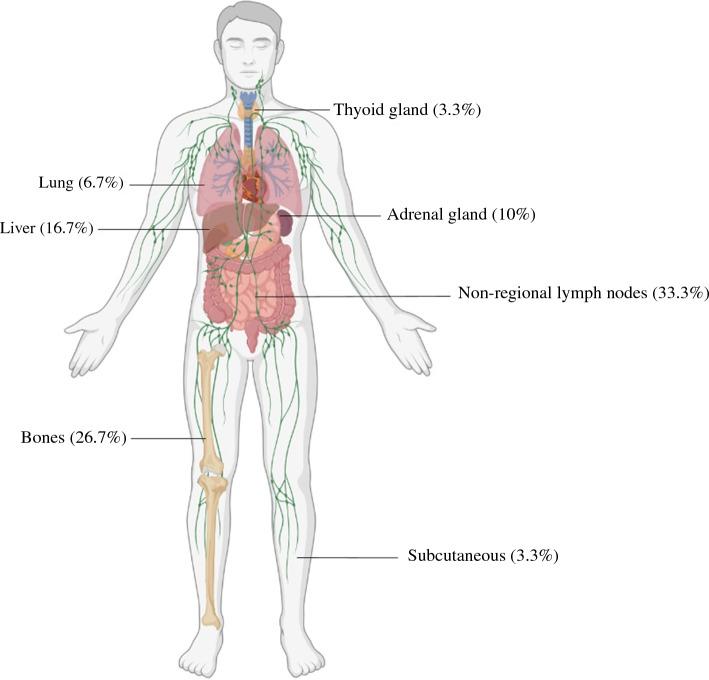
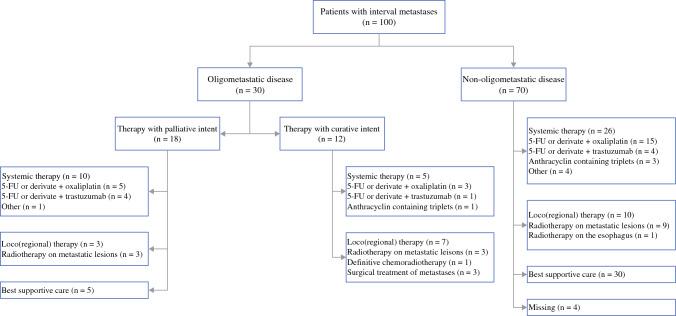
Between 2013 and 2021, 973 patients received nCRT, and 10.3% had interval metastases. Of 100 patients, 30 (30%) had oligometastases, located mostly in non-regional lymph nodes (33.3%) or bones (26.7%). The median OS of this group was 13.8 months (95% confidence interval [CI] 9.2-27.1 months). Of 30 patients, 12 (40%) with oligometastases underwent potentially curative treatment, with a median OS of 22.8 months (95% CI 10.4-NA). The patients with non-oligometastases underwent mostly systemic therapy or BSC and had a median OS of 9 months (95% CI 7.4-10.9 months).
CONCLUSIONS
Interval metastases were detected in about 10% of patients after nCRT, underscoring the importance of re-staging with F-FDG-PET/CT for those who proceed to surgery. A favorable survival might be accomplished for a subgroup of patients with oligometastases.
背景
尽管采用了三联疗法,仍有 10%至 20%的食管癌患者在手术后出现间隔转移。重新分期可以确定不应进行手术的患者,以及可以获得长期疾病控制的有限转移亚组患者。本研究旨在确定新辅助放化疗(nCRT)后出现间隔转移的患者比例,并评估治疗和生存情况。
方法
从一项试验数据库中确定了接受 nCRT 治疗的 cT2-4aN0-3M0 食管癌患者。在 nCRT 后 14 周内通过 F-FDG-PET/CT 或手术检测到的转移灶被归类为寡转移灶(≤3 个病灶位于单一器官或单一区域外淋巴结站)或非寡转移灶。主要结局是 nCRT 后出现转移的患者比例。次要结局是总生存期(OS)和转移部位和治疗方法。
结果
在 2013 年至 2021 年间,973 例患者接受了 nCRT,其中 10.3%出现了间隔转移。在 100 例患者中,30 例(30%)有寡转移灶,主要位于非区域性淋巴结(33.3%)或骨骼(26.7%)。该组的中位 OS 为 13.8 个月(95%置信区间[CI] 9.2-27.1 个月)。在 30 例寡转移灶患者中,有 12 例(40%)接受了潜在治愈性治疗,中位 OS 为 22.8 个月(95%CI 10.4-NA)。非寡转移灶患者主要接受全身治疗或最佳支持治疗,中位 OS 为 9 个月(95%CI 7.4-10.9 个月)。
结论
nCRT 后约 10%的患者出现间隔转移,这凸显了对拟行手术患者进行 F-FDG-PET/CT 重新分期的重要性。对于寡转移灶亚组患者,可能实现较好的生存获益。
 Zotero 插件