
德国 COVID-19 大流行期间私人和职业接触行为的社会人口学影响:基于区域献血者队列的横断面分析。
Sociodemographic influences on private and professional contact behaviour during the COVID-19 pandemic in Germany: cross-sectional analysis based on a Regional Blood Donor Cohort.
机构信息
Institute of Social Medicine and Health Systems Research, Medical Faculty, Otto von Guericke University Magdeburg, Magdeburg, Germany.
Institute of Medical Microbiology and Hospital Hygiene, Medical Faculty, Otto von Guericke University Magdeburg, Magdeburg, Germany.
出版信息
BMC Res Notes. 2024 Jul 27;17(1):206. doi: 10.1186/s13104-024-06867-9.
OBJECTIVE
The COVID-19 pandemic has had significant health and socioeconomic impacts worldwide. Extensive measures, including contact restrictions, were implemented to control the spread of the virus. This study aims to examine the factors that influenced private and professional contact behaviour during the COVID-19 pandemic.
RESULTS
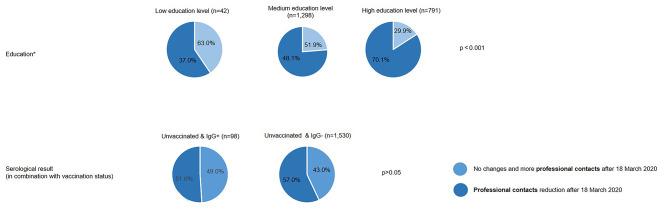
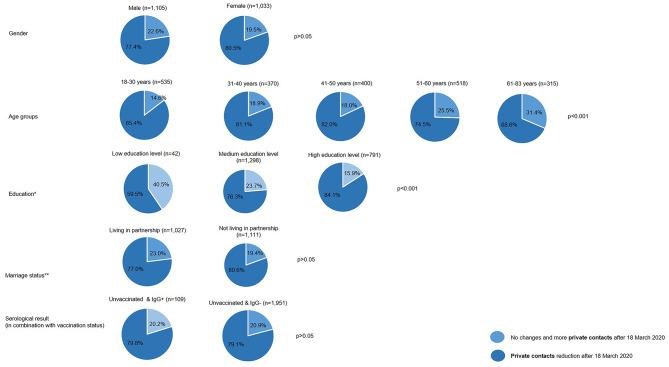
We used baseline data (January-April 2021) from the SeMaCo study (Serologische Untersuchungen bei Blutspendern des Großraums Magdeburg auf Antikörper gegen SARS-CoV-2), a longitudinal, regional cohort study assessing COVID-19 seroprevalence in blood donors from Magdeburg and surrounding areas in Germany. In the blood donor cohort (n = 2,195), there was a general reduction in private contacts (by 78.9%) and professional contacts (by 54.4%) after March 18, 2020. Individuals with higher education reduced both private (by 84.1%) and professional (by 70.1%) contacts more than those with lower education levels (private contacts 59.5%; professional contacts 37%). Younger age groups (18-30 years) reduced private contacts more frequently (by 85.4%) than older individuals (61-83 years, by 68.6%) and demonstrated a higher likelihood of private contact reduction compared to older age groups (51-60 years: odds ratio (OR) 0.45 [95% [CI] 0.32-0.65]; 61-83 years: OR 0.33 [95% [CI] 0.22-0.48]).
目的
COVID-19 大流行在全球范围内造成了重大的健康和社会经济影响。为了控制病毒的传播,采取了广泛的措施,包括限制接触。本研究旨在探讨 COVID-19 大流行期间影响私人和专业接触行为的因素。
结果
我们使用了来自 SeMaCo 研究(Magdeburg 及周边地区献血者对 SARS-CoV-2 抗体的血清学研究)的基线数据(2021 年 1 月至 4 月),该研究是一项纵向区域性队列研究,评估了德国 Magdeburg 及周边地区献血者的 COVID-19 血清流行率。在献血者队列中(n=2195),自 2020 年 3 月 18 日以来,私人接触(减少 78.9%)和专业接触(减少 54.4%)普遍减少。接受高等教育的个体比接受较低教育水平的个体减少了更多的私人(减少 84.1%)和专业(减少 70.1%)接触(私人接触减少 59.5%;专业接触减少 37%)。年轻年龄组(18-30 岁)比年长个体(61-83 岁)更频繁地减少私人接触(减少 85.4%),并且与年长年龄组相比,私人接触减少的可能性更高(51-60 岁:比值比(OR)0.45 [95%置信区间(CI)0.32-0.65];61-83 岁:OR 0.33 [95% CI 0.22-0.48])。
 Zotero 插件