
利用人工智能预测后路脊柱侧弯矫正中融合棒的弯曲角度
Prediction of Fusion Rod Curvature Angles in Posterior Scoliosis Correction Using Artificial Intelligence.
作者信息
Abedi Rasoul, Fatouraee Nasser, Bostanshirin Mahdi, Arjmand Navid, Ghandhari Hasan
机构信息
Department of Biomedical Engineering, Amirkabir University of Technology, Tehran, Iran.
Department of Mechanical Engineering, Sharif University of Technology, Tehran, Iran.
出版信息
Arch Bone Jt Surg. 2024;12(7):494-505. doi: 10.22038/ABJS.2024.76701.3545.
OBJECTIVES
This study aimed to estimate post-operative rod angles in both concave and convex sides of scoliosis curvature in patients who had undergone posterior surgery, using neural networks and support vector machine (SVM) algorithms.
METHODS
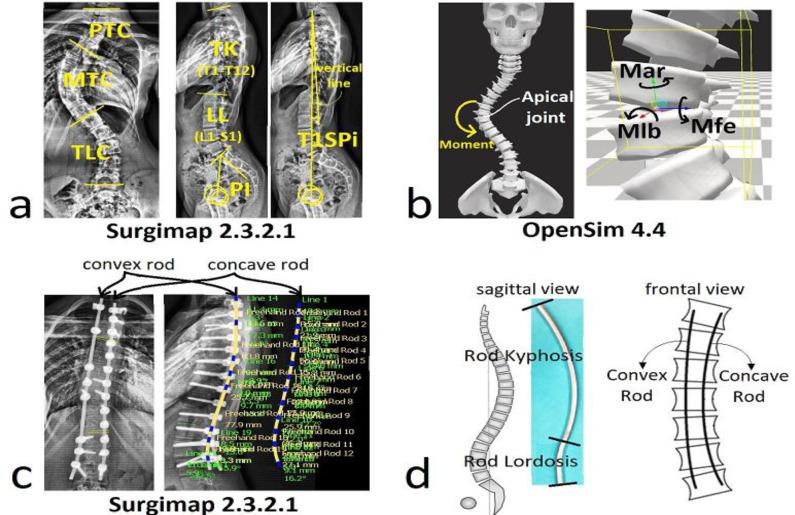
Radiographs of 72 scoliotic individuals were obtained to predict post-operative rod angles at all fusion levels (all spinal joints fused by rods). Pre-operative radiographical indices and pre-operatively resolved net joint moments of the apical vertebrae were employed as inputs for neural networks and SVM with biomechanical modeling using inverse dynamics analysis. Various group combinations were considered as inputs, based on the number of pre-operative angles and moments. Rod angles on both the concave and convex sides of the Cobb angle were considered as outputs. To assess the outcomes, root mean square errors (RMSEs) were evaluated between actual and predicted rod angles.
RESULTS
Among eight groups with various combinations of radiographical and biomechanical parameters (such as Cobb, kyphosis, and lordosis, as well as joint moments), RMSEs of groups 4 (with seven radiographical angles in each case, which is greater in quantity) and 5 (with four radiographical angles and one biomechanical moment in each case, which is the least possible number of inputs with both radiographical and biomechanical parameters) were minimum, particularly in prediction of the concave rod kyphosis angle (errors were 5.5° and 6.3° for groups 4 and 5, respectively). Rod lordosis angles had larger estimation errors than rod kyphosis ones.
CONCLUSION
Neural networks and SVM can be effective techniques for the post-operative estimation of rod angles at all fusion levels to assist surgeons with rod bending procedures before actual surgery. However, since rod lordosis fusion levels vary widely across scoliosis cases, it is simpler to predict rod kyphosis angles, which is more essential for surgeons.
目的
本研究旨在利用神经网络和支持向量机(SVM)算法,估计接受后路手术的脊柱侧弯患者脊柱侧弯曲线凹侧和凸侧的术后棒材角度。
方法
获取72例脊柱侧弯患者的X线片,以预测所有融合节段(所有脊柱关节均用棒材融合)的术后棒材角度。术前X线片指标和术前已解析的顶椎净关节力矩被用作神经网络和支持向量机的输入,并采用逆动力学分析进行生物力学建模。基于术前角度和力矩的数量,将各种组组合视为输入。Cobb角凹侧和凸侧的棒材角度均被视为输出。为评估结果,对实际和预测的棒材角度之间的均方根误差(RMSE)进行了评估。
结果
在具有不同X线和生物力学参数组合(如Cobb角、后凸角和前凸角以及关节力矩)的八组中,第4组(每组有七个X线角度,数量更多)和第5组(每组有四个X线角度和一个生物力学力矩,是同时具有X线和生物力学参数的最少输入数量)的RMSE最小,尤其是在预测凹侧棒材后凸角时(第4组和第5组的误差分别为5.5°和6.3°)。棒材前凸角的估计误差比棒材后凸角的大。
结论
神经网络和支持向量机可以成为有效技术,用于在术前估计所有融合节段的术后棒材角度,以协助外科医生在实际手术前进行棒材弯曲程序。然而,由于棒材前凸融合节段在脊柱侧弯病例中差异很大,预测棒材后凸角更简单,而这对外科医生来说更为重要。



 Zotero 插件