
从报告到改进:团队中的根本原因分析如何塑造患者安全文化。
From Reporting to Improving: How Root Cause Analysis in Teams Shape Patient Safety Culture.
作者信息
Tsamasiotis Christos, Fiard Gaelle, Bouzat Pierre, François Patrice, Fond Guillaume, Boyer Laurent, Boussat Bastien
机构信息
Department of Clinical Epidemiology, Grenoble-Alps University Hospital; Laboratory TIMC-IMAG, UMR 5525 Joint Research Unit, National Center for Scientific Research, Faculty of Medicine, Grenoble Alps University, Grenoble, France.
Department of Urology, Grenoble Alpes University Hospital, CNRS, Grenoble INP, TIMC, Université Grenoble Alpes, Grenoble, France.
出版信息
Risk Manag Healthc Policy. 2024 Jul 22;17:1847-1858. doi: 10.2147/RMHP.S466852. eCollection 2024.
BACKGROUND
Given the increasing focus on patient safety in healthcare systems worldwide, understanding the impact of Continuous Quality Improvement Programs (QIPs) is crucial. QIPs, including Morbidity and Mortality Conferences (MMCs) and Experience Feedback Committees (EFCs), have been identified as effective strategies for enhancing patient safety culture. These programs engage healthcare professionals in the identification and analysis of adverse events to foster a culture of safety (ie the product of individual and group value, attitudes, and perceptions about quality and safety). This study aimed to determine whether patient safety culture differed regarding care provider participation in MMCs and EFCs activities.
METHODS
A cross-sectional web-only survey was conducted in 2022 using the Hospital Survey on Patient Safety Culture (HSOPS) among 4780 employees at an 1836-bed, university-affiliated hospital in France. We quantified the mean differences in the 12 HSOPS dimension scores according to MMCs and EFCs participation, using Cohen d effect size. We performed a multivariate analysis of variance to examine differences in dimension scores after adjusting for background characteristics.
RESULTS
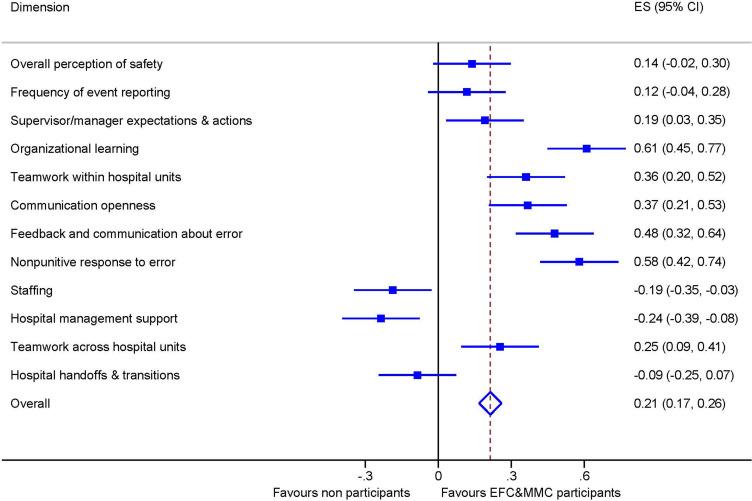
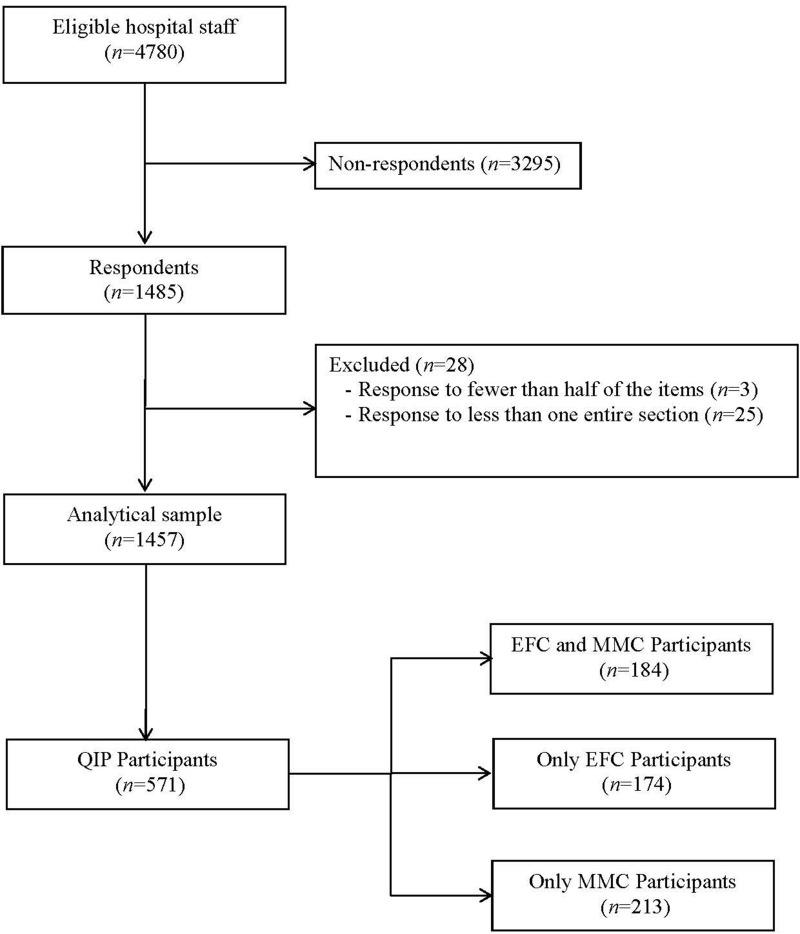
Of 4780 eligible employees, 1457 (30.5%) participated in the study. Among the respondents, 571 (39.2%) participated in MMCs or EFCs activities. Participants engaged in MMCs or EFCs reported significantly higher scores in six out of twelve HSOPS dimensions, particularly in "Nonpunitive response to error", "Feedback and communication about error", and "Organizational learning" (Overall effect size = 0.14, 95% confidence interval = 0.11 to 0.17, P<0.001). Notably, involvement in both MMCs and EFCs was associated with higher improvements in patient safety culture compared to non-participation or singular involvement in either program. However, certain dimensions such as "Staffing", "Hospital management support", and "Hospital handoffs and transition" showed no significant association with MMCs or EFCs participation, highlighting broader systemic challenges.
CONCLUSION
The study confirms the positive association between participation in MMCs or EFCs and an enhanced culture of patient safety, emphasizing the importance of such programs in fostering an environment conducive to learning, communication, and nonpunitive responses to errors. While MMCs or EFCs are effective in promoting certain aspects of patient safety culture, addressing broader systemic challenges remains crucial for comprehensive improvements in patient safety.
背景
鉴于全球医疗系统对患者安全的关注度日益提高,了解持续质量改进计划(QIPs)的影响至关重要。QIPs,包括发病率和死亡率会议(MMCs)以及经验反馈委员会(EFCs),已被确定为增强患者安全文化的有效策略。这些计划促使医疗专业人员识别和分析不良事件,以培育一种安全文化(即个人和群体对质量与安全的价值观、态度及认知的产物)。本研究旨在确定护理人员参与MMCs和EFCs活动时,患者安全文化是否存在差异。
方法
2022年,在法国一家拥有1836张床位的大学附属医院,对4780名员工进行了一项仅通过网络的横断面调查,采用患者安全文化医院调查(HSOPS)。我们根据MMCs和EFCs的参与情况,使用科恩d效应量对HSOPS的12个维度得分的平均差异进行量化。我们进行了多变量方差分析,以在调整背景特征后检查维度得分的差异。
结果
在4780名符合条件的员工中,1457人(30.5%)参与了研究。在受访者中,571人(39.2%)参与了MMCs或EFCs活动。参与MMCs或EFCs的参与者在HSOPS的十二个维度中的六个维度上得分显著更高,特别是在“对错误的非惩罚性反应”、“关于错误的反馈和沟通”以及“组织学习”方面(总体效应量=0.14,95%置信区间=0.11至0.17,P<0.001)。值得注意的是,与不参与或仅参与其中一个计划相比,同时参与MMCs和EFCs与患者安全文化的更高提升相关。然而,某些维度,如“人员配备”、“医院管理支持”和“医院交接与过渡”,与MMCs或EFCs的参与没有显著关联,凸显了更广泛的系统性挑战。
结论
该研究证实了参与MMCs或EFCs与增强患者安全文化之间的正相关关系,强调了此类计划在营造有利于学习、沟通和对错误采取非惩罚性反应的环境方面的重要性。虽然MMCs或EFCs在促进患者安全文化的某些方面有效,但应对更广泛的系统性挑战对于全面改善患者安全仍然至关重要。

 Zotero 插件