
儿童期虐待与纵向表观遗传衰老:NIMHD 社会表观基因组计划。
Childhood Maltreatment and Longitudinal Epigenetic Aging: NIMHD Social Epigenomics Program.
机构信息
School of Social Work, University of Michigan, Ann Arbor.
Department of Psychology, University of Michigan, Ann Arbor.
出版信息
JAMA Netw Open. 2024 Jul 1;7(7):e2421877. doi: 10.1001/jamanetworkopen.2024.21877.
IMPORTANCE
Child physical and emotional abuse and neglect may affect epigenetic signatures of accelerated aging several years after the exposure.
OBJECTIVE
To examine the longitudinal outcomes of early-childhood and midchildhood exposures to maltreatment on later childhood and adolescent profiles of epigenetic accelerated aging.
DESIGN, SETTING, AND PARTICIPANTS: This cohort study used data from the Future of Families and Child Wellbeing Study (enrolled 1998-2000), a US birth cohort study with available DNA methylation (DNAm) data at ages 9 and 15 years (assayed between 2017 and 2020) and phenotypic data at birth (wave 1), and ages 3 (wave 3), 5 (wave 4), 9 (wave 5), and 15 (wave 6) years. Data were analyzed between June 18 and December 10, 2023.
EXPOSURES
Emotional aggression, physical assault, emotional neglect, and physical neglect via the Parent-Child Conflict Tactics Scale at ages 3 and 5 years.
MAIN OUTCOMES AND MEASURES
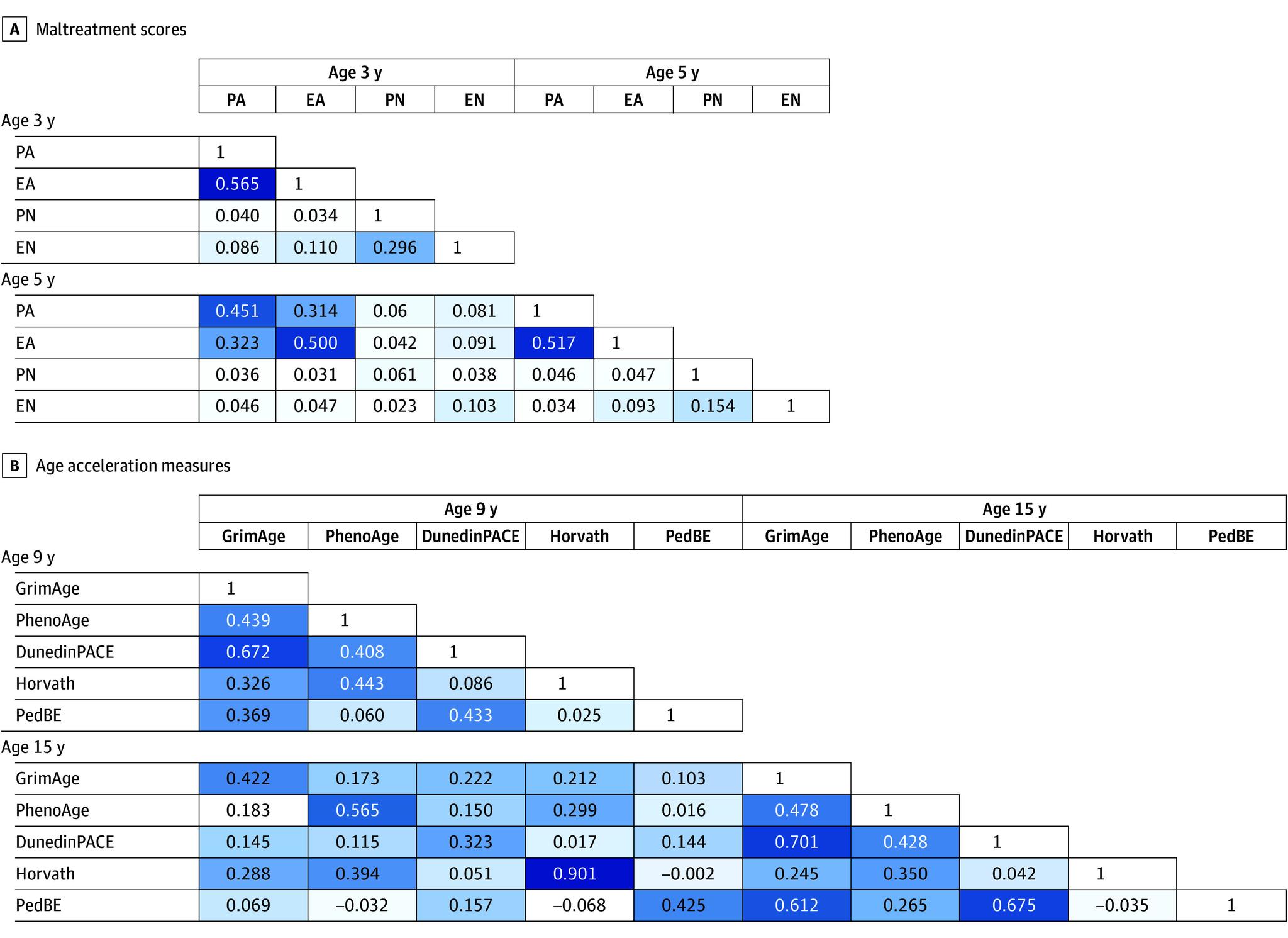
Epigenetic accelerated aging (DNAmAA) was measured using 3 machine learning-derived surrogates of aging (GrimAge, PhenoAge, and DunedinPACE) and 2 machine learning-derived surrogates of age (Horvath and PedBE), residualized for age in months.
RESULTS
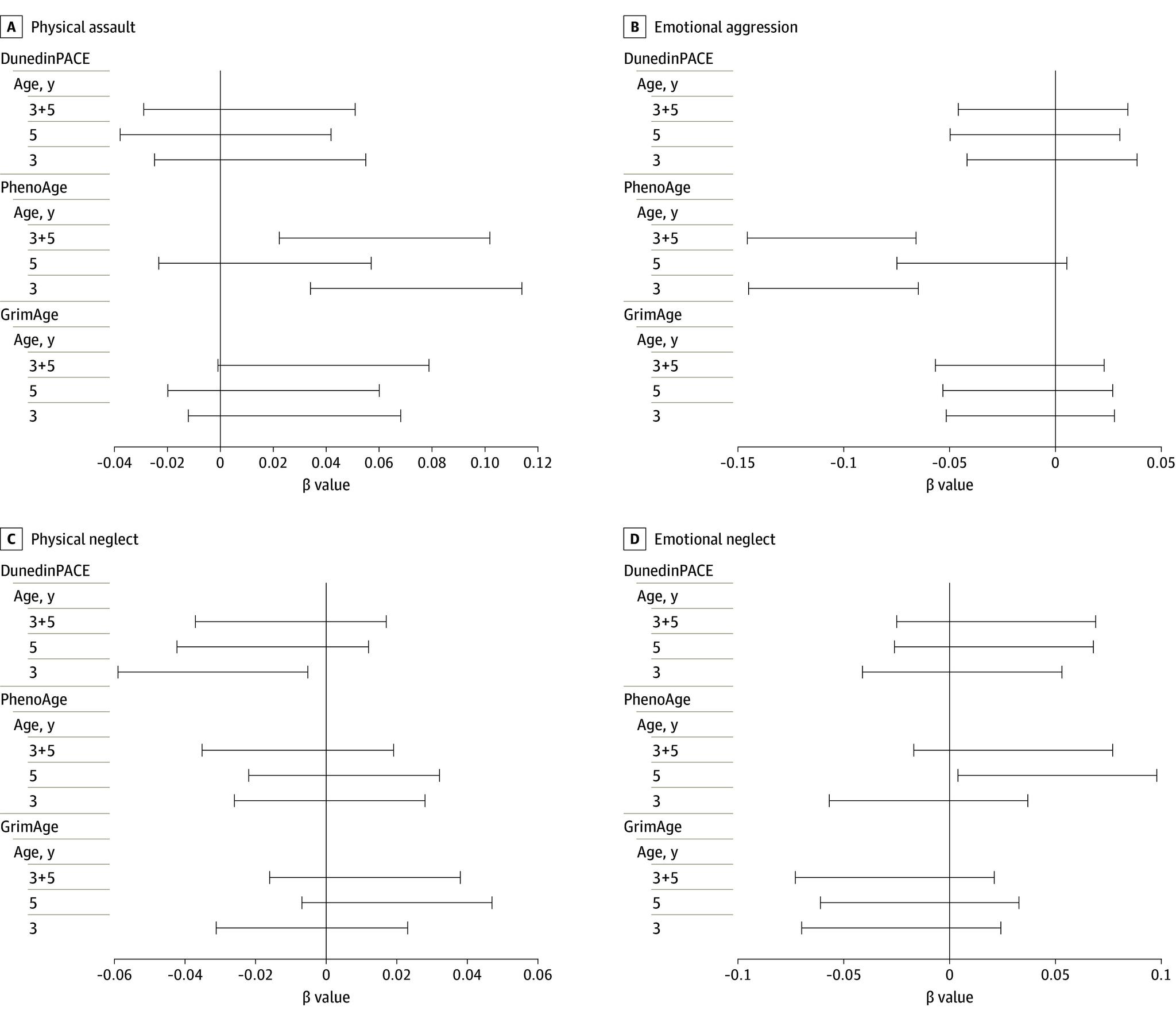
A total of 1971 children (992 [50.3%] male) representative of births in large US cities between 1998 and 2000 were included. Physical assault at age 3 years was positively associated with DNAmAA for PhenoAge (β = 0.073; 95% CI, 0.019-0.127), and emotional aggression at age 3 years was negatively associated with PhenoAge DNAmAA (β = -0.107; 95% CI, -0.162 to -0.052). Emotional neglect at age 5 years was positively associated with PhenoAge DNAmAA (β = 0.051; 95% CI, 0.006-0.097). Cumulative exposure to physical assault between ages 3 and 5 years was positively associated with PhenoAge DNAmAA (β = 0.063; 95% CI, 0.003-0.123); emotional aggression was negatively associated with PhenoAge DNAmAA (β = -0.104; 95% CI, -0.165 to -0.043). The association of these measures with age 15 years PhenoAge DNAmAA was almost fully mediated by age 9 years PhenoAge DNAm age acceleration. Similar patterns were found for GrimAge, DunedinPACE, and PhenoAge, but only those for PhenoAge remained after adjustments for multiple comparisons.
CONCLUSIONS AND RELEVANCE
In this cohort study, altered patterns of DNAmAA were sensitive to the type and timing of child maltreatment exposure and appeared to be associated with more proximate biological embedding of stress.
重要性
儿童身体和情感虐待以及忽视可能会在暴露后数年影响加速衰老的表观遗传特征。
目的
研究儿童早期和中期暴露于虐待对后期儿童和青少年表观遗传加速衰老特征的纵向影响。
设计、地点和参与者:本队列研究使用了未来家庭和儿童福利研究(1998-2000 年招募)的数据,这是一项美国出生队列研究,在 9 岁和 15 岁时(2017 年至 2020 年检测)具有 DNA 甲基化(DNAm)数据和出生时的表型数据(第 1 波),以及 3 岁(第 3 波)、5 岁(第 4 波)、9 岁(第 5 波)和 15 岁(第 6 波)。数据分析于 2023 年 6 月 18 日至 12 月 10 日进行。
暴露
3 岁和 5 岁时通过父母-子女冲突策略量表评估的情感攻击、身体攻击、情感忽视和身体忽视。
主要结果和测量
使用 3 种机器学习衍生的衰老替代物(GrimAge、PhenoAge 和 DunedinPACE)和 2 种机器学习衍生的年龄替代物(Horvath 和 PedBE)测量表观遗传加速衰老(DNAmAA),对年龄进行残差化处理以反映月龄。
结果
共有 1971 名儿童(992[50.3%]名男性)代表了 1998 年至 2000 年间美国大城市的出生儿,3 岁时的身体攻击与 PhenoAge 的 DNAmAA 呈正相关(β=0.073;95%CI,0.019-0.127),3 岁时的情感攻击与 PhenoAge 的 DNAmAA 呈负相关(β=-0.107;95%CI,-0.162 至-0.052)。5 岁时的情感忽视与 PhenoAge 的 DNAmAA 呈正相关(β=0.051;95%CI,0.006-0.097)。3 岁至 5 岁期间累积的身体攻击与 PhenoAge 的 DNAmAA 呈正相关(β=0.063;95%CI,0.003-0.123);情感攻击与 PhenoAge 的 DNAmAA 呈负相关(β=-0.104;95%CI,-0.165 至-0.043)。这些测量值与 15 岁时的 PhenoAge DNAmAA 之间的关联几乎完全由 9 岁时的 PhenoAge DNAm 年龄加速来介导。在 GrimAge、DunedinPACE 和 PhenoAge 中也发现了类似的模式,但只有 PhenoAge 的模式在进行了多次比较调整后仍然存在。
结论和相关性
在这项队列研究中,DNAmAA 改变的模式对儿童虐待暴露的类型和时间敏感,似乎与应激的更直接的生物嵌入有关。
 Zotero 插件