
适用于68锗/68镓发生器多次洗脱的通用型[镓]镓-FAPI-46自动合成方法的开发。
Development of a versatile [Ga]Ga-FAPI-46 automated synthesis suitable to multi-elutions of germanium-68/gallium-68 generators.
作者信息
Paty Louis-Paul, Degueldre Simon, Provost Claire, Schmitt Camille, Trump Laura, Fouque Julien, Vriamont Charles, Valla Frank, Gendron Thibault, Madar Olivier
机构信息
Département de Radiopharmacologie, Ensemble Hospitalier de l'Institut Curie, Saint-Cloud, France.
Trasis, Rue Gilles Magnée, Ans, Belgium.
出版信息
Front Chem. 2024 Jul 15;12:1411312. doi: 10.3389/fchem.2024.1411312. eCollection 2024.
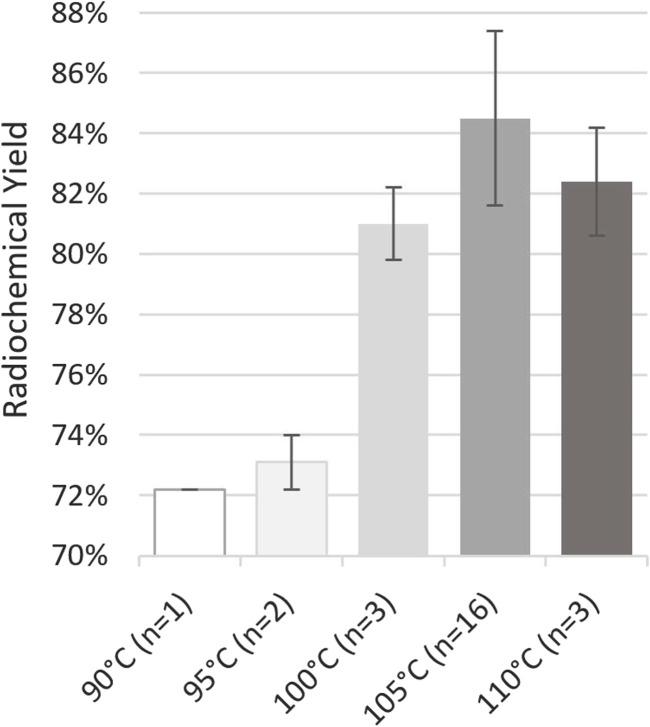
Gallium-68-labeled FAPI-46 has recently been proposed as a novel positron emission tomography imaging probe to diagnose and monitor a wide variety of cancers. Promising results from several ongoing clinical trials have led to a soaring demand for this radiotracer. Typical [Ga]Ga-FAPI-46 labeling protocols do not cope with multiple generator elutions, leaving radiopharmacies unable to scale-up the production and meet the demand. Here, we propose a robust and efficient automated radiosynthesis of [Ga]Ga-FAPI-46 on the Trasis miniAllinOne synthesizer, featuring a prepurification step which allows multiple generator elutions and ensures compatibility with a wide range of gallium-68 generators. Our approach was to optimize the prepurification step by first testing five different cationic cartridge chemistries. Only the strong cationic exchange (SCX) cartridges tested had sufficient affinities for quantitative trapping of >99.9%, while the weak cationics did not exceed 50%. Packaging, rinsing, or flowing of the selected SCX cartridges was not noticeable, but improvements in fluidics managed to save time. Based on our previous development experience of [Ga]Ga-FAPI-46, radiolabeling optimization was also carried out at different temperatures during 10 min. At temperatures above 100°C, radiochemical yield (RCY) > 80% was achieved without significantly increasing the chemical impurities (<5.5 μg mL). The optimized sequence was reproducibly conducted with three different brands of widely used generators (RCY >88%). A comparison with radiosyntheses carried out without prepurification steps was also conclusive in terms of RCY, radiochemical yield, and chemical purity. Finally, high-activity tests using elutions from three generators were also successful for these parameters. [Ga]Ga-FAPI-46 was consistently obtained in good radiochemical yields (>89%, ), and the final product quality was compliant with internal specifications based on European Pharmacopoeia. This process is suitable for GMP production and allows scaling-up of routine productions, higher throughput, and, ultimately, better patient care.
最近,镓-68标记的FAPI-46被提议作为一种新型正电子发射断层成像探针,用于诊断和监测多种癌症。正在进行的几项临床试验取得的良好结果导致对这种放射性示踪剂的需求飙升。典型的[Ga]Ga-FAPI-46标记方案无法应对多次发生器洗脱,使得放射性药物生产企业无法扩大生产规模以满足需求。在此,我们提出了一种在Trasis miniAllinOne合成仪上进行[Ga]Ga-FAPI-46的稳健且高效的自动化放射性合成方法,其具有预纯化步骤,该步骤允许多次发生器洗脱,并确保与多种镓-68发生器兼容。我们的方法是首先测试五种不同的阳离子柱化学性质,以优化预纯化步骤。测试的阳离子柱中,只有强阳离子交换(SCX)柱对定量捕获>99.9%具有足够的亲和力,而弱阳离子柱捕获率不超过50%。所选SCX柱的装柱、冲洗或流动情况不明显,但流体系统的改进成功节省了时间。基于我们之前对[Ga]Ga-FAPI-46的研发经验,还在不同温度下进行了10分钟的放射性标记优化。在高于100°C的温度下,放射性化学产率(RCY)>80%,且化学杂质没有显著增加(<5.5μg/mL)。使用三种不同品牌的广泛使用的发生器可重复进行优化后的流程(RCY>88%)。在RCY、放射性化学产率和化学纯度方面,与无预纯化步骤的放射性合成方法进行比较也得出了明确结论。最后,使用来自三种发生器的洗脱液进行的高活度测试在这些参数方面也取得了成功。[Ga]Ga-FAPI-46始终以良好的放射性化学产率(>89%)获得,最终产品质量符合基于欧洲药典的内部规范。该工艺适用于GMP生产,能够扩大常规生产规模、提高通量,并最终提供更好的患者护理。


 Zotero 插件