
追踪阿尔茨海默病中的神经炎症生物标志物:个体化治疗方法的策略?
Tracking neuroinflammatory biomarkers in Alzheimer's disease: a strategy for individualized therapeutic approaches?
机构信息
i+HeALTH Strategic Research Group, Department of Health Sciences, Miguel de Cervantes European University (UEMC), 47012, Valladolid, Spain.
Department of Research and Development, Chiesi Farmaceutici, 43122, Parma, Italy.
出版信息
J Neuroinflammation. 2024 Jul 30;21(1):187. doi: 10.1186/s12974-024-03163-y.
BACKGROUND
Recent trials of anti-amyloid-β (Aβ) monoclonal antibodies, including lecanemab and donanemab, in early Alzheimer disease (AD) showed that these drugs have limited clinical benefits and their use comes with a significant risk of serious adverse events. Thus, it seems crucial to explore complementary therapeutic approaches. Genome-wide association studies identified robust associations between AD and several AD risk genes related to immune response, including but not restricted to CD33 and TREM2. Here, we critically reviewed the current knowledge on candidate neuroinflammatory biomarkers and their role in characterizing the pathophysiology of AD.
MAIN BODY
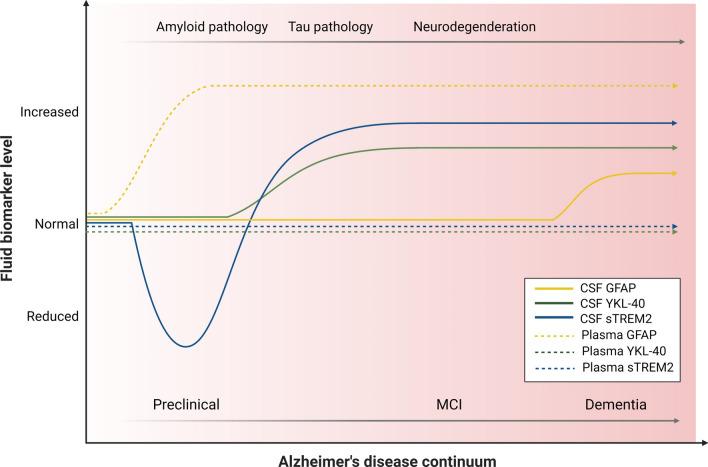
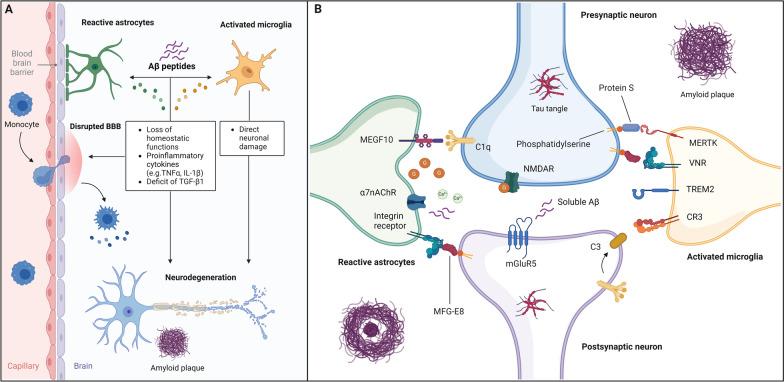
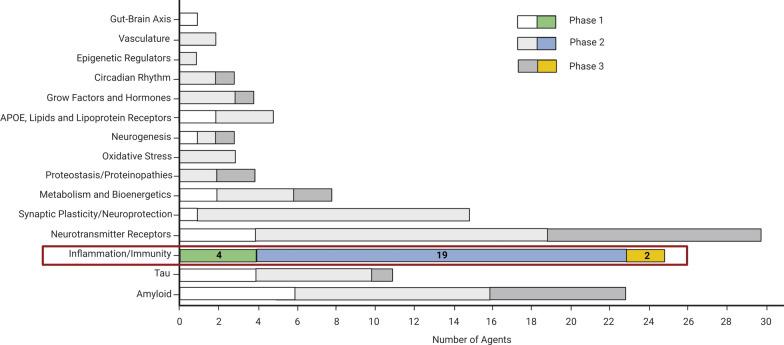
Neuroinflammation is recognized to be a crucial and contributing component of AD pathogenesis. The fact that neuroinflammation is most likely present from earliest pre-stages of AD and co-occurs with the deposition of Aβ reinforces the need to precisely define the sequence and nature of neuroinflammatory events. Numerous clinical trials involving anti-inflammatory drugs previously yielded unfavorable outcomes in early and mild-to-moderate AD. Although the reasons behind these failures remain unclear, these may include the time and the target selected for intervention. Indeed, in our review, we observed a stage-dependent neuroinflammatory process in the AD brain. While the initial activation of glial cells counteracts early brain Aβ deposition, the downregulation in the functional state of microglia occurs at more advanced disease stages. To address this issue, personalized neuroinflammatory modulation therapy is required. The emergence of reliable blood-based neuroinflammatory biomarkers, particularly glial fibrillary acidic protein, a marker of reactive astrocytes, may facilitate the classification of AD patients based on the ATI(N) biomarker framework. This expands upon the traditional classification of Aβ ("A"), tau ("T"), and neurodegeneration ("N"), by incorporating a novel inflammatory component ("I").
CONCLUSIONS
The present review outlines the current knowledge on potential neuroinflammatory biomarkers and, importantly, emphasizes the role of longitudinal analyses, which are needed to accurately monitor the dynamics of cerebral inflammation. Such a precise information on time and place will be required before anti-inflammatory therapeutic interventions can be considered for clinical evaluation. We propose that an effective anti-neuroinflammatory therapy should specifically target microglia and astrocytes, while considering the individual ATI(N) status of patients.
背景
最近针对早期阿尔茨海默病(AD)的抗淀粉样蛋白-β(Aβ)单克隆抗体试验,包括 lecanemab 和 donanemab,表明这些药物的临床获益有限,且使用存在严重不良事件的重大风险。因此,探索补充治疗方法似乎至关重要。全基因组关联研究确定了 AD 与几个与免疫反应相关的 AD 风险基因之间存在强大关联,这些基因包括但不限于 CD33 和 TREM2。在这里,我们批判性地回顾了候选神经炎症生物标志物的现有知识及其在表征 AD 病理生理学中的作用。
主要内容
神经炎症被认为是 AD 发病机制的关键和促成因素。神经炎症很可能从 AD 的最早前阶段就存在,并且与 Aβ的沉积同时发生,这加强了精确定义神经炎症事件的顺序和性质的必要性。以前涉及抗炎药物的许多临床试验在早期和轻度至中度 AD 中均未取得有利结果。尽管这些失败的原因尚不清楚,但可能包括干预的时间和目标选择。事实上,在我们的综述中,我们观察到 AD 大脑中的神经炎症过程具有阶段性。虽然最初的胶质细胞激活可以对抗早期大脑中的 Aβ沉积,但在更晚期的疾病阶段,小胶质细胞的功能状态会下调。为了解决这个问题,需要进行个性化的神经炎症调节治疗。可靠的基于血液的神经炎症生物标志物的出现,特别是胶质纤维酸性蛋白,一种反应性星形胶质细胞的标志物,可能会根据 ATI(N)生物标志物框架促进 AD 患者的分类。这扩展了传统的 Aβ(“A”)、tau(“T”)和神经退行性变(“N”)分类,纳入了新的炎症成分(“I”)。
结论
本综述概述了潜在神经炎症生物标志物的现有知识,并强调了需要进行纵向分析的重要性,这对于准确监测大脑炎症的动态是必要的。在考虑抗炎治疗干预的临床评估之前,需要获得关于时间和地点的这种精确信息。我们建议,有效的抗神经炎症治疗应该特别针对小胶质细胞和星形胶质细胞,同时考虑患者的个体 ATI(N)状态。
 Zotero 插件