
痛泻要方通过调节 CHRM3 和肠道屏障缓解 IBS。
Tongxieyaofang Decotion Alleviates IBS by Modulating CHRM3 and Gut Barrier.
机构信息
Department of Gastroenterology, The First Affiliated Hospital of Zhejiang Chinese Medical University, Hangzhou, Zhejiang, 310003, People's Republic of China.
The First Clinical College of Zhejiang Chinese Medical University, Hangzhou, Zhejiang, 310053, People's Republic of China.
出版信息
Drug Des Devel Ther. 2024 Jul 24;18:3191-3208. doi: 10.2147/DDDT.S455497. eCollection 2024.
PURPOSE
Through network pharmacology combined with molecular docking and in vivo validation, the study examines the unexplored molecular mechanisms of Tongxieyaofang (TXYF) in the treatment of irritable bowel syndrome (IBS). In particular, the potential pharmacological mechanism of TXYF alleviating IBS by regulating CHRM3 and intestinal barrier has not been studied.
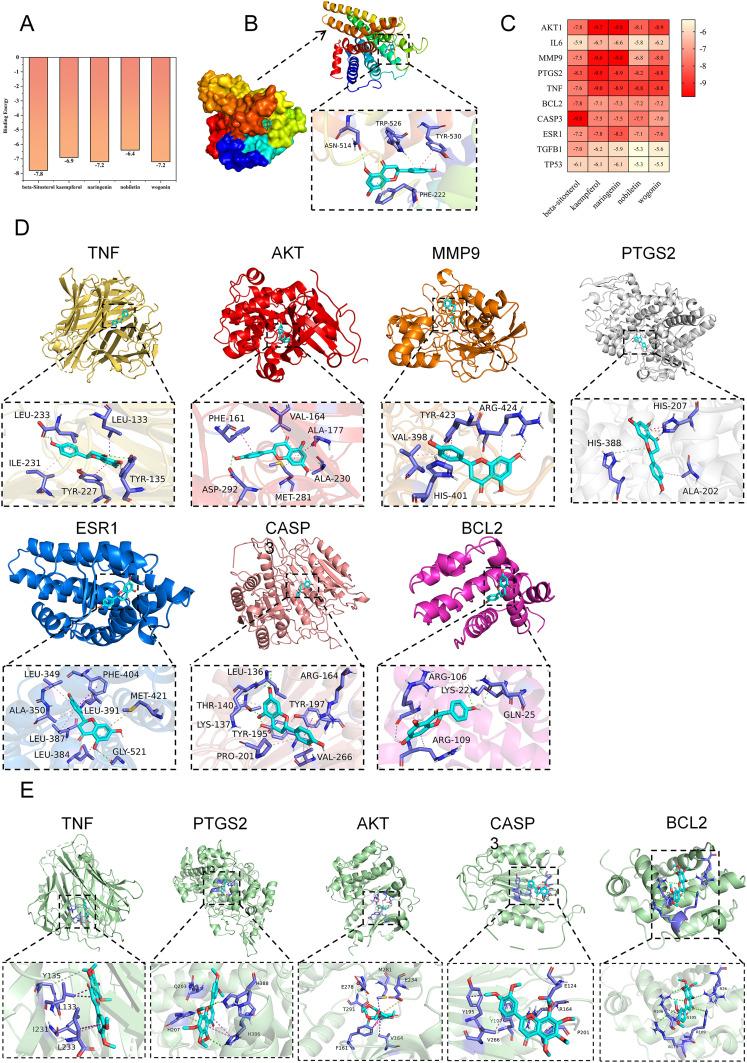
PATIENTS AND METHODS
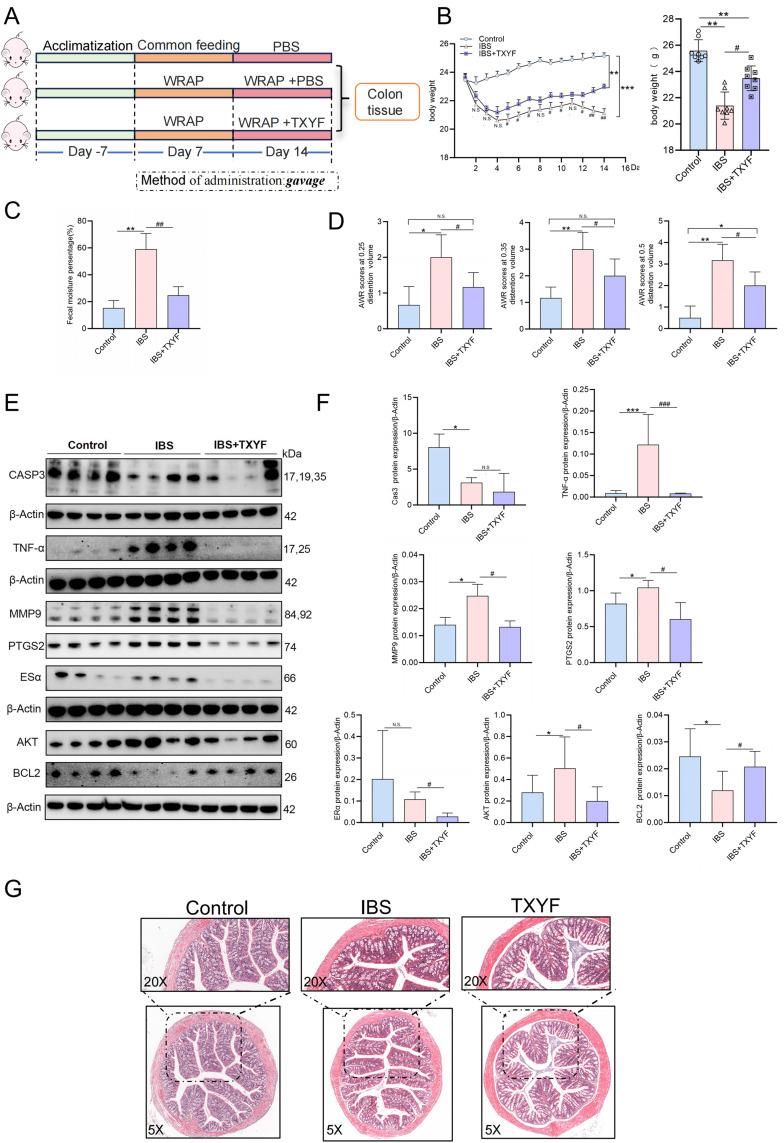
LC-MS technique and TCMSP database were used in combination to identify the potential effective components and target sites of TXYF. Potential targets for IBS were obtained from Genecards and OMIM databases. PPI and cytoHub analysis for targets. Molecular docking was used to validate the binding energy of effective components with related targets and for visualization. GO and KEGG analysis were employed to identify target functions and signaling pathways. In the in vivo validation, wrap restraint stress-induced IBS model was employed to verify the change for cytoHub genes and CHRM3 expression. Furthermore, inflammatory changes of colon were observed by HE staining. The changes of Ach were verified by ELISA. IHC and WB validated CHRM3 and GNAQ/PLC/MLCK channel variations. AB-PAS test and WB test confirmed the protection of TXYF on gut barrier. The NF-κB/MLCK pathway was also verified.
RESULTS
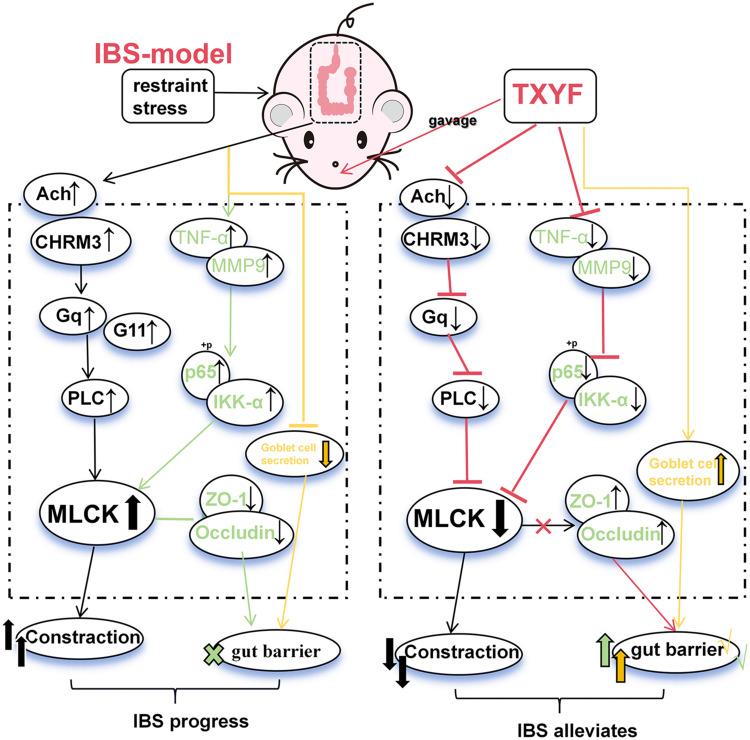
In TXYF decoction, LC-MS identified 559 chemical components, with 23 remaining effective components after screening in TCMSP. KEGG analysis indicated that calcium plays a crucial role in TXYF treated for IBS. Molecular docking validated the binding capacity of the effective components Naringenin and Nobiletin with cytoHub-gene and CHRM3. In vivo validation demonstrated that TXYF inhibits the activation of Ach and CHRM3 in IBS, and inhibits for the GNAQ/PLC/MLCK axis. Additionally, TXYF downregulates TNF-α, MMP9, and NF-κB/MLCK, while modulating goblet cell secretion to protect gut barrier.
CONCLUSION
TXYF inhibits Ach and CHRM3 expression, regulating the relaxation of intestinal smooth muscle via GNAQ/PLC/MLCK. Additionally, TXYF inhibits NF-κB/MLCK activated and goblet cell secretion to protect gut barrier.
目的
通过网络药理学结合分子对接和体内验证,研究探讨了痛泻要方(TXYF)治疗肠易激综合征(IBS)的未探索分子机制。特别是,TXYF 通过调节 CHRM3 和肠道屏障缓解 IBS 的潜在药理机制尚未得到研究。
方法
采用 LC-MS 技术和 TCMSP 数据库联合鉴定 TXYF 的潜在有效成分和靶位。从 Genecards 和 OMIM 数据库中获取 IBS 的潜在靶点。进行 PPI 和 cytoHub 分析以确定靶点。采用分子对接验证有效成分与相关靶点的结合能并进行可视化。进行 GO 和 KEGG 分析以确定靶标功能和信号通路。在体内验证中,采用束缚应激诱导的 IBS 模型验证了 cytoHub 基因和 CHRM3 表达的变化。此外,通过 HE 染色观察结肠的炎症变化。通过 ELISA 验证 Ach 的变化。采用 IHC 和 WB 验证 CHRM3 和 GNAQ/PLC/MLCK 通道的变化。AB-PAS 试验和 WB 试验证实了 TXYF 对肠道屏障的保护作用。还验证了 NF-κB/MLCK 通路。
结果
在 TXYF 方剂中,LC-MS 鉴定出 559 种化学成分,经过 TCMSP 筛选后,有 23 种仍为有效成分。KEGG 分析表明,钙在 TXYF 治疗 IBS 中起着关键作用。分子对接验证了有效成分橙皮苷和川陈皮素与 cytoHub 基因和 CHRM3 的结合能力。体内验证表明,TXYF 抑制 IBS 中 Ach 和 CHRM3 的激活,并抑制 GNAQ/PLC/MLCK 轴。此外,TXYF 下调 TNF-α、MMP9 和 NF-κB/MLCK,同时调节杯状细胞分泌以保护肠道屏障。
结论
TXYF 通过 GNAQ/PLC/MLCK 抑制 Ach 和 CHRM3 的表达,调节肠道平滑肌的松弛。此外,TXYF 通过抑制 NF-κB/MLCK 激活和杯状细胞分泌来保护肠道屏障。




 Zotero 插件