
探索噬菌体-抗生素联合治疗 ESKAPE 病原体中的协同和拮抗相互作用。
Exploring synergistic and antagonistic interactions in phage-antibiotic combinations against ESKAPE pathogens.
机构信息
Anti-Infective Research Laboratory, Department of Pharmacy Practice, Eugene Applebaum College of Pharmacy and Health Sciences, Wayne State University, Detroit, Michigan, USA.
Naval Medical Research Center-Fort Detrick, Frederick, Maryland, USA.
出版信息
Microbiol Spectr. 2024 Oct 3;12(10):e0042724. doi: 10.1128/spectrum.00427-24. Epub 2024 Jul 31.
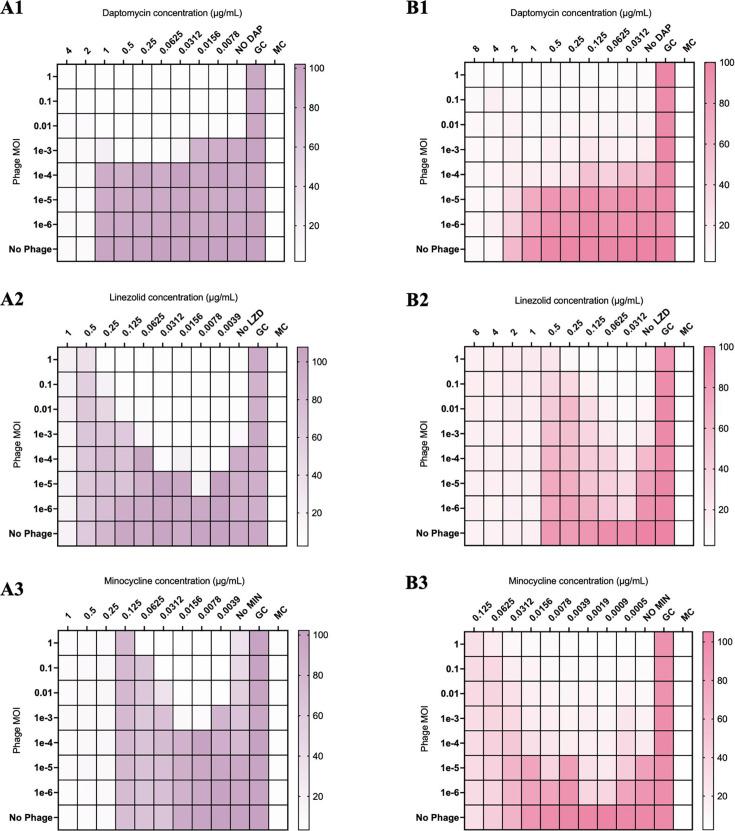
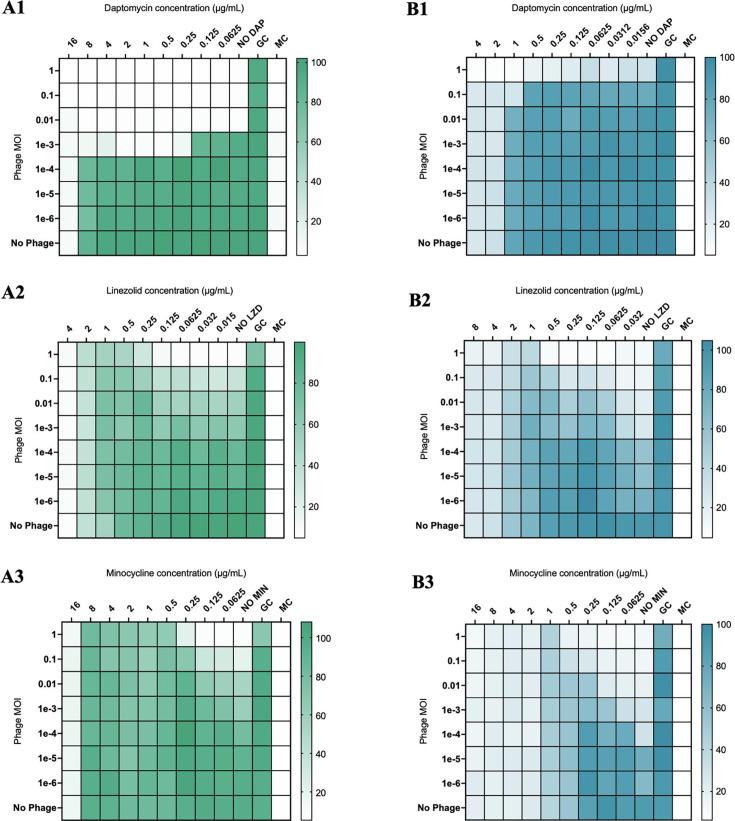
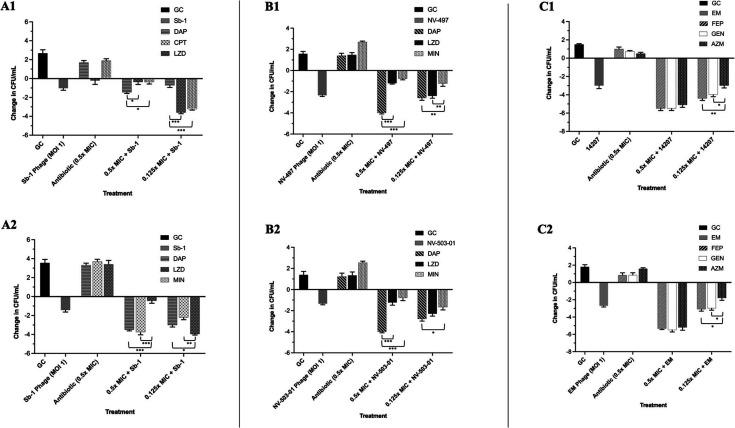
In the era of antimicrobial resistance, phage-antibiotic combinations offer a promising therapeutic option, yet research on their synergy and antagonism is limited. This study aims to assess these interactions, focusing on protein synthesis inhibitors and cell envelope-active agents against multidrug-resistant bacterial strains. We evaluated synergistic and antagonistic interactions in multidrug-resistant , , and strains. Phages were combined with protein synthesis inhibitors [linezolid (LZD), minocycline (MIN), gentamicin (GEN), and azithromycin (AZM)] or cell envelope-active agents [daptomycin (DAP), ceftaroline (CPT), and cefepime (FEP)]. Modified checkerboard minimum inhibitory concentration assays and 24-h time-kill analyses were conducted, alongside one-step growth curves to analyze phage growth kinetics. Statistical comparisons used one-way analysis of variance (ANOVA) and the Tukey test ( < 0.05). In the checkerboard and 24-h time-kill analyses (TKA) of and , phage-LZD and phage-MIN combinations were antagonistic (FIC > 4) while phage-DAP and phage-CPT were synergistic (FIC 0.5) (ANOVA range of mean differences 0.52-2.59 log CFU/mL; < 0.001). For , phage-AZM was antagonistic (FIC > 4), phage-GEN was additive (FIC = 1), and phage-FEP was synergistic (ANOVA range of mean differences 1.04-1.95 log CFU/mL; < 0.001). Phage growth kinetics were altered in the presence of LZD and MIN against and in the presence of LZD against a single strain (HOU503). Our findings indicate that select protein synthesis inhibitors may induce phage-antibiotic antagonism. However, this antagonism may not solely stem from changes in phage growth kinetics, warranting further investigation into the complex interplay among strains, phage attributes, and antibiotic mechanisms affecting bacterial inhibition.IMPORTANCEIn the face of escalating antimicrobial resistance, combining phages with antibiotics offers a promising avenue for treating infections unresponsive to traditional antibiotics. However, while studies have explored synergistic interactions, less attention has been given to potential antagonism and its impact on phage growth kinetics. This research evaluates the interplay between phages and antibiotics, revealing both synergistic and antagonistic patterns across various bacterial strains and shedding light on the complex dynamics that influence treatment efficacy. Understanding these interactions is crucial for optimizing combination therapies and advancing phage therapy as a viable solution for combating antimicrobial resistance.
在抗生素耐药性的时代,噬菌体-抗生素联合治疗提供了一种有前途的治疗选择,但关于它们协同作用和拮抗作用的研究有限。本研究旨在评估这些相互作用,重点是针对多药耐药菌株的蛋白质合成抑制剂和细胞包膜活性剂。我们评估了多药耐药的 、 和 菌株中的协同和拮抗相互作用。噬菌体与蛋白质合成抑制剂[利奈唑胺(LZD)、米诺环素(MIN)、庆大霉素(GEN)和阿奇霉素(AZM)]或细胞包膜活性剂[达托霉素(DAP)、头孢洛林(CPT)和头孢吡肟(FEP)]联合使用。进行了改良棋盘微量稀释最低抑菌浓度测定和 24 小时时间杀伤分析,以及一步生长曲线分析噬菌体生长动力学。使用单向方差分析(ANOVA)和 Tukey 检验(<0.05)进行统计比较。在 和 的棋盘和 24 小时时间杀伤分析(TKA)中,噬菌体-LZD 和噬菌体-MIN 组合是拮抗的(FIC>4),而噬菌体-DAP 和噬菌体-CPT 是协同的(FIC0.5)(ANOVA 平均差异范围为 0.52-2.59 log CFU/mL;<0.001)。对于 ,噬菌体-AZM 是拮抗的(FIC>4),噬菌体-GEN 是相加的(FIC=1),噬菌体-FEP 是协同的(ANOVA 平均差异范围为 1.04-1.95 log CFU/mL;<0.001)。在 LZD 和 MIN 存在的情况下,噬菌体生长动力学在 和 LZD 存在的情况下在单个 菌株(HOU503)中发生改变。我们的研究结果表明,某些蛋白质合成抑制剂可能会引起噬菌体-抗生素拮抗作用。然而,这种拮抗作用可能不仅仅源于噬菌体生长动力学的变化,因此需要进一步研究菌株、噬菌体特性和影响细菌抑制的抗生素机制之间的复杂相互作用。
重要性
在抗生素耐药性不断加剧的情况下,将噬菌体与抗生素联合使用为治疗对传统抗生素无反应的感染提供了一个有前途的途径。然而,尽管已经研究了协同相互作用,但对抗菌作用中潜在的拮抗作用及其对噬菌体生长动力学的影响关注较少。本研究评估了噬菌体和抗生素之间的相互作用,揭示了不同细菌菌株之间的协同和拮抗模式,并阐明了影响治疗效果的复杂动态。了解这些相互作用对于优化联合治疗和推进噬菌体治疗作为应对抗生素耐药性的可行解决方案至关重要。


 Zotero 插件