
开发和验证列线图模型预测非转移性非肌肉浸润性膀胱癌患者的癌症特异性死亡率的竞争风险。
Development and validation of competing risk nomograms for predicting cancer‑specific mortality in non-metastatic patients with non‑muscle invasive urothelial bladder cancer.
机构信息
Department of Urology, Children's Hospital of Chongqing Medical University, Zhongshan 2nd Road, No.136, Yuzhong District, Chongqing, 400014, China.
Chongqing Key Laboratory of Children Urogenital Development and Tissue Engineering, Chongqing, 400014, China.
出版信息
Sci Rep. 2024 Jul 31;14(1):17641. doi: 10.1038/s41598-024-68474-9.
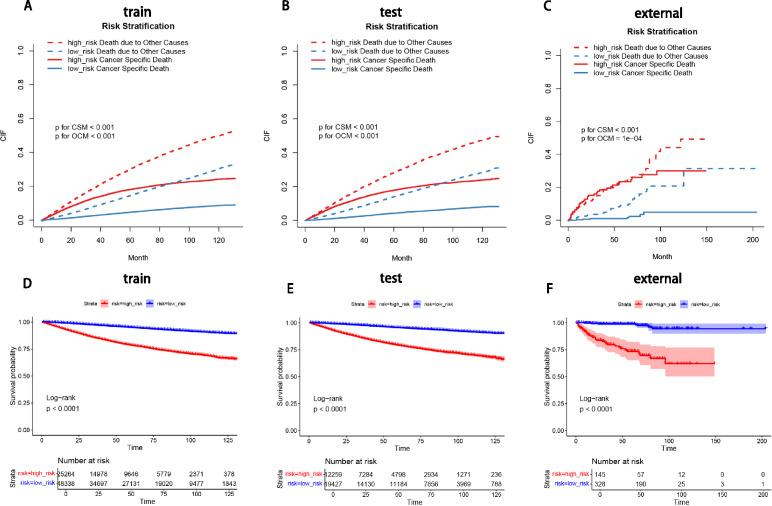
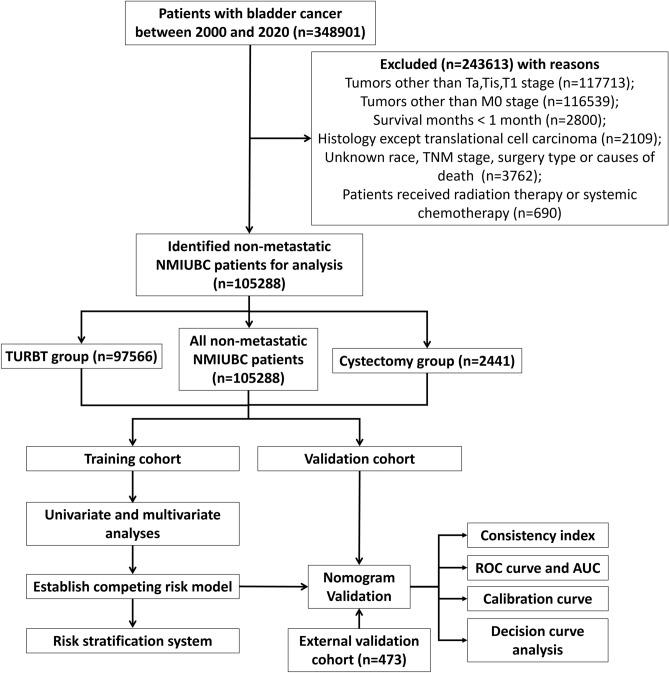
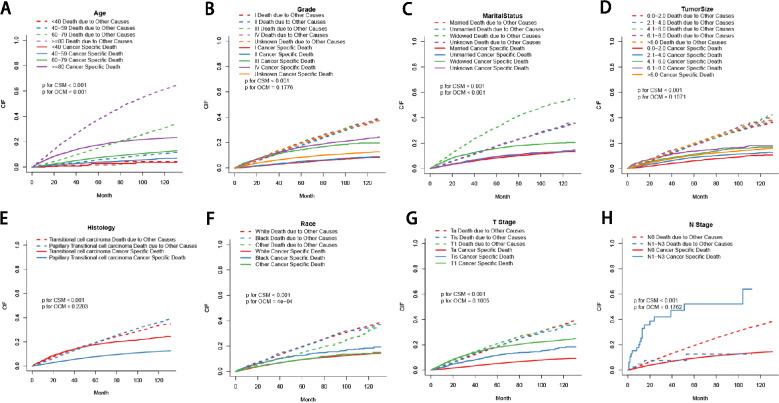
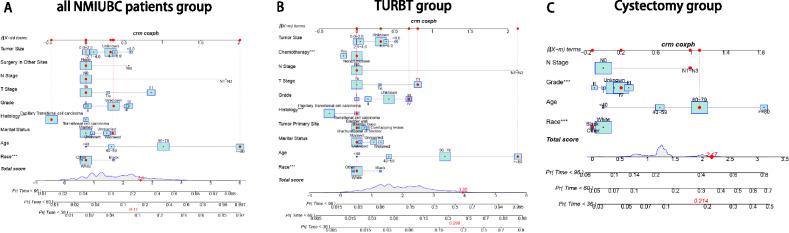
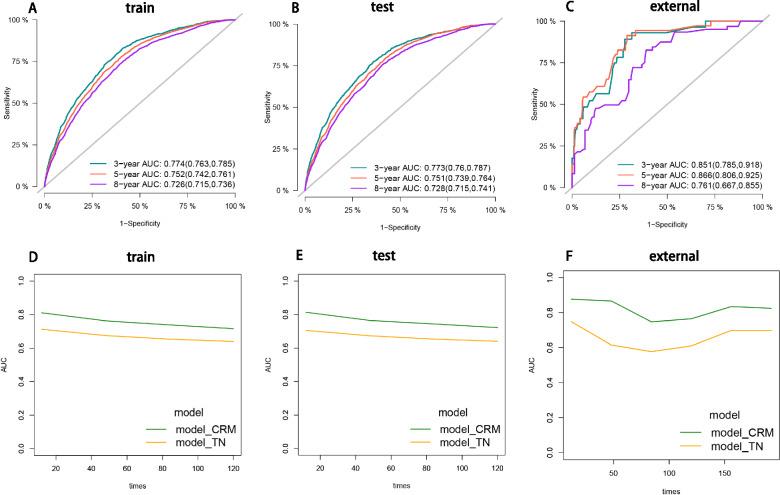
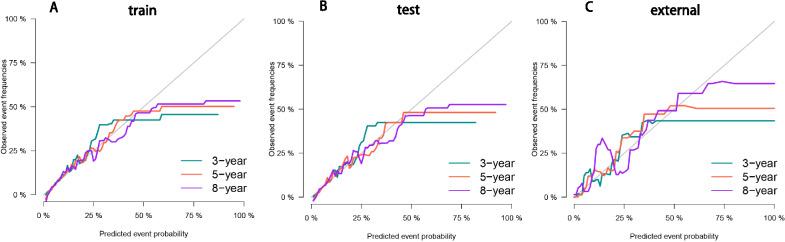
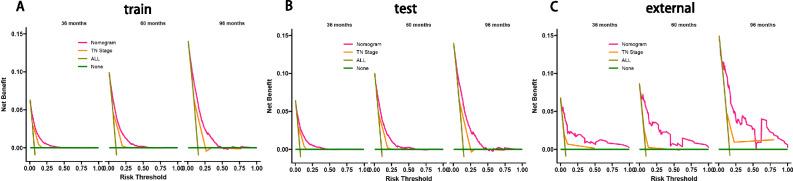
We aimed to assess the cumulative incidences of cancer-specific mortality (CSM) in non-metastatic patients with non‑muscle invasive urothelial bladder cancer (NMIUBC) and establish competing risk nomograms to predict CSM. Patient data was sourced from the Surveillance, Epidemiology, and End Results database, as well as the electronic medical record system in our institution to form the external validation cohort. Sub-distribution proportional hazards model was utilized to determine independent risk factors influencing CSM in non-metastatic NMIUBC patients. Competitive risk nomograms were constructed to predict 3-year, 5-year, and 8-year cancer-specific survival (CSS) in all patients group, TURBT group and cystectomy group, respectively. The discrimination and accuracy of the model were validated through the concordance index (C-index), the area under the receiver operating characteristic curve (AUC), and calibration curves. Decision curve analysis (DCA) and a risk stratification system was employed to evaluate the clinical utility of the model. Race, age, marital status, surgery in other sites, tumor size, histological type, histological grade, T stage and N stage were identified as independent risk factors to predict CSS in all patients group. The C-index for 3-year CSS was 0.771, 0.770 and 0.846 in the training, testing and external validation sets, respectively. The ROC curves showed well discrimination and the calibration plots were well fitted and consistent. Moreover, DCA demonstrated well clinical effectiveness. Altogether, the competing risk nomogram displayed excellent discrimination and accuracy for predicting CSS in non-metastatic NMIUBC patients, which can be applied in clinical practice to help tailor treatment plans and make clinical decisions.
我们旨在评估非转移性非肌肉浸润性膀胱癌(NMIUBC)患者的癌症特异性死亡率(CSM)的累积发生率,并建立竞争风险列线图来预测 CSM。患者数据来源于监测、流行病学和最终结果数据库以及我们机构的电子病历系统,以形成外部验证队列。利用亚分布比例风险模型确定影响非转移性 NMIUBC 患者 CSM 的独立风险因素。构建竞争风险列线图分别预测所有患者组、TURBT 组和膀胱切除术组的 3 年、5 年和 8 年癌症特异性生存(CSS)。通过一致性指数(C 指数)、接收者操作特征曲线下面积(AUC)和校准曲线验证模型的判别能力和准确性。决策曲线分析(DCA)和风险分层系统用于评估模型的临床实用性。种族、年龄、婚姻状况、其他部位手术、肿瘤大小、组织学类型、组织学分级、T 分期和 N 分期被确定为所有患者组 CSS 的独立预测因素。在训练集、测试集和外部验证集中,3 年 CSS 的 C 指数分别为 0.771、0.770 和 0.846。ROC 曲线显示出良好的判别能力,校准图拟合良好且一致。此外,DCA 显示出良好的临床效果。总的来说,竞争风险列线图在预测非转移性 NMIUBC 患者的 CSS 方面表现出良好的判别力和准确性,可应用于临床实践,帮助制定治疗计划和做出临床决策。
 Zotero 插件