
中国社会经济地位与慢性阻塞性肺疾病风险之间的关联:一项前瞻性队列研究。
Association between socioeconomic status and risk of chronic obstructive pulmonary disease in China: a prospective cohort study.
作者信息
Hua Yujie, Fan Xikang, Yang Mengshi, Su Jian, Guo Jia, Jin Jianrong, Sun Dianjianyi, Pei Pei, Yu Canqing, Lyu Jun, Tao Ran, Zhou Jinyi, Lu Yan
机构信息
Department of Non-communicable Chronic Disease Control and Prevention, Suzhou Center for Disease Control and Prevention, Suzhou, 215004, China.
Jiangsu Provincial Center for Disease Control and Prevention, 172 Jiangsu Road, Nanjing, 210009, Jiangsu, China.
出版信息
BMC Public Health. 2024 Jul 31;24(1):2077. doi: 10.1186/s12889-024-19490-x.
OBJECTIVE
Socioeconomic status (SES) has been proven to be associated with chronic obstructive pulmonary disease (COPD) in Western populations, but the evidence is very limited in China. This study aimed to investigate the association between SES and the risk of COPD incident.
METHODS
This study was based on the China Kadoorie Biobank (CKB) project in Wuzhong District, Suzhou. A total of 45,484 adults aged 30-79 were included in the analysis during 2004-2008. We used Cox proportional hazard models to investigate the association between SES and the risk of COPD. Household income, education, private property and consumption potential was used to measure SES. Incident COPD cases were ascertained using hospitalization records, death certificates, and active follow-up.
RESULTS
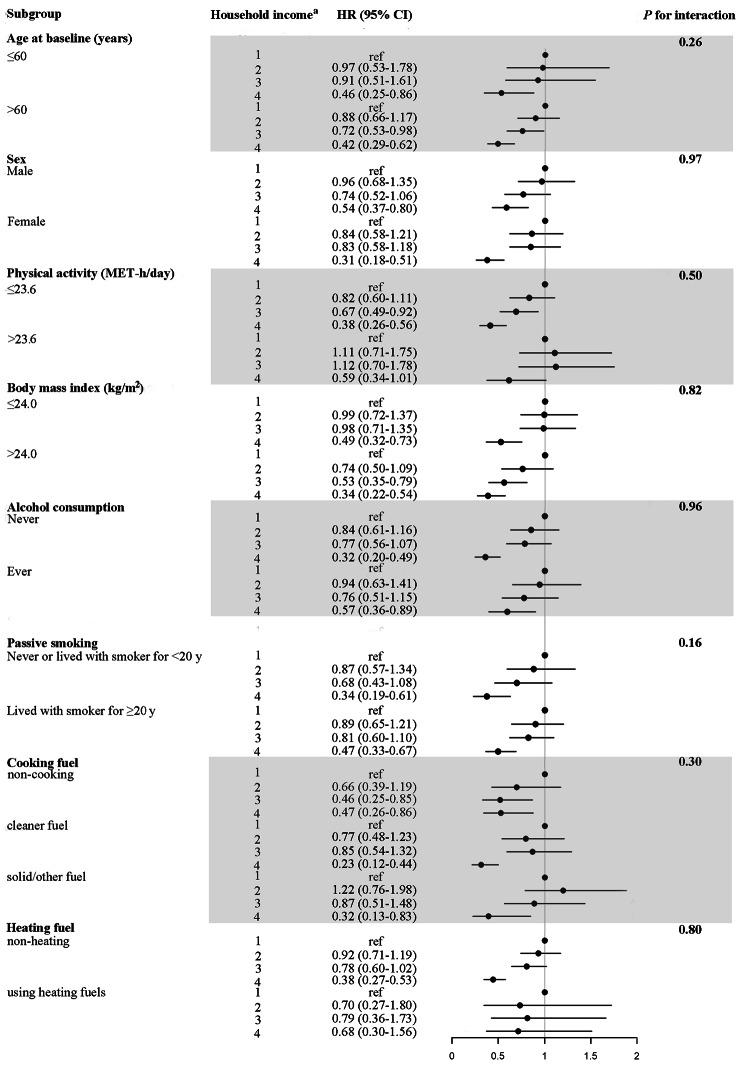
A total of 524 COPD cases were identified during a median follow-up of 11.2 years. Household income was inversely associated with the risk of COPD (P<0.005). The adjusted hazard ratios (95% confidence intervals) for incident COPD were 0.88 (0.69-1.14), 0.77 (0.60-0.99), and 0.42 (0.31-0.57) for participants with annual household income of 10,000 ~ 19,999 yuan, 20,000 ~ 34,999 yuan and ≥ 35,000 yuan respectively, in comparison to participants with an annual household income < 10,000 yuan. Furthermore, we found that education level, refrigerator use, private toilet, private phone, and motor vehicle were adversely associated with COPD risk, while ownership of newly renovated flats was positively correlated with COPD incident.
CONCLUSIONS
This prospective study suggests that SES is associated with the risk of COPD in Chinese adults. Population-based COPD prevention strategies tailored for people with different SES could help reduce the burden of COPD in Chinese.
目的
在西方人群中,社会经济地位(SES)已被证明与慢性阻塞性肺疾病(COPD)相关,但在中国,相关证据非常有限。本研究旨在调查SES与COPD发病风险之间的关联。
方法
本研究基于苏州吴中区的中国嘉道理生物样本库(CKB)项目。2004年至2008年期间,共有45484名30 - 79岁的成年人纳入分析。我们使用Cox比例风险模型来研究SES与COPD风险之间的关联。家庭收入、教育程度、私有财产和消费潜力用于衡量SES。通过住院记录、死亡证明和主动随访确定COPD发病病例。
结果
在中位随访11.2年期间,共识别出524例COPD病例。家庭收入与COPD风险呈负相关(P<0.005)。与家庭年收入<10000元的参与者相比,家庭年收入为10000 - 19999元、20000 - 34999元和≥35000元的参与者发生COPD的调整后风险比(95%置信区间)分别为0.88(0.69 - 1.14)、0.77(0.60 - 0.99)和0.42(0.31 - 0.57)。此外,我们发现教育水平、冰箱使用情况、私人厕所、私人电话和机动车与COPD风险呈负相关,而新装修公寓的拥有情况与COPD发病呈正相关。
结论
这项前瞻性研究表明,SES与中国成年人的COPD风险相关。针对不同SES人群制定的基于人群的COPD预防策略可能有助于减轻中国的COPD负担。
 Zotero 插件