
抗菌无孔表面:ISO 22196:2011标准与最近发布的ISO 7581:2023标准的比较
Antimicrobial non-porous surfaces: a comparison of the standards ISO 22196:2011 and the recently published ISO 7581:2023.
作者信息
Maitz Stephanie, Poelzl Sabine, Dreisiebner Daniela, Zarschenas Eva, Kittinger Clemens
机构信息
Diagnostic and Research Institute for Hygiene, Microbiology and Environmental Medicine, Medical University of Graz, Graz, Austria.
出版信息
Front Microbiol. 2024 Jul 17;15:1400265. doi: 10.3389/fmicb.2024.1400265. eCollection 2024.
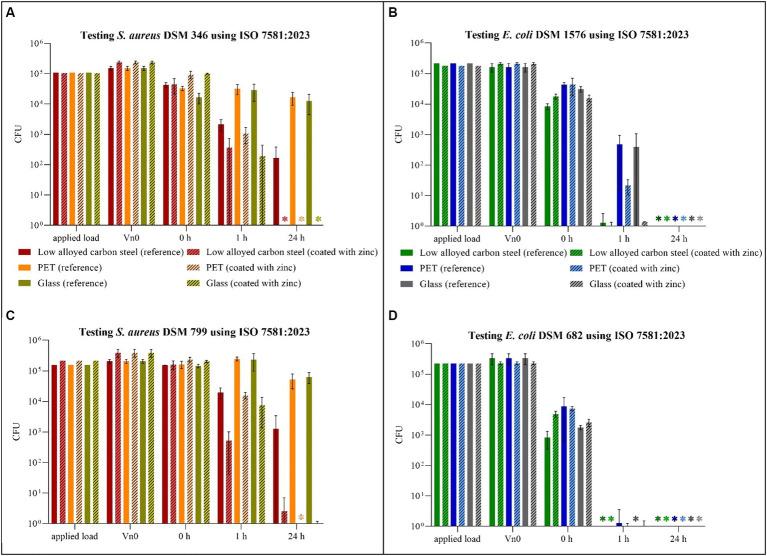
The application of antimicrobial surfaces requires the proof of their effectivity by methods in laboratories. One of the most well-known test methods is ISO 22196:2011, which represents a simple and inexpensive protocol by applying the bacterial suspension with known volume and concentration covered under a polyethylene film on the surfaces. The incubation is then done under defined humidity conditions for 24 h. Another approach for testing of non-porous surfaces is the newly published ISO 7581:2023. A "dry test" is achieved through spreading and drying 1 μL of a bacterial suspension on the surface. In this study, low alloyed carbon steel, polyethylene terephthalate (PET), and glass specimens were tested uncoated (reference) and coated with zinc according to both ISOs to compare and to evaluate the advantages and disadvantages of each one of them. Although ISO 7581:2023 allows a more realistic test environment than ISO 22196:2011, the reproducibility of the results is not given due to the low application volume. In addition, not all bacterial strains are equally suitable for this testing type. Individual adaptations to the protocols, including incubation conditions (time, temperature, or relative humidity), testing strains and volume, seem necessary to generate conditions that simulate the final application. Nevertheless, both ISOs, if used correctly, provide a good basis for estimating the antimicrobial efficacy of non-porous surfaces.
抗菌表面的应用需要通过实验室方法来证明其有效性。最著名的测试方法之一是ISO 22196:2011,它是一种简单且成本低廉的方案,即将已知体积和浓度的细菌悬液覆盖在聚乙烯薄膜下涂覆于表面。然后在规定的湿度条件下孵育24小时。另一种用于测试无孔表面的方法是新发布的ISO 7581:2023。“干式测试”是通过将1μL细菌悬液铺展并干燥在表面上来实现的。在本研究中,对低合金碳钢、聚对苯二甲酸乙二酯(PET)和玻璃试样进行了未涂层(参考)和按照这两种ISO标准涂覆锌的测试,以比较和评估它们各自的优缺点。尽管ISO 7581:2023比ISO 22196:2011允许更真实的测试环境,但由于涂覆量低,结果的可重复性未得到保证。此外,并非所有细菌菌株都同样适用于这种测试类型。为了生成模拟最终应用的条件,似乎有必要对方案进行个别调整,包括孵育条件(时间、温度或相对湿度)、测试菌株和涂覆量。然而,如果正确使用,这两种ISO标准都为评估无孔表面的抗菌效果提供了良好的基础。


 Zotero 插件