
早期给予地塞米松对无急性低氧性呼吸衰竭的新型冠状病毒肺炎患者及急性呼吸窘迫综合征发生风险的影响:EARLY-DEX新型冠状病毒肺炎试验
Effect of early administration of dexamethasone in patients with COVID-19 pneumonia without acute hypoxemic respiratory failure and risk of development of acute respiratory distress syndrome: EARLY-DEX COVID-19 trial.
作者信息
Franco-Moreno Anabel, Acedo-Gutiérrez María Soledad, Casado-Suela Miguel Ángel, Labrador-San Martín Nicolás, de Carranza-López María, Ibáñez-Estéllez Fátima, Hernández-Blanco Clara, Jiménez-Torres José, Vallejo-Maroto Ignacio, Romero-Pareja Rodolfo, Peña-Lillo Gabriela, Escobar-Rodríguez Ismael, Torres-Macho Juan
机构信息
Internal Medicine Department, Hospital Universitario Infanta Leonor-Virgen de la Torre, Madrid, Spain.
Internal Medicine Department, Hospital Universitario Puerta de Hierro, Madrid, Spain.
出版信息
Front Med (Lausanne). 2024 Jul 17;11:1385833. doi: 10.3389/fmed.2024.1385833. eCollection 2024.
INTRODUCTION AND OBJECTIVES
Corticosteroids are among the drugs demonstrating a mortality benefit for coronavirus disease 2019 (COVID-19). The RECOVERY trial highlighted that dexamethasone reduced 28-day mortality for hospitalized COVID-19 patients requiring either supplemental oxygen or mechanical ventilation. It is noted that approximately 30% of COVID-19 patients, initially presenting with mild symptoms, will advance to acute respiratory distress syndrome (ARDS), especially those with detectable laboratory markers of inflammation indicative of disease progression. Our research aimed to explore the efficacy of dexamethasone in preventing the progression to ARDS in patients hospitalized with COVID-19 pneumonia who do not yet require additional oxygen but are at high risk of developing ARDS, potentially leading to a reduction in morbimortality.
METHODS
In this multicenter, randomized, controlled trial, we evaluated the impact of dexamethasone on adult patients diagnosed with COVID-19 pneumonia who did not need supplementary oxygen at admission but were identified as having risk factors for ARDS. The risk of ARDS was determined based on specific criteria: elevated lactate dehydrogenase levels over 245 U/L, C-reactive protein levels exceeding 100 mg/L, and a lymphocyte count below 0.80 × 10/L. Participants were randomly allocated to either receive dexamethasone or the standard care. The primary endpoints included the incidence of moderate or severe ARDS and all-cause mortality within 30 days post-enrollment.
RESULTS
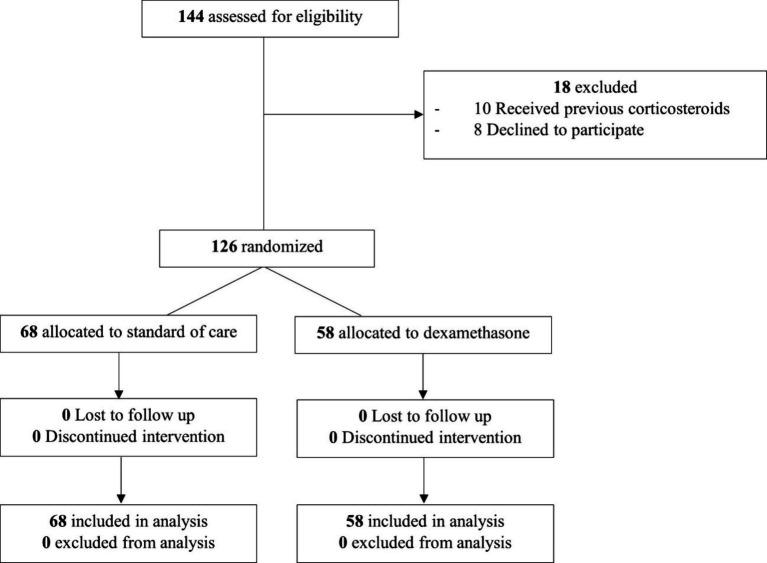
One hundred twenty-six patients were randomized. Among them, 41 were female (30.8%), with a mean age of 48.8 ± 14.4 years. Ten patients in the dexamethasone group (17.2%) and ten patients in the control group (14.7%) developed moderate ARDS with no significant differences. Mechanical ventilation was required in six patients (4.7%), with four in the treatment group and two in the control group. There were no deaths during hospitalization or during follow-up. An intermediate analysis for futility showed some differences between the control and treatment groups (Z = 0.0284). However, these findings were within the margins close to the region where the null hypothesis would not be rejected.
CONCLUSION
In patients with COVID-19 pneumonia without oxygen needs but at risk of progressing to severe disease, early dexamethasone administration did not lead to a decrease in ARDS development.
CLINICAL TRIAL REGISTRATION
ClinicalTrials.gov, identifier NCT04836780.
引言与目的
皮质类固醇是对2019冠状病毒病(COVID-19)显示出有降低死亡率益处的药物之一。RECOVERY试验强调,地塞米松降低了需要补充氧气或机械通气的住院COVID-19患者的28天死亡率。值得注意的是,约30%最初表现为轻度症状的COVID-19患者会进展为急性呼吸窘迫综合征(ARDS),尤其是那些具有可检测到的炎症实验室指标表明疾病进展的患者。我们的研究旨在探讨地塞米松在预防尚未需要额外氧气但有发生ARDS高风险的COVID-19肺炎住院患者进展为ARDS方面的疗效,这可能会降低病死率。
方法
在这项多中心、随机、对照试验中,我们评估了地塞米松对确诊为COVID-19肺炎、入院时不需要补充氧气但被确定有ARDS风险因素的成年患者的影响。ARDS风险根据特定标准确定:乳酸脱氢酶水平超过245 U/L、C反应蛋白水平超过100 mg/L以及淋巴细胞计数低于0.80×10⁹/L。参与者被随机分配接受地塞米松或标准治疗。主要终点包括中度或重度ARDS的发生率以及入组后30天内的全因死亡率。
结果
126例患者被随机分组。其中,41例为女性(30.8%),平均年龄为48.8±14.4岁。地塞米松组有10例患者(17.2%)发生中度ARDS,对照组有10例患者(14.7%)发生中度ARDS,差异无统计学意义。6例患者(4.7%)需要机械通气,治疗组4例,对照组2例。住院期间或随访期间均无死亡。无效性中期分析显示对照组和治疗组之间存在一些差异(Z = 0.0284)。然而,这些发现处于接近不拒绝零假设的区域范围内。
结论
在无氧气需求但有进展为重症疾病风险的COVID-19肺炎患者中,早期给予地塞米松并未导致ARDS发生率降低。
临床试验注册
ClinicalTrials.gov,标识符NCT04836780。

 Zotero 插件