
巨噬细胞可塑性:信号通路、组织修复与再生
Macrophage plasticity: signaling pathways, tissue repair, and regeneration.
作者信息
Yan Lingfeng, Wang Jue, Cai Xin, Liou Yih-Cherng, Shen Han-Ming, Hao Jianlei, Huang Canhua, Luo Gaoxing, He Weifeng
机构信息
Institute of Burn Research State Key Laboratory of Trauma and Chemical Poisoning the First Affiliated Hospital of Army Medical University (the Third Military Medical University) Chongqing China.
Chongqing Key Laboratory for Wound Damage Repair and Regeneration Chongqing China.
出版信息
MedComm (2020). 2024 Aug 1;5(8):e658. doi: 10.1002/mco2.658. eCollection 2024 Aug.
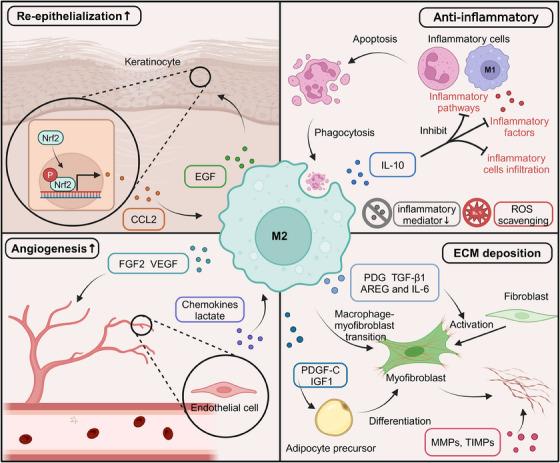
Macrophages are versatile immune cells with remarkable plasticity, enabling them to adapt to diverse tissue microenvironments and perform various functions. Traditionally categorized into classically activated (M1) and alternatively activated (M2) phenotypes, recent advances have revealed a spectrum of macrophage activation states that extend beyond this dichotomy. The complex interplay of signaling pathways, transcriptional regulators, and epigenetic modifications orchestrates macrophage polarization, allowing them to respond to various stimuli dynamically. Here, we provide a comprehensive overview of the signaling cascades governing macrophage plasticity, focusing on the roles of Toll-like receptors, signal transducer and activator of transcription proteins, nuclear receptors, and microRNAs. We also discuss the emerging concepts of macrophage metabolic reprogramming and trained immunity, contributing to their functional adaptability. Macrophage plasticity plays a pivotal role in tissue repair and regeneration, with macrophages coordinating inflammation, angiogenesis, and matrix remodeling to restore tissue homeostasis. By harnessing the potential of macrophage plasticity, novel therapeutic strategies targeting macrophage polarization could be developed for various diseases, including chronic wounds, fibrotic disorders, and inflammatory conditions. Ultimately, a deeper understanding of the molecular mechanisms underpinning macrophage plasticity will pave the way for innovative regenerative medicine and tissue engineering approaches.
巨噬细胞是具有显著可塑性的多功能免疫细胞,使其能够适应多种组织微环境并执行各种功能。传统上分为经典活化(M1)和替代活化(M2)表型,最近的进展揭示了一系列超出这种二分法的巨噬细胞活化状态。信号通路、转录调节因子和表观遗传修饰之间的复杂相互作用协调巨噬细胞极化,使其能够动态响应各种刺激。在这里,我们全面概述了控制巨噬细胞可塑性的信号级联反应,重点关注Toll样受体、信号转导和转录激活蛋白、核受体和微小RNA的作用。我们还讨论了巨噬细胞代谢重编程和训练免疫的新兴概念,这有助于它们的功能适应性。巨噬细胞可塑性在组织修复和再生中起关键作用,巨噬细胞协调炎症、血管生成和基质重塑以恢复组织稳态。通过利用巨噬细胞可塑性的潜力,可以针对各种疾病,包括慢性伤口、纤维化疾病和炎症性疾病,开发靶向巨噬细胞极化的新型治疗策略。最终,对巨噬细胞可塑性基础分子机制的更深入理解将为创新的再生医学和组织工程方法铺平道路。



 Zotero 插件