
仿人机器人中手势的仿生学习。
Biomimetic learning of hand gestures in a humanoid robot.
作者信息
Olikkal Parthan, Pei Dingyi, Karri Bharat Kashyap, Satyanarayana Ashwin, Kakoty Nayan M, Vinjamuri Ramana
机构信息
Department of Computer Science and Electrical Engineering, Sensorimotor Control Lab, University of Maryland, Baltimore, MD, United States.
Department of Computer Systems Technology, City Tech at City University of New York, New York, NY, United States.
出版信息
Front Hum Neurosci. 2024 Jul 19;18:1391531. doi: 10.3389/fnhum.2024.1391531. eCollection 2024.
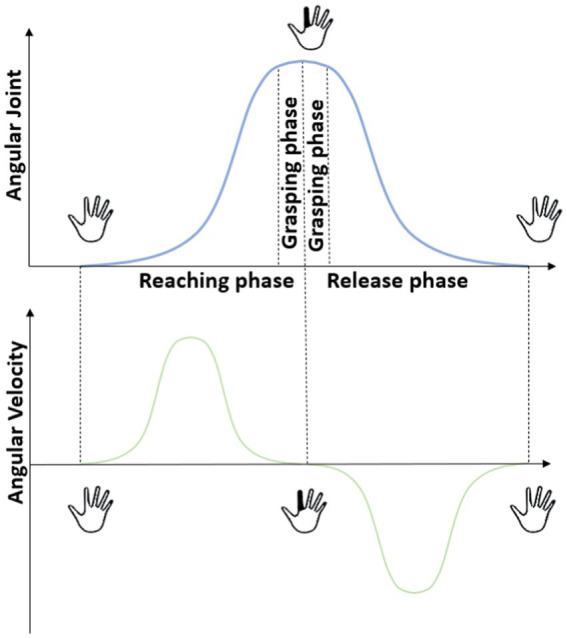
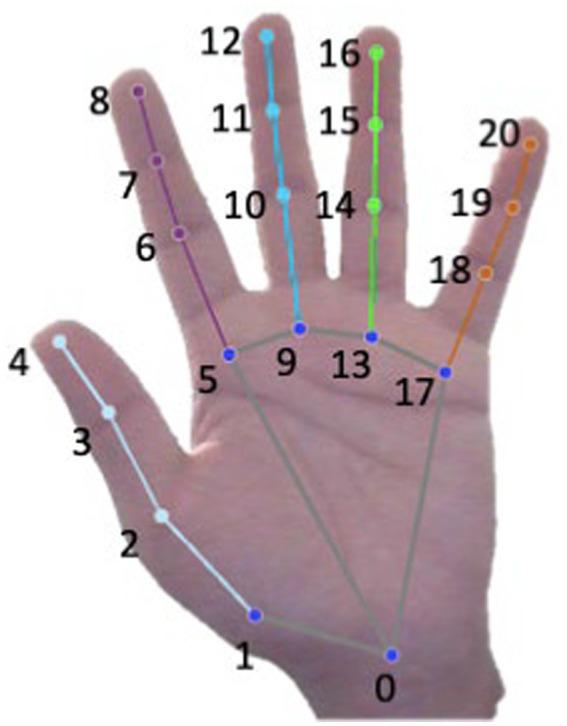
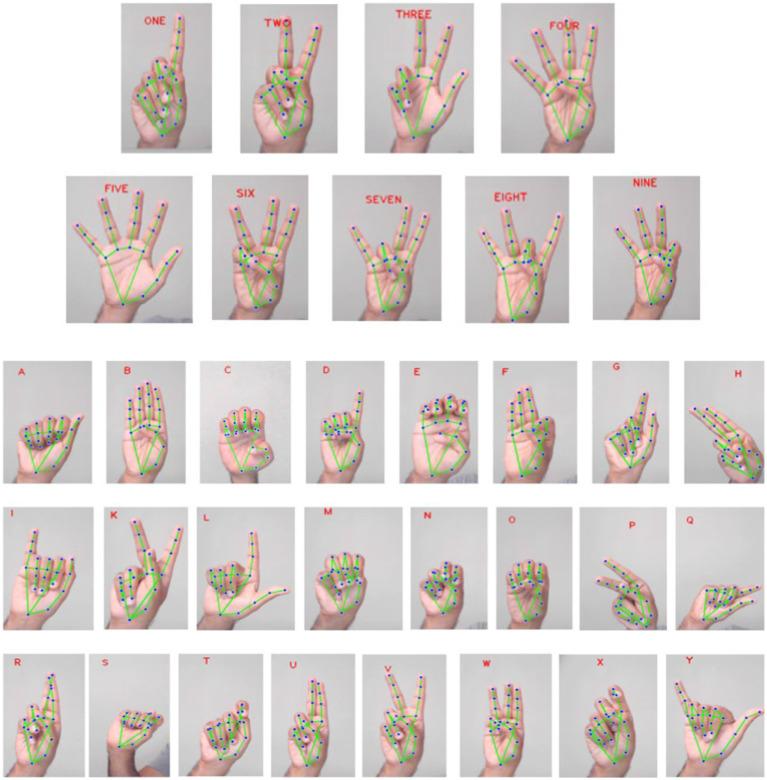
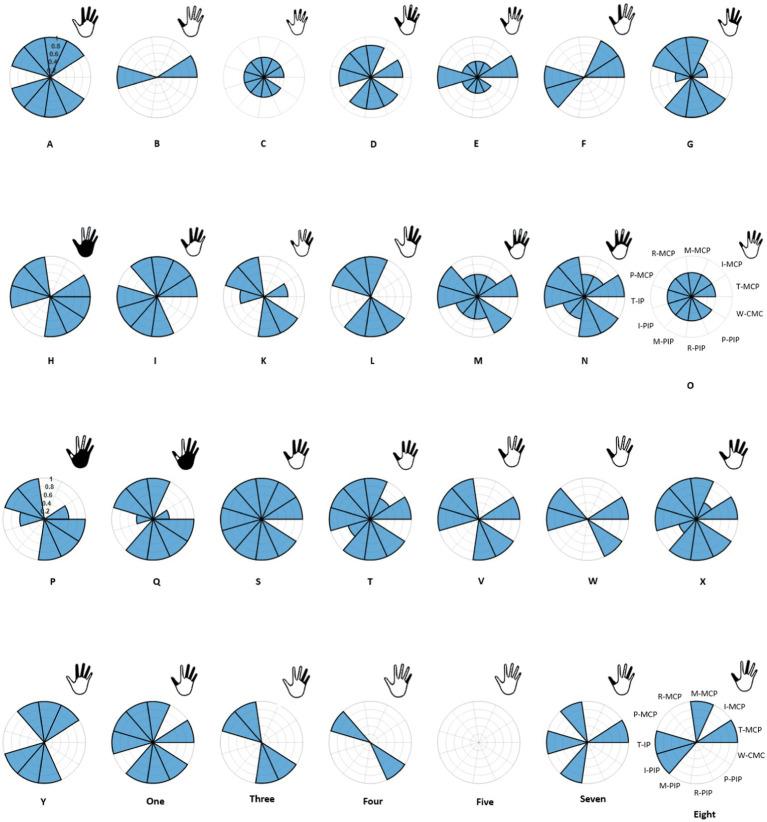
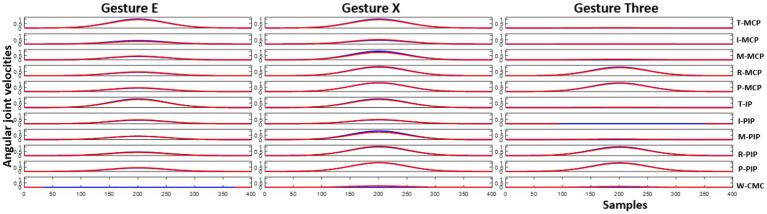
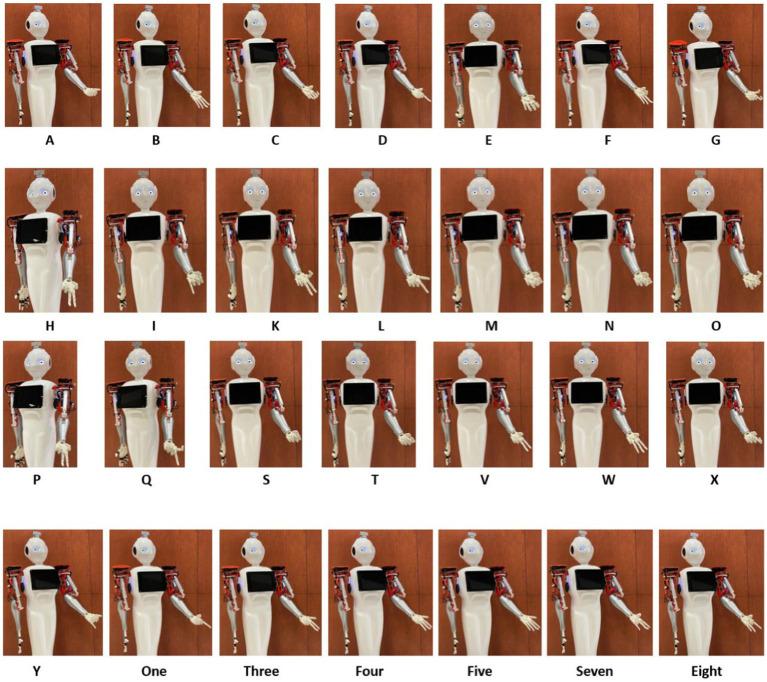
Hand gestures are a natural and intuitive form of communication, and integrating this communication method into robotic systems presents significant potential to improve human-robot collaboration. Recent advances in motor neuroscience have focused on replicating human hand movements from synergies also known as movement primitives. Synergies, fundamental building blocks of movement, serve as a potential strategy adapted by the central nervous system to generate and control movements. Identifying how synergies contribute to movement can help in dexterous control of robotics, exoskeletons, prosthetics and extend its applications to rehabilitation. In this paper, 33 static hand gestures were recorded through a single RGB camera and identified in real-time through the MediaPipe framework as participants made various postures with their dominant hand. Assuming an open palm as initial posture, uniform joint angular velocities were obtained from all these gestures. By applying a dimensionality reduction method, kinematic synergies were obtained from these joint angular velocities. Kinematic synergies that explain 98% of variance of movements were utilized to reconstruct new hand gestures using convex optimization. Reconstructed hand gestures and selected kinematic synergies were translated onto a humanoid robot, Mitra, in real-time, as the participants demonstrated various hand gestures. The results showed that by using only few kinematic synergies it is possible to generate various hand gestures, with 95.7% accuracy. Furthermore, utilizing low-dimensional synergies in control of high dimensional end effectors holds promise to enable near-natural human-robot collaboration.
手势是一种自然且直观的交流形式,将这种交流方式融入机器人系统对于改善人机协作具有巨大潜力。运动神经科学的最新进展聚焦于从协同作用(也称为运动原语)中复制人类手部动作。协同作用作为运动的基本组成部分,是中枢神经系统用来产生和控制运动的一种潜在策略。确定协同作用如何对运动产生影响有助于实现机器人、外骨骼和假肢的灵巧控制,并将其应用扩展到康复领域。在本文中,通过单个RGB摄像头记录了33种静态手势,并在参与者用优势手做出各种姿势时,通过MediaPipe框架进行实时识别。假设初始姿势为手掌张开,从所有这些手势中获得了均匀的关节角速度。通过应用降维方法,从这些关节角速度中获得了运动学协同作用。利用解释98%运动方差的运动学协同作用,通过凸优化来重建新手势。当参与者展示各种手势时,将重建的手势和选定的运动学协同作用实时映射到类人机器人Mitra上。结果表明,仅使用少数运动学协同作用就有可能生成各种手势,准确率达95.7%。此外,在高维末端执行器的控制中利用低维协同作用有望实现近乎自然的人机协作。



 Zotero 插件