
你不可能总是随心所欲地获取所需的铁元素:水稻如何应对必需营养素的过量问题。
You can't always get as much iron as you want: how rice plants deal with excess of an essential nutrient.
作者信息
Wairich Andriele, Aung May Sann, Ricachenevsky Felipe Klein, Masuda Hiroshi
机构信息
Department of Agronomy and Crop Physiology, Justus Liebig University Giessen, Giessen, Germany.
Department of Biological Production, Faculty of Bioresource Sciences, Akita Prefectural University, Akita, Japan.
出版信息
Front Plant Sci. 2024 Jul 19;15:1381856. doi: 10.3389/fpls.2024.1381856. eCollection 2024.
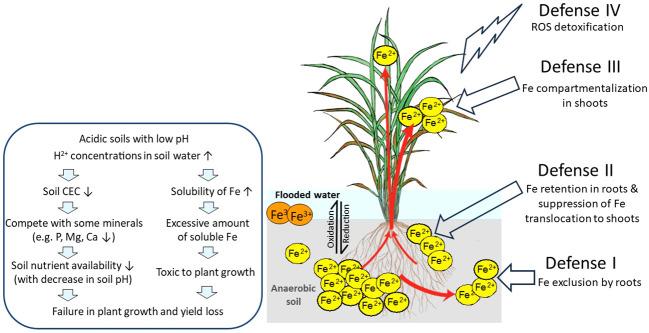
Iron (Fe) is an essential nutrient for almost all organisms. However, free Fe within cells can lead to damage to macromolecules and oxidative stress, making Fe concentrations tightly controlled. In plants, Fe deficiency is a common problem, especially in well-aerated, calcareous soils. Rice ( L.) is commonly cultivated in waterlogged soils, which are hypoxic and can cause Fe reduction from Fe to Fe, especially in low pH acidic soils, leading to high Fe availability and accumulation. Therefore, Fe excess decreases rice growth and productivity. Despite the widespread occurrence of Fe excess toxicity, we still know little about the genetic basis of how rice plants respond to Fe overload and what genes are involved in variation when comparing genotypes with different tolerance levels. Here, we review the current knowledge about physiological and molecular data on Fe excess in rice, providing a comprehensive summary of the field.
铁(Fe)是几乎所有生物体必需的营养元素。然而,细胞内的游离铁会导致大分子损伤和氧化应激,因此铁的浓度受到严格控制。在植物中,缺铁是一个常见问题,尤其是在通气良好的石灰性土壤中。水稻通常种植在淹水土壤中,这种土壤缺氧,会导致铁从Fe还原为Fe,特别是在低pH酸性土壤中,从而导致铁的有效性和积累量较高。因此,铁过量会降低水稻的生长和生产力。尽管铁过量毒性普遍存在,但我们对水稻植株如何应对铁过载的遗传基础以及在比较不同耐受水平的基因型时哪些基因参与变异仍知之甚少。在此,我们综述了当前关于水稻铁过量的生理和分子数据的知识,对该领域进行了全面总结。
 Zotero 插件