
常规实验室检测对预测 SARS-CoV-2 感染者死亡和病情恶化为重症或危重症 COVID-19 的准确性。
Accuracy of routine laboratory tests to predict mortality and deterioration to severe or critical COVID-19 in people with SARS-CoV-2.
机构信息
Department of Public Health and Primary Care, KU Leuven, Leuven, Belgium.
Department of Otorhinolaryngology and Head & Neck Surgery, University Medical Center Utrecht, Utrecht, Netherlands.
出版信息
Cochrane Database Syst Rev. 2024 Aug 6;8(8):CD015050. doi: 10.1002/14651858.CD015050.pub2.
BACKGROUND
Identifying patients with COVID-19 disease who will deteriorate can be useful to assess whether they should receive intensive care, or whether they can be treated in a less intensive way or through outpatient care. In clinical care, routine laboratory markers, such as C-reactive protein, are used to assess a person's health status.
OBJECTIVES
To assess the accuracy of routine blood-based laboratory tests to predict mortality and deterioration to severe or critical (from mild or moderate) COVID-19 in people with SARS-CoV-2.
SEARCH METHODS
On 25 August 2022, we searched the Cochrane COVID-19 Study Register, encompassing searches of various databases such as MEDLINE via PubMed, CENTRAL, Embase, medRxiv, and ClinicalTrials.gov. We did not apply any language restrictions.
SELECTION CRITERIA
We included studies of all designs that produced estimates of prognostic accuracy in participants who presented to outpatient services, or were admitted to general hospital wards with confirmed SARS-CoV-2 infection, and studies that were based on serum banks of samples from people. All routine blood-based laboratory tests performed during the first encounter were included. We included any reference standard used to define deterioration to severe or critical disease that was provided by the authors.
DATA COLLECTION AND ANALYSIS
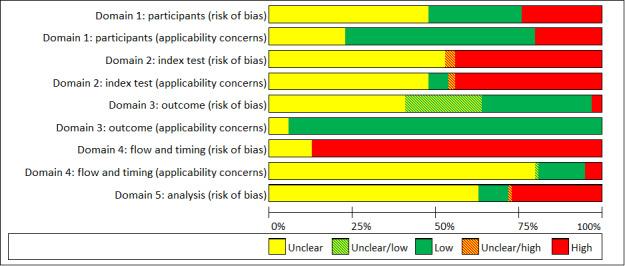
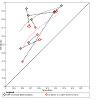
Two review authors independently extracted data from each included study, and independently assessed the methodological quality using the Quality Assessment of Prognostic Accuracy Studies tool. As studies reported different thresholds for the same test, we used the Hierarchical Summary Receiver Operator Curve model for meta-analyses to estimate summary curves in SAS 9.4. We estimated the sensitivity at points on the SROC curves that corresponded to the median and interquartile range boundaries of specificities in the included studies. Direct and indirect comparisons were exclusively conducted for biomarkers with an estimated sensitivity and 95% CI of ≥ 50% at a specificity of ≥ 50%. The relative diagnostic odds ratio was calculated as a summary of the relative accuracy of these biomarkers.
MAIN RESULTS
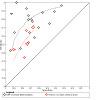
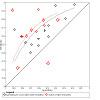
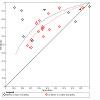
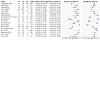
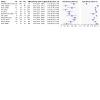
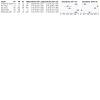
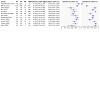
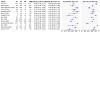
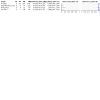
We identified a total of 64 studies, including 71,170 participants, of which 8169 participants died, and 4031 participants deteriorated to severe/critical condition. The studies assessed 53 different laboratory tests. For some tests, both increases and decreases relative to the normal range were included. There was important heterogeneity between tests and their cut-off values. None of the included studies had a low risk of bias or low concern for applicability for all domains. None of the tests included in this review demonstrated high sensitivity or specificity, or both. The five tests with summary sensitivity and specificity above 50% were: C-reactive protein increase, neutrophil-to-lymphocyte ratio increase, lymphocyte count decrease, d-dimer increase, and lactate dehydrogenase increase. Inflammation For mortality, summary sensitivity of a C-reactive protein increase was 76% (95% CI 73% to 79%) at median specificity, 59% (low-certainty evidence). For deterioration, summary sensitivity was 78% (95% CI 67% to 86%) at median specificity, 72% (very low-certainty evidence). For the combined outcome of mortality or deterioration, or both, summary sensitivity was 70% (95% CI 49% to 85%) at median specificity, 60% (very low-certainty evidence). For mortality, summary sensitivity of an increase in neutrophil-to-lymphocyte ratio was 69% (95% CI 66% to 72%) at median specificity, 63% (very low-certainty evidence). For deterioration, summary sensitivity was 75% (95% CI 59% to 87%) at median specificity, 71% (very low-certainty evidence). For mortality, summary sensitivity of a decrease in lymphocyte count was 67% (95% CI 56% to 77%) at median specificity, 61% (very low-certainty evidence). For deterioration, summary sensitivity of a decrease in lymphocyte count was 69% (95% CI 60% to 76%) at median specificity, 67% (very low-certainty evidence). For the combined outcome, summary sensitivity was 83% (95% CI 67% to 92%) at median specificity, 29% (very low-certainty evidence). For mortality, summary sensitivity of a lactate dehydrogenase increase was 82% (95% CI 66% to 91%) at median specificity, 60% (very low-certainty evidence). For deterioration, summary sensitivity of a lactate dehydrogenase increase was 79% (95% CI 76% to 82%) at median specificity, 66% (low-certainty evidence). For the combined outcome, summary sensitivity was 69% (95% CI 51% to 82%) at median specificity, 62% (very low-certainty evidence). Hypercoagulability For mortality, summary sensitivity of a d-dimer increase was 70% (95% CI 64% to 76%) at median specificity of 56% (very low-certainty evidence). For deterioration, summary sensitivity was 65% (95% CI 56% to 74%) at median specificity of 63% (very low-certainty evidence). For the combined outcome, summary sensitivity was 65% (95% CI 52% to 76%) at median specificity of 54% (very low-certainty evidence). To predict mortality, neutrophil-to-lymphocyte ratio increase had higher accuracy compared to d-dimer increase (RDOR (diagnostic Odds Ratio) 2.05, 95% CI 1.30 to 3.24), C-reactive protein increase (RDOR 2.64, 95% CI 2.09 to 3.33), and lymphocyte count decrease (RDOR 2.63, 95% CI 1.55 to 4.46). D-dimer increase had higher accuracy compared to lymphocyte count decrease (RDOR 1.49, 95% CI 1.23 to 1.80), C-reactive protein increase (RDOR 1.31, 95% CI 1.03 to 1.65), and lactate dehydrogenase increase (RDOR 1.42, 95% CI 1.05 to 1.90). Additionally, lactate dehydrogenase increase had higher accuracy compared to lymphocyte count decrease (RDOR 1.30, 95% CI 1.13 to 1.49). To predict deterioration to severe disease, C-reactive protein increase had higher accuracy compared to d-dimer increase (RDOR 1.76, 95% CI 1.25 to 2.50). The neutrophil-to-lymphocyte ratio increase had higher accuracy compared to d-dimer increase (RDOR 2.77, 95% CI 1.58 to 4.84). Lastly, lymphocyte count decrease had higher accuracy compared to d-dimer increase (RDOR 2.10, 95% CI 1.44 to 3.07) and lactate dehydrogenase increase (RDOR 2.22, 95% CI 1.52 to 3.26).
AUTHORS' CONCLUSIONS: Laboratory tests, associated with hypercoagulability and hyperinflammatory response, were better at predicting severe disease and mortality in patients with SARS-CoV-2 compared to other laboratory tests. However, to safely rule out severe disease, tests should have high sensitivity (> 90%), and none of the identified laboratory tests met this criterion. In clinical practice, a more comprehensive assessment of a patient's health status is usually required by, for example, incorporating these laboratory tests into clinical prediction rules together with clinical symptoms, radiological findings, and patient's characteristics.
背景
识别 COVID-19 疾病恶化的患者有助于评估他们是否需要接受重症监护,或者他们是否可以通过轻症治疗或门诊护理来治疗。在临床护理中,常规实验室标志物,如 C 反应蛋白,用于评估人的健康状况。
目的
评估常规基于血液的实验室检查预测 SARS-CoV-2 感染者从轻症或中度疾病恶化至重症或危重症的准确性。
检索策略
于 2022 年 8 月 25 日,我们检索了 Cochrane COVID-19 研究注册库,涵盖了对 MEDLINE 中各种数据库(如 PubMed)、CENTRAL、Embase、medRxiv 和 ClinicalTrials.gov 的检索。我们没有对语言进行任何限制。
纳入排除标准
我们纳入了所有设计的研究,这些研究在门诊服务或在因 SARS-CoV-2 感染而入住普通医院病房的患者中,对预后准确性进行了估计,并且基于血清库的样本进行了研究。纳入的所有常规基于血液的实验室检查均在首次就诊时进行。我们纳入了由作者提供的任何用于定义严重或危重症恶化的参考标准。
数据收集和分析
两位综述作者独立地从每一项纳入的研究中提取数据,并使用质量评估工具对预后准确性研究的方法学质量进行了独立评估。由于研究报告了同一测试的不同阈值,我们使用 SAS 9.4 中的分层综合接收者操作特征曲线模型进行荟萃分析,以估计汇总曲线。我们估计了在纳入研究特异性的特异性的中位数和四分位间距边界对应的 SROC 曲线上的敏感性。仅对灵敏度在特异性≥50%时≥50%的生物标志物进行直接和间接比较。相对诊断比值比是这些生物标志物相对准确性的总结。
主要结果
我们共确定了 64 项研究,共纳入了 71170 名参与者,其中 8169 名参与者死亡,4031 名参与者病情恶化至重症/危重症。这些研究评估了 53 种不同的实验室测试。对于一些测试,包括了增加和减少相对于正常范围的情况。不同的测试及其截断值之间存在重要的异质性。纳入的研究均未存在低偏倚风险或低适用性关注。在本综述中纳入的测试均未表现出高敏感性或特异性,或两者兼而有之。汇总敏感性和特异性均高于 50%的五项测试是:C 反应蛋白增加、中性粒细胞与淋巴细胞比值增加、淋巴细胞计数减少、D-二聚体增加和乳酸脱氢酶增加。炎症对死亡率,C 反应蛋白增加的汇总敏感性为 76%(95%CI 73%至 79%),特异性为 59%(低确定性证据)。对恶化的情况,汇总敏感性为 78%(95%CI 67%至 86%),特异性为 72%(非常低确定性证据)。对于死亡率或恶化,或两者均有的联合结局,汇总敏感性为 70%(95%CI 49%至 85%),特异性为 60%(非常低确定性证据)。对死亡率,中性粒细胞与淋巴细胞比值增加的汇总敏感性为 69%(95%CI 66%至 72%),特异性为 63%(非常低确定性证据)。对恶化的情况,汇总敏感性为 75%(95%CI 59%至 87%),特异性为 71%(非常低确定性证据)。对于死亡率,淋巴细胞计数减少的汇总敏感性为 67%(95%CI 56%至 77%),特异性为 61%(非常低确定性证据)。对恶化的情况,淋巴细胞计数减少的汇总敏感性为 69%(95%CI 60%至 76%),特异性为 67%(非常低确定性证据)。对于联合结局,汇总敏感性为 83%(95%CI 67%至 92%),特异性为 29%(非常低确定性证据)。对死亡率,乳酸脱氢酶增加的汇总敏感性为 82%(95%CI 66%至 91%),特异性为 60%(非常低确定性证据)。对恶化的情况,乳酸脱氢酶增加的汇总敏感性为 79%(95%CI 76%至 82%),特异性为 66%(低确定性证据)。对于联合结局,汇总敏感性为 69%(95%CI 51%至 82%),特异性为 62%(非常低确定性证据)。高凝状态对死亡率,D-二聚体增加的汇总敏感性为 70%(95%CI 64%至 76%),特异性为 56%(非常低确定性证据)。对恶化的情况,汇总敏感性为 65%(95%CI 56%至 74%),特异性为 63%(非常低确定性证据)。对于联合结局,汇总敏感性为 65%(95%CI 52%至 76%),特异性为 54%(非常低确定性证据)。为了预测死亡率,中性粒细胞与淋巴细胞比值增加的准确性高于 D-二聚体增加(诊断比值比(RDOR)2.05,95%CI 1.30 至 3.24),C 反应蛋白增加(RDOR 2.64,95%CI 2.09 至 3.33)和淋巴细胞计数减少(RDOR 2.63,95%CI 1.55 至 4.46)。D-二聚体增加的准确性高于淋巴细胞计数减少(RDOR 1.49,95%CI 1.23 至 1.80),C 反应蛋白增加(RDOR 1.31,95%CI 1.03 至 1.65)和乳酸脱氢酶增加(RDOR 1.42,95%CI 1.05 至 1.90)。此外,乳酸脱氢酶增加的准确性高于淋巴细胞计数减少(RDOR 1.30,95%CI 1.13 至 1.49)。为了预测严重疾病的恶化,C 反应蛋白增加的准确性高于 D-二聚体增加(RDOR 1.76,95%CI 1.25 至 2.50)。中性粒细胞与淋巴细胞比值增加的准确性高于 D-二聚体增加(RDOR 2.77,95%CI 1.58 至 4.84)。最后,淋巴细胞计数减少的准确性高于 D-二聚体增加(RDOR 2.10,95%CI 1.44 至 3.07)和乳酸脱氢酶增加(RDOR 2.22,95%CI 1.52 至 3.26)。
作者结论
与 SARS-CoV-2 相比,与高凝状态和高炎症反应相关的实验室检测在预测严重疾病和死亡率方面优于其他实验室检测。然而,为了安全地排除严重疾病,检测应具有高灵敏度(>90%),而本研究中确定的任何实验室检测均未达到这一标准。在临床实践中,通常需要更全面地评估患者的健康状况,例如,将这些实验室检测纳入临床预测规则中,同时结合临床症状、影像学发现和患者特征。





























 Zotero 插件