
神经调节蛋白1-表皮生长因子受体4信号通路紊乱:产前吗啡暴露对大鼠幼崽的影响及神经损伤的分子途径。
Disrupted neuregulin 1-ErbB4 signaling: Consequences of prenatal morphine exposure in rat pups and molecular gateway to neurological impairment.
作者信息
Khayat Samira, Fanaei Hamed, Hafezinouri Hamid, Ghanbarzehi Abdolhakim, Parsi-Moud Abolfazl, Mirzaei Ilia
机构信息
Pregnancy Health Research Center, Zahedan University of Medical Sciences, Zahedan, Iran.
Department of Midwifery, School of Nursing and Midwifery, Zahedan University of Medical Sciences, Zahedan, Iran.
出版信息
Toxicol Rep. 2024 Jul 8;13:101687. doi: 10.1016/j.toxrep.2024.101687. eCollection 2024 Dec.
OBJECTIVE
Morphine exposure during pregnancy has detrimental effects on both the mother and her offspring, both during and after childbirth. This study aimed to investigate the impact of prenatal morphine exposure on rat pups and dams, specifically focusing on changes in Neuregulin-1 (Nrg-1)/ErbB4 gene expression, inflammation, and brain-derived neurotrophic factor (BDNF) levels.
MATERIALS AND METHODS
Twenty female rats were randomized into two experimental groups:1-Morphine Group: Dams received morphine throughout pregnancy. 2-Control Group: Dams received no interventions.At the end of gestation, blood samples were collected from the dams. Subsequently, dams and their pups underwent tissue collection from the cortical area of the brain to evaluate the following parameters: Interleukin-6 (IL-6), Interleukin-10 (IL-10), total antioxidant capacity (TAC), Malondialdehyde (MDA), and Brain-derived neurotrophic factor (BDNF).Additionally, RNA was extracted from the pup's cortical brain tissue for the assessment of gene expression levels of Neuregulin-1 (NRG-1) and ErbB-4 using quantitative real-time polymerase chain reaction (qrt-PCR).
RESULTS
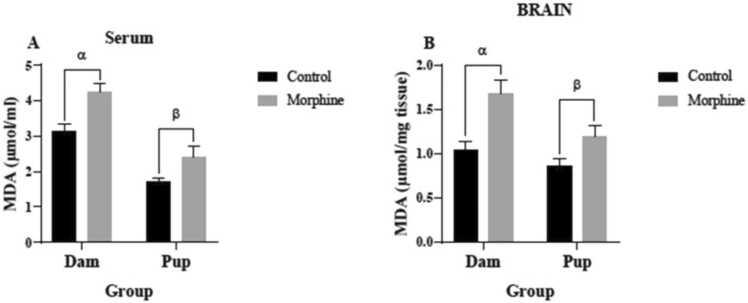
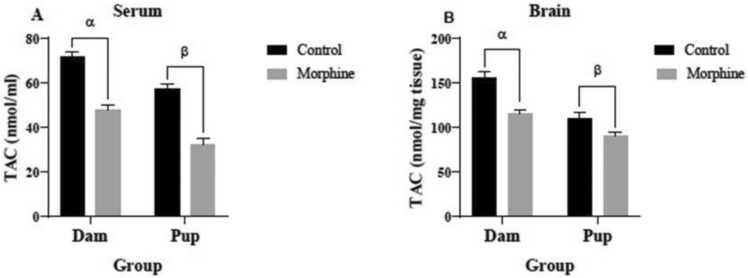
The molecular investigation revealed a decrease in NRG-1 and ErbB-4 expressions in the brain cortex of offspring exposed to morphine during prenatal development. Additionally, the levels of IL-6 and IL-10 in both the serum and brain of both the mothers and their offspring in the morphine group were significantly higher compared to the control group. The morphine-exposed group also exhibited significantly lower levels of TAC and higher levels of MDA, indicating increased oxidative stress. Furthermore, the levels of BDNF in the morphine group were significantly lower compared to the control group.
CONCLUSION
Prenatal morphine exposure in rats has detrimental effects on both the dams and their offspring. This study demonstrates that prenatal morphine exposure disrupts critical molecular pathways involved in neurodevelopment, inflammation, oxidative stress, and neurotrophic signaling. These findings suggest that prenatal morphine exposure can have long-lasting consequences for the offspring, potentially contributing to neurodevelopmental disorders and other health issues later in life.
目的
孕期接触吗啡对母亲及其后代在分娩期间及之后均有不利影响。本研究旨在调查产前接触吗啡对大鼠幼崽和母鼠的影响,特别关注神经调节蛋白-1(Nrg-1)/表皮生长因子受体4(ErbB4)基因表达、炎症和脑源性神经营养因子(BDNF)水平的变化。
材料与方法
将20只雌性大鼠随机分为两个实验组:1-吗啡组:母鼠在整个孕期接受吗啡。2-对照组:母鼠不接受任何干预。在妊娠末期,采集母鼠的血液样本。随后,对母鼠及其幼崽进行脑组织皮质区域的组织采集,以评估以下参数:白细胞介素-6(IL-6)、白细胞介素-10(IL-10)、总抗氧化能力(TAC)、丙二醛(MDA)和脑源性神经营养因子(BDNF)。此外,从幼崽的皮质脑组织中提取RNA,使用定量实时聚合酶链反应(qrt-PCR)评估神经调节蛋白-1(NRG-1)和表皮生长因子受体4(ErbB-4)的基因表达水平。
结果
分子研究显示,产前发育期间接触吗啡的后代大脑皮质中NRG-1和ErbB-4的表达降低。此外,与对照组相比,吗啡组母鼠及其后代血清和大脑中的IL-6和IL-10水平显著更高。接触吗啡的组还表现出TAC水平显著降低和MDA水平升高,表明氧化应激增加。此外,与对照组相比,吗啡组的BDNF水平显著更低。
结论
大鼠产前接触吗啡对母鼠及其后代均有不利影响。本研究表明,产前接触吗啡会破坏参与神经发育、炎症、氧化应激和神经营养信号传导的关键分子途径。这些发现表明,产前接触吗啡可能会对后代产生长期影响,可能导致神经发育障碍和生命后期的其他健康问题。


 Zotero 插件