
基于低强度治疗的新诊断 AML 老年患者的 Beat-AML 2024 ELN 精细化风险分层。
Beat-AML 2024 ELN-refined risk stratification for older adults with newly diagnosed AML given lower-intensity therapy.
机构信息
Department of Internal Medicine, University of Texas Southwestern Medical Center, Dallas, TX.
Department of Hematology and Medical Oncology, Winship Cancer Institute of Emory University, Atlanta, GA.
出版信息
Blood Adv. 2024 Oct 22;8(20):5297-5305. doi: 10.1182/bloodadvances.2024013685.
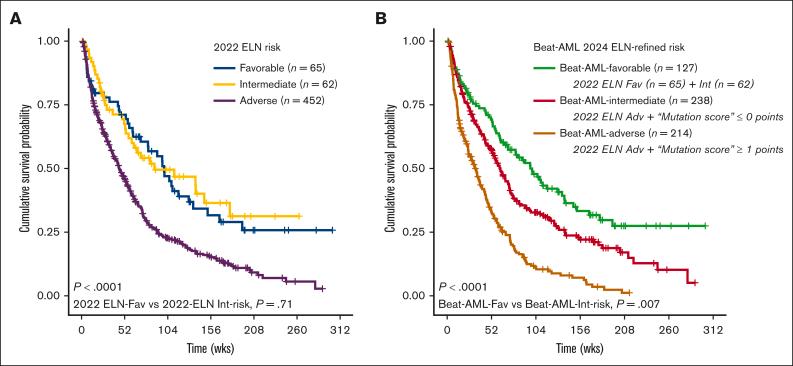
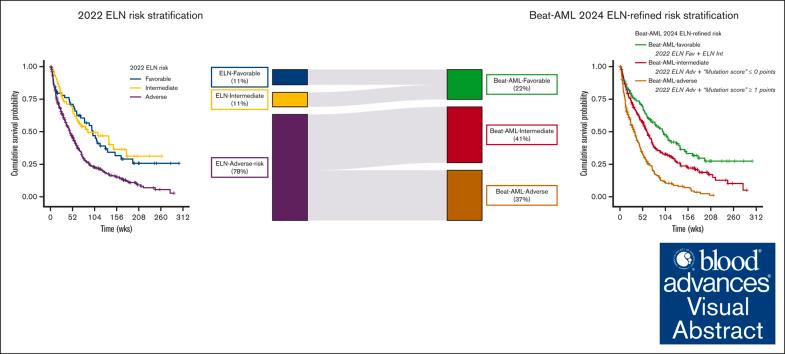
Although the 2022 European LeukemiaNet (ELN) acute myeloid leukemia (AML) risk classification reliably predicts outcomes in younger patients treated with intensive chemotherapy, it is unclear whether it applies to adults ≥60 years treated with lower-intensity treatment (LIT). We aimed to test the prognostic impact of ELN risk in patients with newly diagnosed (ND) AML aged ≥60 years given LIT and to further refine risk stratification for these patients. A total of 595 patients were included: 11% had favorable-, 11% intermediate-, and 78% had adverse-risk AML. ELN risk was prognostic for overall survival (OS) (P < .001) but did not stratify favorable- from intermediate-risk (P = .71). Within adverse-risk AML, the impact of additional molecular abnormalities was further evaluated. Multivariable analysis was performed on a training set (n = 316) and identified IDH2 mutation as an independent favorable prognostic factor, and KRAS, MLL2, and TP53 mutations as unfavorable (P < .05). A "mutation score" was calculated for each combination of these mutations, assigning adverse-risk patients to 2 risk groups: -1 to 0 points ("Beat-AML intermediate") vs 1+ points ("Beat-AML adverse"). In the final refined risk classification, ELN favorable- and intermediate-risk were combined into a newly defined "Beat-AML favorable-risk" group, in addition to mutation scoring within the ELN adverse-risk group. This approach redefines risk for older patients with ND AML and proposes refined Beat-AML risk groups with improved discrimination for OS (2-year OS, 48% vs 33% vs 11%, respectively; P < .001), providing patients and providers additional information for treatment decision-making.
虽然 2022 年欧洲白血病网络(ELN)急性髓系白血病(AML)风险分类能够可靠地预测接受强化化疗的年轻患者的结局,但尚不清楚其是否适用于接受低强度治疗(LIT)的年龄≥60 岁的成人。我们旨在检验 ELN 风险对接受 LIT 治疗的新诊断(ND)AML 年龄≥60 岁患者的预后影响,并进一步完善这些患者的风险分层。共纳入 595 例患者:11%为低危型、11%为中危型、78%为高危型 AML。ELN 风险与总生存期(OS)相关(P<0.001),但不能区分低危型与中危型(P=0.71)。在高危型 AML 中,进一步评估了其他分子异常的影响。在训练集(n=316)上进行了多变量分析,发现 IDH2 突变是独立的有利预后因素,KRAS、MLL2 和 TP53 突变是不利因素(P<0.05)。计算了这些突变的每种组合的“突变评分”,将具有这些突变的高危型患者分为 2 个风险组:-1 至 0 分(“Beat-AML 中危”)与 1+分(“Beat-AML 高危”)。在最终的改良风险分类中,将 ELN 低危型和中危型合并为新定义的“Beat-AML 低危”组,除了在 ELN 高危型中进行突变评分。这种方法重新定义了年龄较大的 ND AML 患者的风险,并提出了改良的 Beat-AML 风险组,改善了 OS 的区分度(2 年 OS 分别为 48%、33%和 11%;P<0.001),为患者和治疗医生提供了更多的治疗决策信息。


 Zotero 插件