
重新审视不稳定残疾与衰弱的波动:一种测量爆发方法。
Revisiting unstable disability and the fluctuations of frailty: a measurement burst approach.
作者信息
Stolz Erwin, Schultz Anna, Mayerl Hannes, Roller-Wirnsberger Regina, Andrew Clegg
机构信息
Institute of Social Medicine and Epidemiology, Medical University of Graz, Graz, Austria.
Department of Internal Medicine, Medical University of Graz, Graz, Austria.
出版信息
Age Ageing. 2024 Aug 6;53(8). doi: 10.1093/ageing/afae170.
BACKGROUND
It has been hypothesised that frailty is the root cause of clinically observed but rarely systematically measured unstable disability among older adults. In this study, we measure the extent of short-term disability fluctuations and estimate their association with frailty using intensive longitudinal data.
METHODS
Repeated measurements of disability were collected under a measurement burst design in the FRequent health Assessment In Later life (FRAIL70+) study. A total of 426 community-dwelling older adults (70+) in Austria were interviewed about difficulties with basic, instrumental and mobility-related activities of daily living biweekly up to a total of 14 times in two measurement bursts (2891 and 2192 observations). Baseline frailty was assessed with both physical frailty (FP) and the frailty index (FI). Disability fluctuations were measured with the intra-individual interquartile range (iIQR) and estimated with a two-step generalised mixed regression procedure.
RESULTS
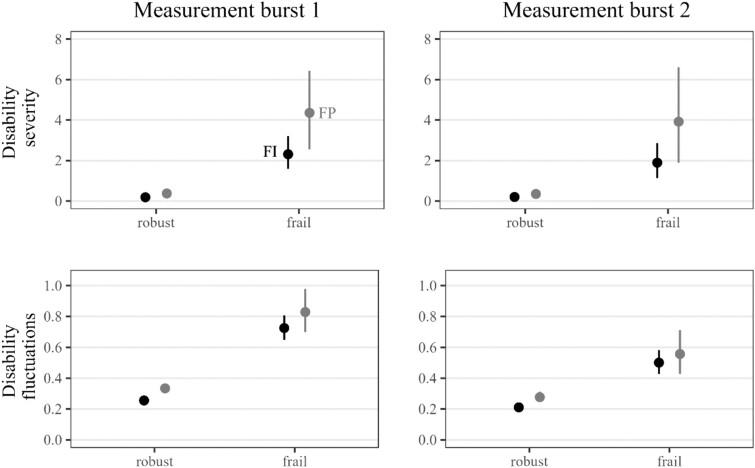
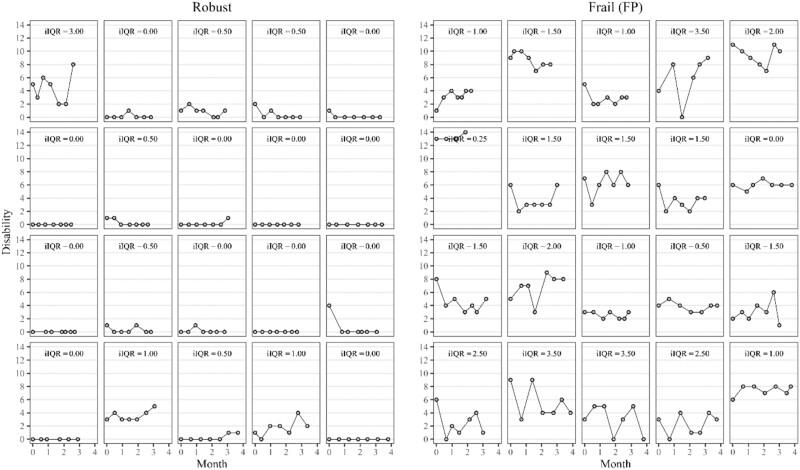
Fewer participants were frail at baseline according to FP (11%) than FI (32%). Frail study participants reported not only more severe disability but also had more short-term disability fluctuations (iIQR = 1.0-1.5) compared with their robust counterparts (iIQR = 0). Regression models indicated that baseline frailty was associated with 2-3 times larger short-term disability fluctuations, which were also more prevalent among women, and increased with age and disability severity.
CONCLUSION
Compared with those who were robust, frail older adults were characterised by not only more severe but also more unstable disability. Short-term disability fluctuations are closely tied to disability severity. Future studies should assess both stressors that may cause disability fluctuations among frail older adults as well as their potential consequences to inform frailty-centred care.
背景
有假设认为,衰弱是老年人临床观察到但很少系统测量的不稳定残疾的根本原因。在本研究中,我们使用密集纵向数据测量短期残疾波动的程度,并估计其与衰弱的关联。
方法
在“晚年频繁健康评估(FRAIL70+)”研究中,采用测量突发设计收集残疾的重复测量数据。对奥地利426名社区居住的老年人(70岁以上)进行了访谈,询问他们在基本、工具性和与移动相关的日常生活活动方面的困难,每两周进行一次,在两个测量周期中共进行14次(2891次和2192次观察)。通过身体衰弱(FP)和衰弱指数(FI)评估基线衰弱情况。用个体内四分位距(iIQR)测量残疾波动,并通过两步广义混合回归程序进行估计。
结果
根据FP,基线时衰弱的参与者(11%)少于根据FI的参与者(32%)。与健康的参与者相比,衰弱的研究参与者不仅报告了更严重的残疾,而且短期残疾波动更大(iIQR = 1.0 - 1.5),而健康参与者的iIQR为0。回归模型表明,基线衰弱与短期残疾波动大2至3倍相关,这种波动在女性中也更普遍,并且随着年龄和残疾严重程度的增加而增加。
结论
与健康的老年人相比,衰弱的老年人不仅残疾更严重,而且更不稳定。短期残疾波动与残疾严重程度密切相关。未来的研究应评估可能导致衰弱老年人残疾波动的应激源及其潜在后果,以为以衰弱为中心的护理提供信息。
 Zotero 插件