
基于磺胺的嘧啶衍生物作为抗疟药,通过抑制疟原虫蛋白酶-2和疟原虫蛋白酶-3来对抗寄生虫。
Sulfonamide based pyrimidine derivatives combating parasite by inhibiting falcipains-2 and falcipains-3 as antimalarial agents.
作者信息
Rahman Abdur, Anjum Shazia, Bhatt Jaimin D, Dixit Bharat C, Singh Anju, Khan Sabiha, Fatima Sadaf, Patel Tarosh S, Hoda Nasimul
机构信息
Drug Design and Synthesis Lab., Department of Chemistry Jamia Millia Islamia, Jamia Nagar New Delhi 110025 India
Chemistry Department, V. P. & R. P. T. P Science College, Affiliated to Sardar Patel University Vallabh Vidyanagar 388120 Gujarat India
出版信息
RSC Adv. 2024 Aug 7;14(34):24725-24740. doi: 10.1039/d4ra04370g. eCollection 2024 Aug 5.
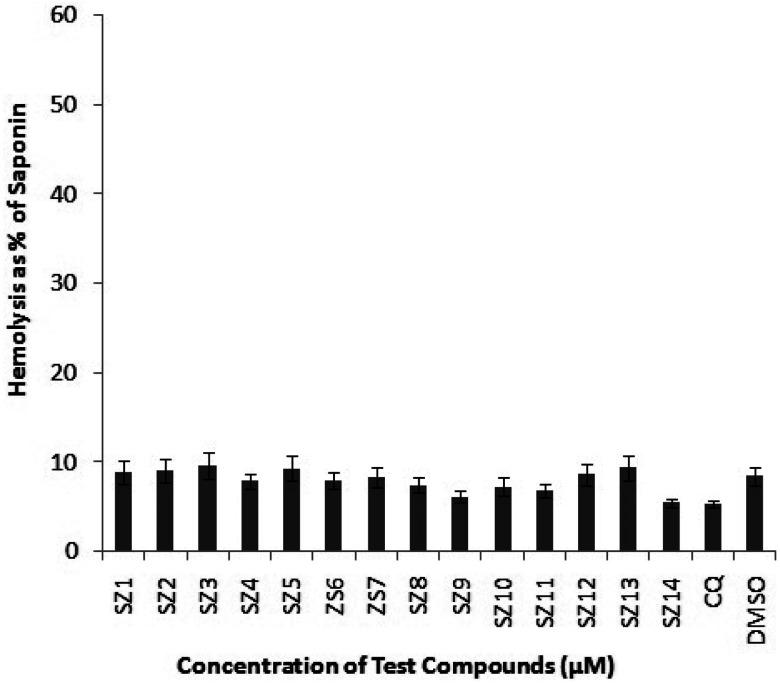
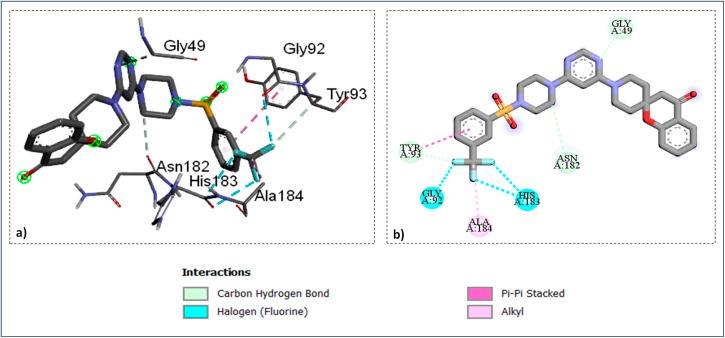
In this report, we present the design and synthesis of a novel series of pyrimidine-tethered spirochromane-based sulfonamide derivatives aimed at combating drug resistance in malaria. The antimalarial effectiveness of these compounds was assessed . Structural validation of the synthesized compounds was conducted using mass spectrometry and NMR spectroscopy. Strong antimalarial activity against CQ-sensitive (3D7) and CQ-resistant (W2) strains of was demonstrated by the majority of the compounds. Notably, compounds SZ14 and SZ9 demonstrated particularly potent effects, with compound SZ14 showing IC values of 2.84 μM and SZ9 3.22 μM, indicating single-digit micromolar activity. The compounds exhibiting strong antimalarial activity were assessed through enzymatic tests against the cysteine protease enzymes of , falcipain-2 and falcipain-3. The results indicated that SZ14 and SZ9 inhibited FP-2 (IC values: 4.1 and 5.4 μM, respectively), and FP-3 (IC values: 4.9 and 6.3 μM, respectively). To confirm the compounds' specificity towards the parasite, we investigated their cytotoxicity against Vero cell lines, revealing strong selectivity indices and no significant cytotoxic effects. Additionally, hemolysis testing showed these compounds to be non-toxic to normal human blood cells. Moreover, predicted ADME parameters and physiochemical characteristics demonstrated the drug-likeness of the synthetic compounds. These collective findings suggest that sulfonamide derivatives based on pyrimidine-tethered oxospirochromane could serve as templates for the future development of potential antimalarial drugs.
在本报告中,我们展示了一系列新型嘧啶连接的螺色满基磺酰胺衍生物的设计与合成,旨在对抗疟疾中的耐药性。评估了这些化合物的抗疟效果。使用质谱和核磁共振光谱对合成化合物进行了结构验证。大多数化合物对氯喹敏感(3D7)和氯喹耐药(W2)的疟原虫菌株表现出强大的抗疟活性。值得注意的是,化合物SZ14和SZ9表现出特别强效的效果,化合物SZ14的IC值为2.84 μM,SZ9为3.22 μM,表明具有个位数微摩尔活性。通过针对疟原虫半胱氨酸蛋白酶、恶性疟原虫蛋白酶-2和恶性疟原虫蛋白酶-3的酶促试验,对表现出强大抗疟活性的化合物进行了评估。结果表明,SZ14和SZ9分别抑制FP-2(IC值:4.1和5.4 μM)和FP-3(IC值:4.9和6.3 μM)。为了确认这些化合物对寄生虫的特异性,我们研究了它们对Vero细胞系的细胞毒性,结果显示出强大的选择性指数且无明显细胞毒性作用。此外,溶血试验表明这些化合物对正常人类血细胞无毒。此外,预测的ADME参数和理化特性证明了合成化合物的类药性。这些综合研究结果表明,基于嘧啶连接的氧杂螺色满的磺酰胺衍生物可作为未来开发潜在抗疟药物的模板。



 Zotero 插件