
代谢功能障碍相关脂肪性肝病及酒精摄入增加的代谢功能障碍相关脂肪性肝病会增加肝细胞癌和新发或失代偿期肝硬化的发生风险:一项韩国全国性研究
Metabolic Dysfunction-Associated Steatotic Liver Disease and Metabolic Dysfunction-Associated Steatotic Liver Disease with Increased Alcohol Intake Increase the Risk of Developing Hepatocellular Carcinoma and Incident or Decompensated Cirrhosis: A Korean Nationwide Study.
作者信息
Kim Gi-Ae, Jeong Seogsong, Jang Heejoon, Lee Dong Hyeon, Joo Sae Kyung, Kim Won
机构信息
Division of Gastroenterology and Hepatology, Department of Internal Medicine, College of Medicine, Kyung Hee University Hospital, Kyung Hee University, Seoul, South Korea.
Department of Medical Informatics, College of Medicine, Korea University, Seoul, Republic of Korea.
出版信息
Liver Cancer. 2023 Dec 22;13(4):426-437. doi: 10.1159/000535943. eCollection 2024 Aug.
INTRODUCTION
This study aimed to investigate the liver-related outcomes of newly suggested metabolic dysfunction-associated steatotic liver disease (MASLD) and MASLD with increased alcohol intake (MetALD), as well as alcohol-associated liver disease (ALD).
METHODS
From a National Health Insurance Service Health Screening Cohort, we included 369,094 participants who underwent health checkups between 2009 and 2010 in South Korea. Steatotic liver disease (SLD) was defined as a fatty liver index ≥60. The risk of primary liver cancer (PLCa), hepatocellular carcinoma (HCC), intrahepatic cholangiocarcinoma (iCCA), incident cirrhosis, and decompensated cirrhosis was compared with no SLD. The subdistribution hazard ratio (SHR) was calculated using the Fine-Gray model regarding competing risks.
RESULTS
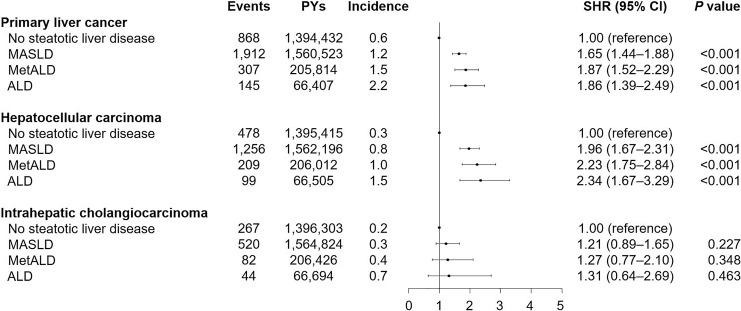
A total of 3,232 participants (0.9%) developed PLCa during the median follow-up of 3,227,176 person-years: 0.5% with no SLD, 1.1% with MASLD, 1.3% with MetALD, and 1.9% with ALD. Competing risk analysis revealed that compared with no SLD, MASLD (SHR: 1.65; 95% CI: 1.44-1.88), MetALD (SHR: 1.87; 95% CI: 1.52-2.29), and ALD (SHR: 1.86; 95% CI: 1.39-2.49) were associated with an increased risk of PLCa. MASLD (SHR: 1.96; 95% CI: 1.67-2.31), MetALD (SHR: 2.23; 95% CI: 1.75-2.84), and ALD (SHR: 2.34; 95% CI: 1.67-3.29) were associated with a higher risk of HCC. No significant difference was observed in the risk of iCCA. The risk of incident cirrhosis and decompensated cirrhosis increased in the order of no SLD, MASLD, MetALD, and ALD.
CONCLUSION
MASLD, MetALD, and ALD have an increased risk of PLCa, HCC, incident cirrhosis, and decompensated cirrhosis but not iCCA. These findings may serve as a robust ground for the prognostic value of the newly suggested MASLD and MetALD.
引言
本研究旨在调查新提出的代谢功能障碍相关脂肪性肝病(MASLD)、酒精摄入量增加的MASLD(MetALD)以及酒精性肝病(ALD)的肝脏相关结局。
方法
我们从韩国国民健康保险服务健康筛查队列中纳入了2009年至2010年间接受健康检查的369,094名参与者。脂肪性肝病(SLD)定义为脂肪肝指数≥60。将原发性肝癌(PLCa)、肝细胞癌(HCC)、肝内胆管癌(iCCA)、新发肝硬化和失代偿性肝硬化的风险与无SLD的情况进行比较。使用Fine-Gray模型计算关于竞争风险的亚分布风险比(SHR)。
结果
在3,227,176人年的中位随访期间,共有3,232名参与者(0.9%)发生了PLCa:无SLD者为0.5%,MASLD者为1.1%,MetALD者为1.3%,ALD者为1.9%。竞争风险分析显示,与无SLD相比,MASLD(SHR:1.65;95%CI:1.44-1.88),MetALD(SHR:1.87;95%CI:1.52-2.29)和ALD(SHR:1.86;95%CI:1.39-2.49)与PLCa风险增加相关。MASLD(SHR:1.96;95%CI:1.67-2.31),MetALD(SHR:2.23;95%CI:1.75-2.84)和ALD(SHR:2.34;95%CI:1.67-3.29)与HCC风险较高相关。iCCA风险未观察到显著差异。新发肝硬化和失代偿性肝硬化的风险按无SLD、MASLD、MetALD和ALD的顺序增加。
结论
MASLD、MetALD和ALD发生PLCa、HCC、新发肝硬化和失代偿性肝硬化的风险增加,但iCCA风险未增加。这些发现可能为新提出的MASLD和MetALD的预后价值提供有力依据。




 Zotero 插件