
心力衰竭患者表型年龄与死亡风险的关联:一项回顾性队列研究
Association Between Phenotypic Age and the Risk of Mortality in Patients With Heart Failure: A Retrospective Cohort Study.
作者信息
Xu Xuhong, Xu Zhiqi
机构信息
Department of Cardiovascular Medicine, Huadu District People's Hospital of Guangzhou, Guangzhou, Guangdong, People's Republic of China.
出版信息
Clin Cardiol. 2024 Aug;47(8):e24321. doi: 10.1002/clc.24321.
BACKGROUND
Chronological age (CA) is an imperfect proxy for the true biological aging state of the body. As novel measures of biological aging, Phenotypic age (PhenoAge) and Phenotypic age acceleration (PhenoAgeAccel), have been shown to identify morbidity and mortality risks in the general population.
HYPOTHESIS
PhenoAge and PhenoAgeAccel might be associated with mortality in heart failure (HF) patients.
METHODS
This cohort study extracted adult data from the National Health and Nutrition Examination Survey (NHANES) databases. Weighted univariable and multivariable Cox models were performed to analyze the effect of PhenoAge and PhenoAgeAccel on all-cause mortality in HF patients, and hazard ratio (HR) with 95% confidence intervals (CI) was calculated.
RESULTS
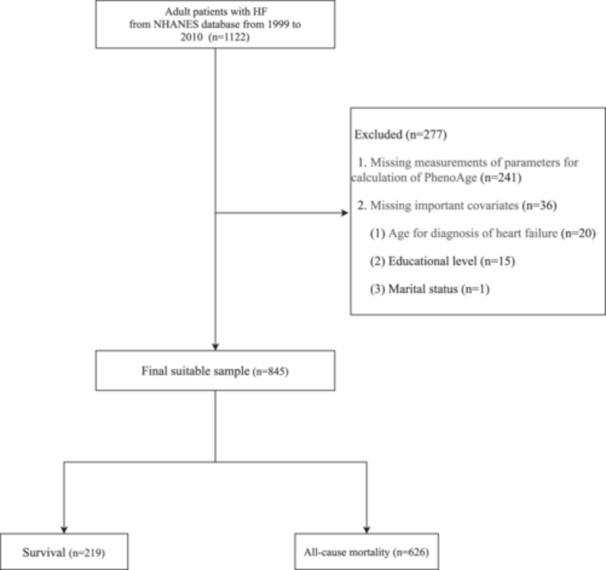
In total, 845 HF patients were identified, with 626 all-cause mortality patients. The findings suggested that (1) each 1- and 10-year increase in PhenoAge were associated with a 3% (HR = 1.03, 95% CI: 1.03-1.04) and 41% (HR = 1.41, 95% CI: 1.29-1.54) increased risk of all-cause mortality, respectively; (2) when the PhenoAgeAccel < 0 as reference, the ≥ 0 group was associated with higher risk of all-cause mortality (HR = 1.91, 95% CI = 1.49-2.45). Subgroup analyses showed that (1) older PhenoAge was associated with an increased risk of all-cause mortality in all subgroups; (2) when the PhenoAgeAccel < 0 as a reference, PhenoAgeAccel ≥ 0 was associated with a higher risk of all-cause mortality in all subgroups.
CONCLUSION
Older PhenoAge was associated with an increased risk of all-cause mortality in HF patients. PhenoAge and PhenoAgeAccel can be used as convenient tools to facilitate the identification of at-risk individuals with HF and the evaluation of intervention efficacy.
背景
实足年龄(CA)并非人体真实生物衰老状态的完美指标。作为生物衰老的新指标,表型年龄(PhenoAge)和表型年龄加速(PhenoAgeAccel)已被证明可识别普通人群的发病和死亡风险。
假设
PhenoAge和PhenoAgeAccel可能与心力衰竭(HF)患者的死亡率相关。
方法
这项队列研究从国家健康与营养检查调查(NHANES)数据库中提取了成人数据。采用加权单变量和多变量Cox模型分析PhenoAge和PhenoAgeAccel对HF患者全因死亡率的影响,并计算风险比(HR)及95%置信区间(CI)。
结果
共识别出845例HF患者,其中626例为全因死亡患者。研究结果表明:(1)PhenoAge每增加1岁和10岁,全因死亡风险分别增加3%(HR = 1.03,95% CI:1.03 - 1.04)和41%(HR = 1.41,95% CI:1.29 - 1.54);(2)以PhenoAgeAccel < 0为参照,PhenoAgeAccel≥0组的全因死亡风险更高(HR = 1.91,95% CI = 1.49 - 2.45)。亚组分析显示:(1)在所有亚组中,较高的PhenoAge与全因死亡风险增加相关;(2)以PhenoAgeAccel < 0为参照,在所有亚组中,PhenoAgeAccel≥0与全因死亡风险更高相关。
结论
较高的PhenoAge与HF患者全因死亡风险增加相关。PhenoAge和PhenoAgeAccel可作为便捷工具,有助于识别HF高危个体并评估干预效果。


 Zotero 插件