
社区社会经济劣势与常见心血管病 30 天结局
Neighborhood Socioeconomic Disadvantage and 30-Day Outcomes for Common Cardiovascular Conditions.
机构信息
Duke University School of Medicine Durham NC USA.
Duke University Fuqua School of Business Durham NC USA.
出版信息
J Am Heart Assoc. 2024 Aug 20;13(16):e036265. doi: 10.1161/JAHA.124.036265. Epub 2024 Aug 9.
BACKGROUND
Understanding the relationship between neighborhood environment and cardiovascular outcomes is important to achieve health equity and implement effective quality strategies. We conducted a population-based cohort study to determine the association of neighborhood socioeconomic deprivation and 30-day mortality and readmission rate for patients admitted with common cardiovascular conditions.
METHODS AND RESULTS
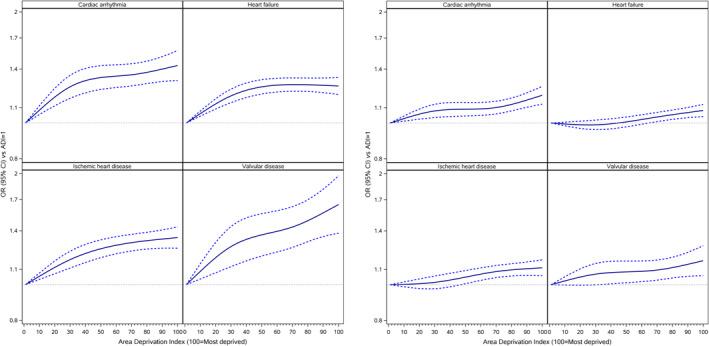
We examined claims data from fee-for-service Medicare beneficiaries aged ≥65 years between 2017 and 2019 admitted for heart failure, valvular heart disease, ischemic heart disease, or cardiac arrhythmias. The primary exposure was the Area Deprivation Index; outcomes were 30-day all-cause death and unplanned readmission. More than 2 million admissions were included. After sequential adjustment for patient characteristics (demographics, dual eligibility, comorbidities), area health care resources (primary care clinicians, specialists, and hospital beds per capita), and admitting hospital characteristics (ownership, size, teaching status), there was a dose-dependent association between neighborhood socioeconomic deprivation and 30-day mortality rate for all conditions. In the fully adjusted model for death, estimated effect sizes of residence in the most disadvantaged versus least disadvantaged neighborhoods ranged from adjusted odds ratio 1.29 (95% CI, 1.22-1.36) for the heart failure group to adjusted odds ratio 1.63 (95% CI, 1.36-1.95) for the valvular heart disease group. Neighborhood deprivation was associated with increased adjusted 30-day readmission rates, with estimated effect sizes from adjusted odds ratio 1.09 (95% CI, 1.05-1.14) for heart failure to adjusted odds ratio 1.19 (95% CI, 1.13-1.26) for arrhythmia.
CONCLUSIONS
Neighborhood socioeconomic disadvantage was associated with 30-day mortality rate and readmission for patients admitted with common cardiovascular conditions independent of individual demographics, socioeconomic status, medical risk, care access, or admitting hospital characteristics.
背景
了解邻里环境与心血管结局之间的关系对于实现健康公平和实施有效的质量策略至关重要。我们进行了一项基于人群的队列研究,以确定邻里社会经济剥夺与因常见心血管疾病入院患者的 30 天死亡率和再入院率之间的关系。
方法和结果
我们检查了 2017 年至 2019 年期间年龄≥65 岁的自费医疗保险受益人的索赔数据,这些人因心力衰竭、心脏瓣膜病、缺血性心脏病或心律失常入院。主要暴露因素是区域贫困指数;结果是 30 天全因死亡和非计划再入院。共纳入 200 多万例入院病例。在连续调整患者特征(人口统计学、双重资格、合并症)、区域医疗保健资源(初级保健临床医生、专科医生和人均床位)和入院医院特征(所有权、规模、教学地位)后,所有情况下邻里社会经济剥夺与 30 天死亡率之间存在剂量依赖性关联。在死亡的完全调整模型中,居住在最贫困与最不贫困社区的估计效应大小范围为心力衰竭组的调整比值比 1.29(95%置信区间,1.22-1.36)至心脏瓣膜病组的调整比值比 1.63(95%置信区间,1.36-1.95)。邻里贫困与调整后的 30 天再入院率增加相关,心力衰竭组的估计效应大小为调整比值比 1.09(95%置信区间,1.05-1.14),心律失常组为调整比值比 1.19(95%置信区间,1.13-1.26)。
结论
无论个体人口统计学、社会经济地位、医疗风险、护理机会还是入院医院特征如何,邻里社会经济劣势与因常见心血管疾病入院患者的 30 天死亡率和再入院率相关。
 Zotero 插件