
疼痛的表观遗传学景观:慢性疼痛中的 DNA 甲基化动态。
Epigenetic Landscapes of Pain: DNA Methylation Dynamics in Chronic Pain.
机构信息
Pain in Motion Research Group (PAIN), Department of Physiotherapy, Human Physiology and Anatomy, Faculty of Physical Education & Physiotherapy, Vrije Universiteit Brussel, 1090 Brussels, Belgium.
Department of Public Health and Primary Care, Centre for Environment & Health, KU Leuven, 3000 Leuven, Belgium.
出版信息
Int J Mol Sci. 2024 Jul 30;25(15):8324. doi: 10.3390/ijms25158324.
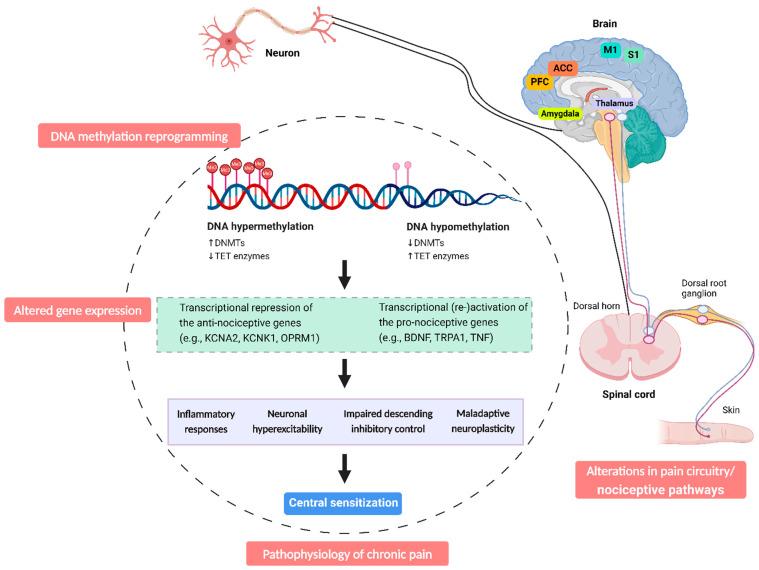
Chronic pain is a prevalent condition with a multifaceted pathogenesis, where epigenetic modifications, particularly DNA methylation, might play an important role. This review delves into the intricate mechanisms by which DNA methylation and demethylation regulate genes associated with nociception and pain perception in nociceptive pathways. We explore the dynamic nature of these epigenetic processes, mediated by DNA methyltransferases (DNMTs) and ten-eleven translocation (TET) enzymes, which modulate the expression of pro- and anti-nociceptive genes. Aberrant DNA methylation profiles have been observed in patients with various chronic pain syndromes, correlating with hypersensitivity to painful stimuli, neuronal hyperexcitability, and inflammatory responses. Genome-wide analyses shed light on differentially methylated regions and genes that could serve as potential biomarkers for chronic pain in the epigenetic landscape. The transition from acute to chronic pain is marked by rapid DNA methylation reprogramming, suggesting its potential role in pain chronicity. This review highlights the importance of understanding the temporal dynamics of DNA methylation during this transition to develop targeted therapeutic interventions. Reversing pathological DNA methylation patterns through epigenetic therapies emerges as a promising strategy for pain management.
慢性疼痛是一种普遍存在的病症,其发病机制具有多面性,其中表观遗传修饰,特别是 DNA 甲基化,可能起着重要作用。本综述深入探讨了 DNA 甲基化和去甲基化调节伤害感受和疼痛感知相关基因在伤害感受途径中的复杂机制。我们探讨了这些表观遗传过程的动态性质,这些过程由 DNA 甲基转移酶(DNMTs)和 ten-eleven 转位(TET)酶介导,调节促伤害和抗伤害基因的表达。在各种慢性疼痛综合征患者中观察到异常的 DNA 甲基化谱,与对疼痛刺激的超敏反应、神经元过度兴奋和炎症反应相关。全基因组分析揭示了差异甲基化区域和基因,它们可能是表观遗传景观中慢性疼痛的潜在生物标志物。从急性疼痛到慢性疼痛的转变伴随着快速的 DNA 甲基化重编程,表明其在疼痛持续性中的潜在作用。本综述强调了在这一转变过程中理解 DNA 甲基化的时间动态的重要性,以开发有针对性的治疗干预措施。通过表观遗传疗法逆转病理性 DNA 甲基化模式是一种有前途的疼痛管理策略。

 Zotero 插件