
NPM1 突变且 FLT3-ITD 野生型 AML 患者中遗传共突变对化疗结果的影响。
Influence of genetic co-mutation on chemotherapeutic outcome in NPM1-mutated and FLT3-ITD wild-type AML patients.
机构信息
Department of Hematology, Nanfang Hospital, Southern Medical University, Guangzhou, Guangdong, China.
出版信息
Cancer Med. 2024 Aug;13(15):e70102. doi: 10.1002/cam4.70102.
BACKGROUND
Nucleophosmin 1 (NPM1) gene-mutated acute myeloid leukemia (NPM1 AML) is classified as a subtype with a favorable prognosis. However, some patients fail to achieve a complete remission or relapse after intensified chemotherapy. Genetic abnormalities in concomitant mutations contribute to heterogeneous prognosis of NPM1 AML patients.
METHODS
In this study, 91 NPM1-mutated and FLT3-ITD wild-type (NPM1/FLT3-ITD) AML patients with intermediate-risk karyotype were enrolled to analyze the impact of common genetic co-mutations on chemotherapeutic outcome.
RESULTS
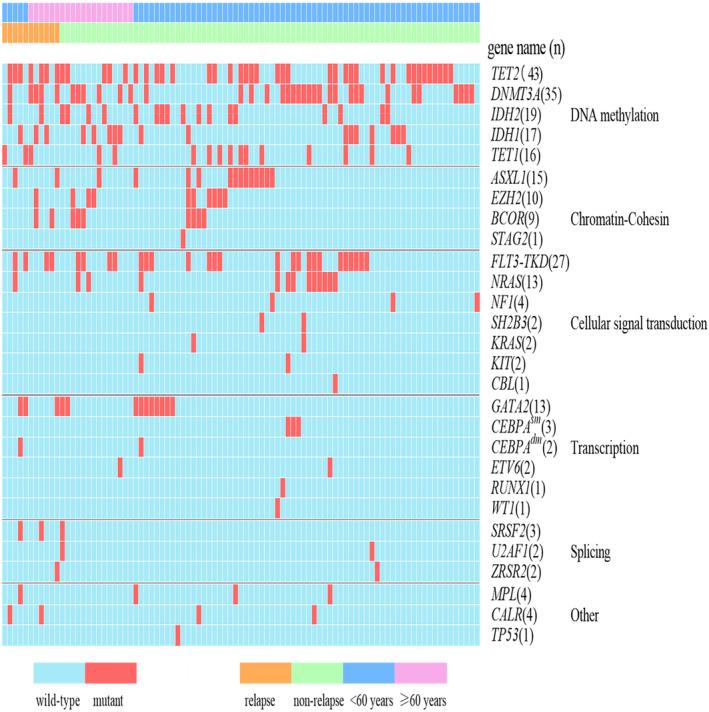
Our data revealed that TET1/2 (52/91, 57.1%) was the most prevalent co-mutation in NPM1 AML patients, followed by IDH1/2 (36/91, 39.6%), DNMT3A (35/91, 38.5%), myelodysplastic syndrome related genes (MDS-related genes) (ASXL1, BCOR, EZH2, RUNX1, SF3B1, SRSF2, STAG2, U2AF1 and ZRSR2 genes) (35/91, 38.5%), FLT3-TKD (27/91, 29.7%) and GATA2 (13/91, 14.3%) mutations. Patients with TET1/2 exhibited significantly worse relapse-free survival (RFS) (median, 28.7 vs. not reached (NR) months; p = 0.0382) compared to patients with TET1/2, while no significant difference was observed in overall survival (OS) (median, NR vs. NR; p = 0.3035). GATA2 subtype was associated with inferior OS (median, 28 vs. NR months; p < 0.0010) and RFS (median, 24 vs. NR months; p = 0.0224) compared to GATA2. By multivariate analysis, GATA2 and MDS-related genes were independently associated with worse survival.
CONCLUSION
Mutations in TET1/2, GATA2 and MDS-related genes were found to significantly influence the chemotherapeutic outcome of patients with NPM1 AML. The findings of our study have significant clinical implications for identifying patients who have an adverse response to frontline chemotherapy and provide a novel reference for further prognostic stratification of NPM1/FLT3-ITD AML patients.
背景
核磷蛋白 1(NPM1)基因突变急性髓系白血病(NPM1 AML)被归类为预后良好的亚型。然而,一些患者在强化化疗后无法达到完全缓解或复发。伴随突变中的遗传异常导致 NPM1 AML 患者的预后存在异质性。
方法
本研究纳入 91 例 NPM1 突变且 FLT3-ITD 野生型(NPM1/FLT3-ITD)中危核型的 AML 患者,分析常见遗传共突变对化疗结果的影响。
结果
我们的数据显示,TET1/2(52/91,57.1%)是 NPM1 AML 患者中最常见的共突变,其次是 IDH1/2(36/91,39.6%)、DNMT3A(35/91,38.5%)、骨髓增生异常综合征相关基因(ASXL1、BCOR、EZH2、RUNX1、SF3B1、SRSF2、STAG2、U2AF1 和 ZRSR2 基因)(35/91,38.5%)、FLT3-TKD(27/91,29.7%)和 GATA2(13/91,14.3%)突变。与 TET1/2 患者相比,TET1/2 患者的无复发生存(RFS)(中位时间,28.7 个月 vs. 未达到(NR)个月;p=0.0382)显著更差,而总生存(OS)(中位时间,NR vs. NR;p=0.3035)无显著差异。GATA2 亚型与较差的 OS(中位时间,28 个月 vs. NR 个月;p<0.0010)和 RFS(中位时间,24 个月 vs. NR 个月;p=0.0224)相关,与 GATA2 相比。多变量分析显示,GATA2 和 MDS 相关基因与生存不良独立相关。
结论
TET1/2、GATA2 和 MDS 相关基因的突变显著影响 NPM1 AML 患者的化疗结果。本研究的发现对识别对一线化疗反应不良的患者具有重要的临床意义,并为进一步对 NPM1/FLT3-ITD AML 患者进行预后分层提供了新的参考。




 Zotero 插件