
埃博拉病毒病数学模型和流行病学参数:系统评价。
Ebola virus disease mathematical models and epidemiological parameters: a systematic review.
机构信息
MRC Centre for Global Infectious Disease Analysis and WHO Collaborating Centre for Infectious Disease Modelling, Jameel Institute, School of Public Health, Imperial College London, London, UK.
MRC Centre for Global Infectious Disease Analysis and WHO Collaborating Centre for Infectious Disease Modelling, Jameel Institute, School of Public Health, Imperial College London, London, UK; Health Protection Research Unit in Modelling and Health Economics, London, UK; Modelling and Economics Unit, UK Health Security Agency, London, UK.
出版信息
Lancet Infect Dis. 2024 Dec;24(12):e762-e773. doi: 10.1016/S1473-3099(24)00374-8. Epub 2024 Aug 7.
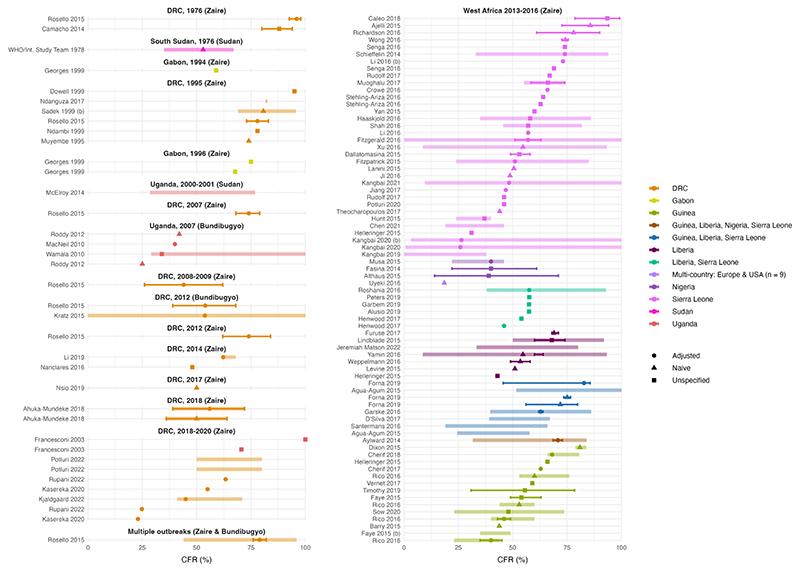
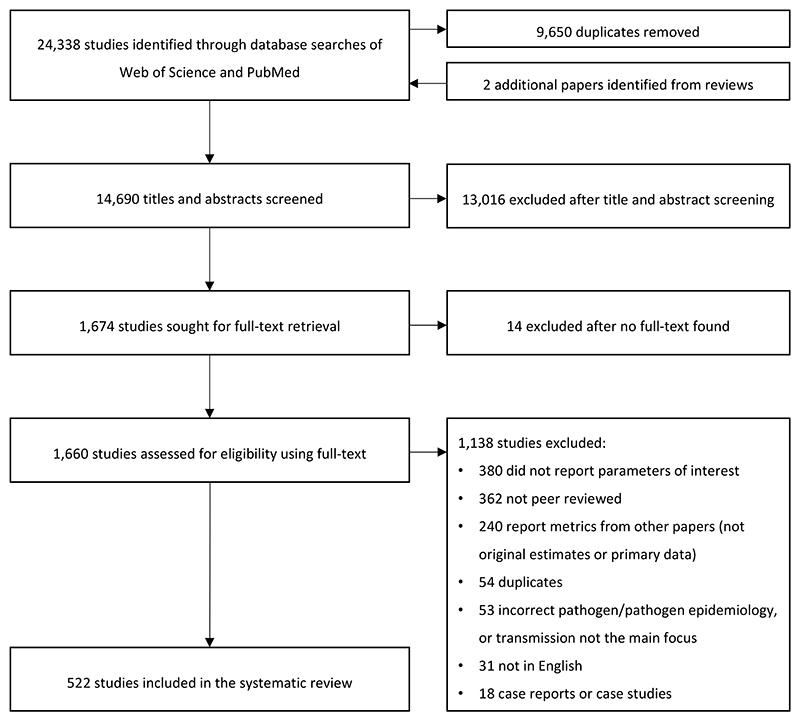
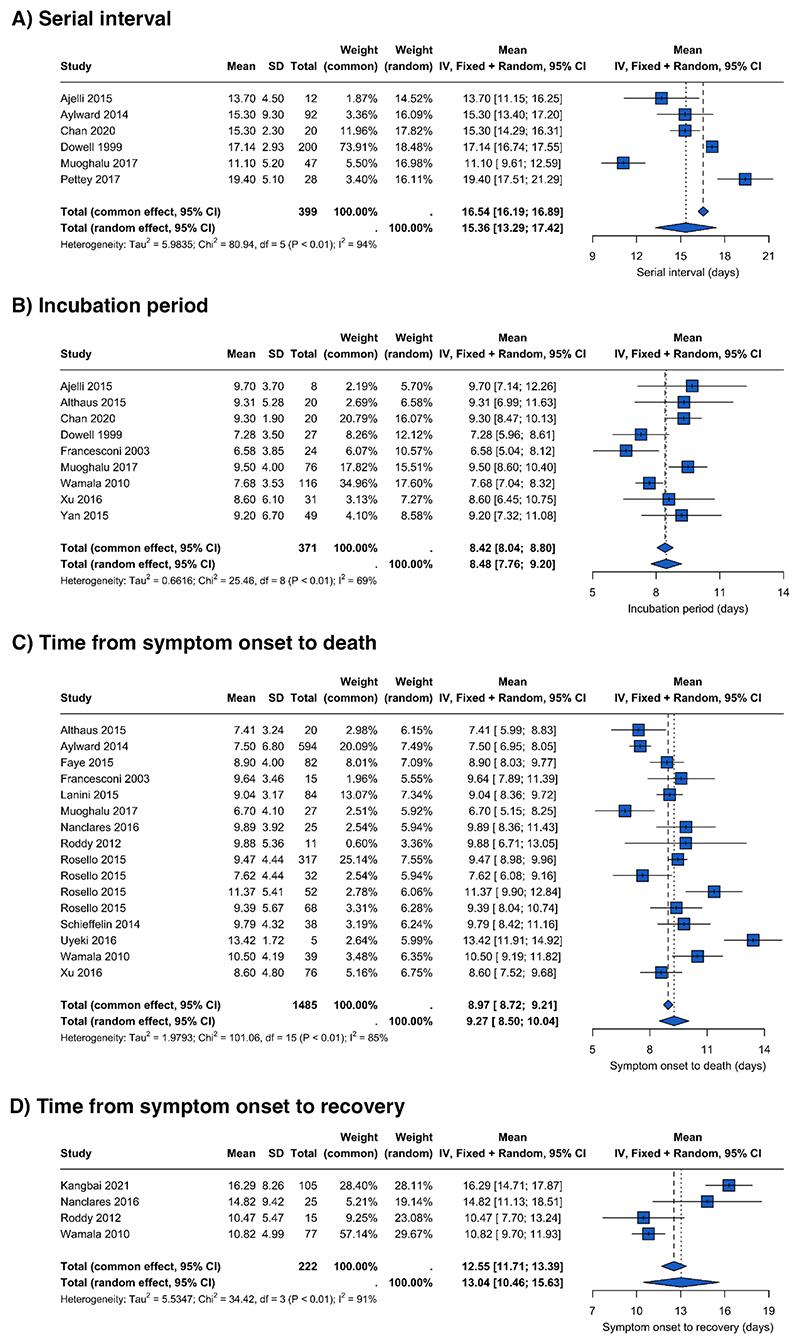
Ebola virus disease poses a recurring risk to human health. We conducted a systematic review (PROSPERO CRD42023393345) of Ebola virus disease transmission models and parameters published from database inception to July 7, 2023, from PubMed and Web of Science. Two people screened each abstract and full text. Papers were extracted with a bespoke Access database, 10% were double extracted. We extracted 1280 parameters and 295 models from 522 papers. Basic reproduction number estimates were highly variable, as were effective reproduction numbers, likely reflecting spatiotemporal variability in interventions. Random-effect estimates were 15·4 days (95% CI 13·2-17·5) for the serial interval, 8·5 days (7·7-9·2) for the incubation period, 9·3 days (8·5-10·1) for the symptom-onset-to-death delay, and 13·0 days (10·4-15·7) for symptom-onset-to-recovery. Common effect estimates were similar, albeit with narrower CIs. Case-fatality ratio estimates were generally high but highly variable, which could reflect heterogeneity in underlying risk factors. Although a substantial body of literature exists on Ebola virus disease models and epidemiological parameter estimates, many of these studies focus on the west African Ebola epidemic and are primarily associated with Zaire Ebola virus, which leaves a key gap in our knowledge regarding other Ebola virus species and outbreak contexts.
埃博拉病毒病对人类健康构成持续威胁。我们对从数据库建立到 2023 年 7 月 7 日发表的埃博拉病毒病传播模型和参数进行了系统评价(PROSPERO CRD42023393345),检索了 PubMed 和 Web of Science。两人分别筛选摘要和全文。使用定制的 Access 数据库提取论文,10%的论文进行了双重提取。我们从 522 篇论文中提取了 1280 个参数和 295 个模型。基本繁殖数估计值差异很大,有效繁殖数也如此,这可能反映了干预措施在时空上的变化。随机效应估计值为 15.4 天(95%CI 13.2-17.5),序列间隔为 8.5 天(7.7-9.2),潜伏期为 9.3 天(8.5-10.1),症状发作至死亡延迟为 13.0 天(10.4-15.7),症状发作至恢复。常见效应估计值相似,尽管置信区间较窄。病死率估计值通常较高,但差异很大,这可能反映了潜在危险因素的异质性。尽管关于埃博拉病毒病模型和流行病学参数估计值的文献很多,但其中许多研究都集中在西非埃博拉疫情上,并且主要与扎伊尔埃博拉病毒有关,这使得我们对其他埃博拉病毒种类和疫情背景的了解存在一个关键的空白。

 Zotero 插件