
Cereblon 缺乏通过抑制 MAPK 介导的细胞凋亡改善四氯化碳诱导的 HepG2 细胞急性肝毒性。
Cereblon deficiency ameliorates carbon tetrachloride-induced acute hepatotoxicity in HepG2 cells by suppressing MAPK-mediated apoptosis.
机构信息
Department of Life Science and Environmental Biochemistry, Pusan National University, Miryang, Republic of Korea.
Department of Convergence Medicine, Pusan National University School of Medicine, Yangsan, Republic of Korea.
出版信息
Front Immunol. 2024 Jul 30;15:1457636. doi: 10.3389/fimmu.2024.1457636. eCollection 2024.
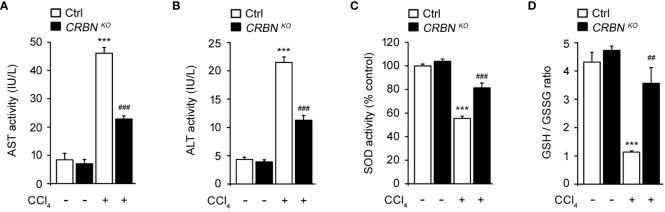
The liver is vulnerable to various hepatotoxins, including carbon tetrachloride (CCl), which induces oxidative stress and apoptosis by producing reactive oxygen species (ROS) and activating the mitogen-activated protein kinase (MAPK) pathway. Cereblon (CRBN), a multifunctional protein implicated in various cellular processes, functions in the pathogenesis of various diseases; however, its function in liver injury remains unknown. We established a CRBN-knockout (KO) HepG2 cell line and examined its effect on CCl-induced hepatocellular damage. CRBN-KO cells exhibited reduced sensitivity to CCl-induced cytotoxicity, as evidenced by decreased levels of apoptosis markers, such as cleaved caspase-3, and aspartate aminotransferase (AST) and alanine aminotransferase (ALT) activities. CRBN deficiency enhanced antioxidant defense, with increased superoxide dismutase activity and glutathione ratios (GSH/GSSG), as well as reduced pro-inflammatory cytokine expression. Mechanistically, the protective effects of CRBN deficiency appeared to involve the attenuation of the MAPK-mediated pathways, particularly through decreased phosphorylation of JNK and ERK. Overall, these results suggest the crucial role of CRBN in mediating the hepatocellular response to oxidative stress and inflammation triggered by CCl exposure, offering potential clinical implications for liver injury in a wide range of liver diseases.
肝脏容易受到各种肝毒素的影响,包括四氯化碳 (CCl),它通过产生活性氧 (ROS) 和激活丝裂原活化蛋白激酶 (MAPK) 途径来诱导氧化应激和细胞凋亡。 cereblon (CRBN) 是一种涉及多种细胞过程的多功能蛋白,它在各种疾病的发病机制中起作用;然而,它在肝损伤中的作用尚不清楚。我们建立了 CRBN 敲除 (KO) HepG2 细胞系,并研究了其对 CCl 诱导的肝细胞损伤的影响。CRBN-KO 细胞对 CCl 诱导的细胞毒性的敏感性降低,这表现在凋亡标志物如 cleaved caspase-3 的水平降低,以及天冬氨酸转氨酶 (AST) 和丙氨酸转氨酶 (ALT) 活性降低。CRBN 缺失增强了抗氧化防御能力,超氧化物歧化酶活性和谷胱甘肽比值 (GSH/GSSG) 增加,促炎细胞因子表达减少。从机制上讲,CRBN 缺失的保护作用似乎涉及到 MAPK 介导的途径的衰减,特别是通过减少 JNK 和 ERK 的磷酸化。总的来说,这些结果表明 CRBN 在介导 CCl 暴露引起的肝细胞对氧化应激和炎症的反应中起着关键作用,为广泛的肝脏疾病中的肝损伤提供了潜在的临床意义。




 Zotero 插件