
解除与 COVID-19 相关的非药物干预措施:对 2022 年德国巴伐利亚州人与人之间传播的传染病报告的潜在影响。
Lifting COVID-19-associated non-pharmaceutical interventions: potential impact on notifications of infectious diseases transmitted from person to person in 2022 in Bavaria, Germany.
机构信息
Institute for Medical Information Processing, Biometry, and Epidemiology - IBE, LMU Munich, Munich, Germany.
Pettenkofer School of Public Health, Munich, Germany.
出版信息
Front Public Health. 2024 Jul 31;12:1437485. doi: 10.3389/fpubh.2024.1437485. eCollection 2024.
BACKGROUND
The COVID-19 pandemic and associated non-pharmaceutical interventions (NPIs) have led to substantial decreases in case numbers of infectious diseases in several countries worldwide. As NPIs were gradually lifted, intense or out-of-season outbreaks of respiratory and gastrointestinal diseases were reported, raising the hypothesis of a potential catch-up effect of infections. By analysing surveillance data from the federal reporting system for notifiable infectious diseases, we aimed to assess the potential impact of lifting COVID-19 associated NPIs on notifications of selected infectious diseases in Bavaria, 2022.
METHODS
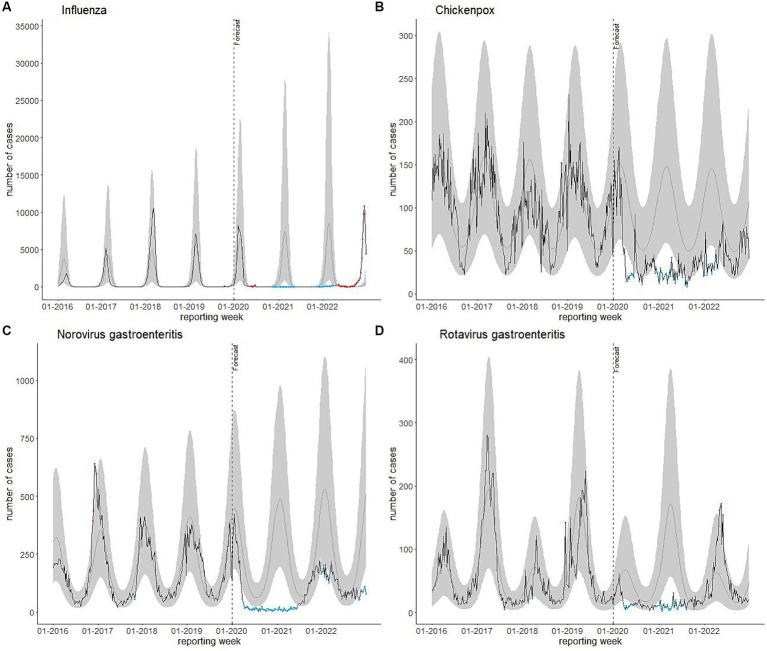
We compared influenza, chickenpox, norovirus gastroenteritis, rotavirus gastroenteritis weekly case numbers in a pre-pandemic period (2016-2019) and 2022 using two time series analyses approaches: (i) a predictive model forecasting weekly case numbers for the pandemic years 2020-2022, based on 2016-2019 data, (ii) interrupted time series model, based on 2016-2022 data, including a term per pandemic period.
RESULTS
In 2022, incidence rates were higher compared to pre-pandemic period for influenza (IRR = 3.47, 95%CI: 1.49-7.94) and rotavirus gastroenteritis (IRR = 1.36, 95%CI: 0.95-1.93), though not significant for rotavirus gastroenteritis. Conversely, case numbers remained significantly below pre-pandemic levels for chickenpox (IRR = 0.52, 95%CI: 0.41-0.65) and norovirus gastroenteritis (IRR = 0.59, 95%CI: 0.42-0.82). Seasonality changed notably for influenza, showing an earlier influenza wave compared to pre-pandemic periods.
CONCLUSION
The lifting of NPIs was associated with heterogenic epidemiological patterns depending on the selected disease. The full impact of NPIs and their discontinuation may only become clear with continued monitoring and assessment of potential additional contributing factors.
背景
COVID-19 大流行和相关的非药物干预(NPIs)导致全球多个国家传染病病例数大幅下降。随着 NPIs 的逐步取消,报告了呼吸道和胃肠道疾病的集中或非季节性爆发,这引发了感染潜在追赶效应的假说。通过分析传染病联邦报告系统的监测数据,我们旨在评估 2022 年 COVID-19 相关 NPIs 取消对巴伐利亚州选定传染病报告的潜在影响。
方法
我们使用两种时间序列分析方法比较了流感、水痘、诺如病毒肠胃炎和轮状病毒肠胃炎在大流行前时期(2016-2019 年)和 2022 年的每周病例数:(i)基于 2016-2019 年数据,预测 2020-2022 年大流行年份每周病例数的预测模型;(ii)基于 2016-2022 年数据的中断时间序列模型,包括每个大流行时期的一个术语。
结果
2022 年,流感(IRR=3.47,95%CI:1.49-7.94)和轮状病毒肠胃炎(IRR=1.36,95%CI:0.95-1.93)的发病率与大流行前时期相比有所升高,尽管轮状病毒肠胃炎的发病率升高不显著。相反,水痘(IRR=0.52,95%CI:0.41-0.65)和诺如病毒肠胃炎(IRR=0.59,95%CI:0.42-0.82)的病例数仍明显低于大流行前水平。流感的季节性变化显著,与大流行前时期相比,出现了更早的流感波。
结论
NPIs 的取消与所选疾病的异质流行病学模式有关。只有通过持续监测和评估潜在的其他促成因素,才能更清楚地了解 NPIs 的全部影响及其停止。
 Zotero 插件