
血小板/高密度脂蛋白胆固醇比值在预测抑郁及其心血管疾病死亡率中的价值:一项基于人群的观察性研究。
The value of the platelet/high-density lipoprotein cholesterol ratio in predicting depression and its cardiovascular disease mortality: a population-based observational study.
机构信息
Department of Cardiovascular, The First Affiliated Hospital, and College of Clinical Medicine of Henan University of Science and Technology, Luoyang, China.
Department of Hematology, The First Affiliated Hospital, and College of Clinical Medicine of Henan University of Science and Technology, Luoyang, China.
出版信息
Front Endocrinol (Lausanne). 2024 Jul 29;15:1402336. doi: 10.3389/fendo.2024.1402336. eCollection 2024.
BACKGROUND
Cardiovascular disease (CVD) and depression have a bidirectional association, with inflammation and metabolic factors being common important triggers for both conditions. However, as a novel inflammatory and metabolic marker, platelet-to-HDL-C ratio (PHR) has not been established in relation to depression and cardiovascular disease.
MATERIALS AND METHODS
Participants aged 20 years and older were included in the 2005-2018 NHANES database. PHR was calculated as the ratio of platelet count (1000 cells/μL) to HDL-C (mmol/L). The Patient Health Questionnaire (PHQ-9) was used to diagnose depression, with a cutoff value of 10. Weighted logistic regression analysis and restricted cubic spline (RCS) analysis were employed to examine the association between PHR and depression-related features. Additionally, weighted COX regression and RCS were used to analyze the association of PHR with CVD mortality in patients with depression. Receiver operating characteristic curves were used to assess whether PHR had an advantage over HDL-C in predicting depression. Finally, the mediating role of PHR in the latest cardiovascular health indicator Life's Essential 8 and depression was explored.
RESULTS
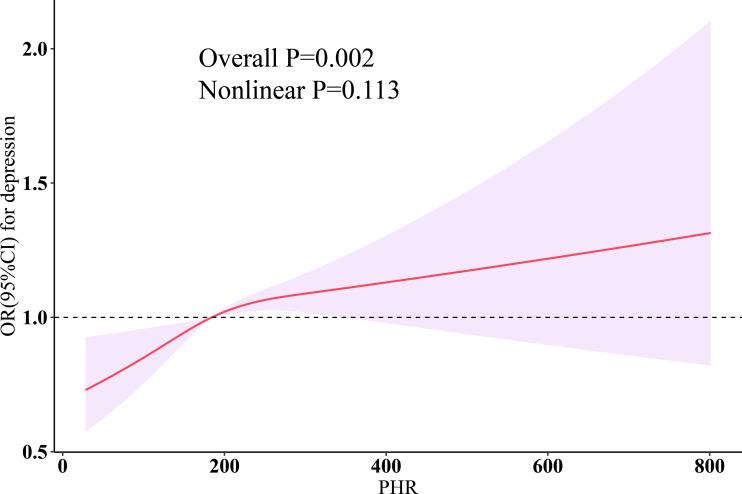
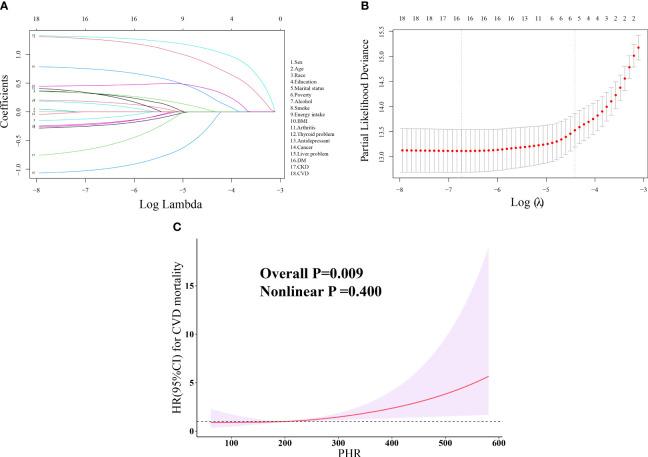
A total of 26,970 eligible participants were included, including 2,308 individuals with depression, representing approximately 160 million U.S. adults when weighted. After full adjustment, we estimated that the odds ratio (OR) of depression associated with a per standard deviation (SD) increase in PHR was 1.06 (95% CI: 1.01-1.12, P=0.03). The restricted cubic spline (RCS) analysis indicated a linear association (Nonlinear P=0.113). When PHR was divided into four groups based on quartiles and included in the model after full adjustment for depression risk factors, participants in quartile 2, quartile 3, and quartile 4 of PHR showed a trend of increasing risk of depression compared to the lowest quartile group (P trend=0.01). In addition, weighted COX regression and RCS revealed that a per SD increase in PHR was associated with a higher risk of CVD mortality among patients with depression (HR: 1.38, 95% CI: 1.05-1.81, P=0.02, Nonlinear P=0.400). Subgroup analyses showed that current alcohol consumption enhanced the association between PHR and depression (P for interaction=0.017). Furthermore, the areas under the ROC curves (AUC) were 0.556 (95% CI, 0.544-0.568; P < 0.001) for PHR and 0.536 (95% CI, 0.524-0.549; P < 0.001) for HDL-C (P = 0.025). Finally, mediation analysis indicated that PHR was an intermediate mechanism between LE8 and depression (mediation proportion=5.02%, P=0.02).
CONCLUSION
In U.S. adults, an increase in PHR linearly increases the risk of depression and CVD mortality among individuals with depression. Additionally, PHR has a better predictive advantage for depression compared to HDL-C. Furthermore, PHR significantly mediates the association between LE8 scores and depression.
背景
心血管疾病(CVD)和抑郁症之间存在双向关联,炎症和代谢因素是这两种疾病的常见重要触发因素。然而,作为一种新的炎症和代谢标志物,血小板与高密度脂蛋白胆固醇的比值(PHR)与抑郁症和心血管疾病之间的关系尚未确定。
材料和方法
参与者年龄在 20 岁及以上,纳入 2005 年至 2018 年 NHANES 数据库。PHR 计算为血小板计数(1000 个细胞/μL)与高密度脂蛋白胆固醇(mmol/L)的比值。采用患者健康问卷(PHQ-9)诊断抑郁症,截断值为 10。采用加权逻辑回归分析和限制性三次样条(RCS)分析探讨 PHR 与抑郁相关特征之间的关系。此外,采用加权 COX 回归和 RCS 分析 PHR 与抑郁患者心血管疾病死亡率之间的关系。采用受试者工作特征曲线评估 PHR 在预测抑郁症方面是否优于高密度脂蛋白胆固醇。最后,探讨了 PHR 在最新的心血管健康指标“生活的八项基本要素”和抑郁症之间的中介作用。
结果
共纳入 26970 名符合条件的参与者,包括 2308 名抑郁症患者,加权后代表约 1.6 亿美国成年人。在充分调整后,我们估计 PHR 每增加一个标准差(SD),与抑郁症相关的比值比(OR)为 1.06(95%CI:1.01-1.12,P=0.03)。限制性三次样条(RCS)分析显示呈线性关系(非线性 P=0.113)。当根据四分位数将 PHR 分为四组,并在充分调整抑郁症风险因素后将其纳入模型时,与最低四分位组相比,PHR 第二、三、四分位组的参与者抑郁风险呈上升趋势(P 趋势=0.01)。此外,加权 COX 回归和 RCS 显示,PHR 每增加一个 SD 与抑郁患者的心血管疾病死亡率升高相关(HR:1.38,95%CI:1.05-1.81,P=0.02,非线性 P=0.400)。亚组分析显示,目前饮酒会增强 PHR 与抑郁症之间的关联(P 交互=0.017)。此外,ROC 曲线下面积(AUC)为 PHR 为 0.556(95%CI,0.544-0.568;P<0.001),高密度脂蛋白胆固醇为 0.536(95%CI,0.524-0.549;P<0.001)(P=0.025)。最后,中介分析表明 PHR 是 LE8 和抑郁之间的中间机制(中介比例=5.02%,P=0.02)。
结论
在美国成年人中,PHR 呈线性增加与抑郁症患者的抑郁风险和心血管疾病死亡率升高相关。此外,PHR 对抑郁症的预测优势优于高密度脂蛋白胆固醇。此外,PHR 显著介导了 LE8 评分与抑郁之间的关联。


 Zotero 插件