
在基督复临安息日会健康研究2人群中,绿地对非意外死亡率和特定病因死亡率的影响。
The impact of green space on nonaccidental and cause-specific mortality in the Adventist Health Study-2 population.
作者信息
Hreha Holly, Spencer-Hwang Rhonda, Knutsen Synnove, Shavlik David
机构信息
School of Public Health, Loma Linda University, Loma Linda, California.
出版信息
Environ Epidemiol. 2024 Aug 14;8(5):e332. doi: 10.1097/EE9.0000000000000332. eCollection 2024 Oct.
BACKGROUND
There is growing interest in evaluating the long-term health effects of neighborhood environments, particularly green space. However, only a limited body of research further incorporates multiple ambient air pollutants.
METHODS
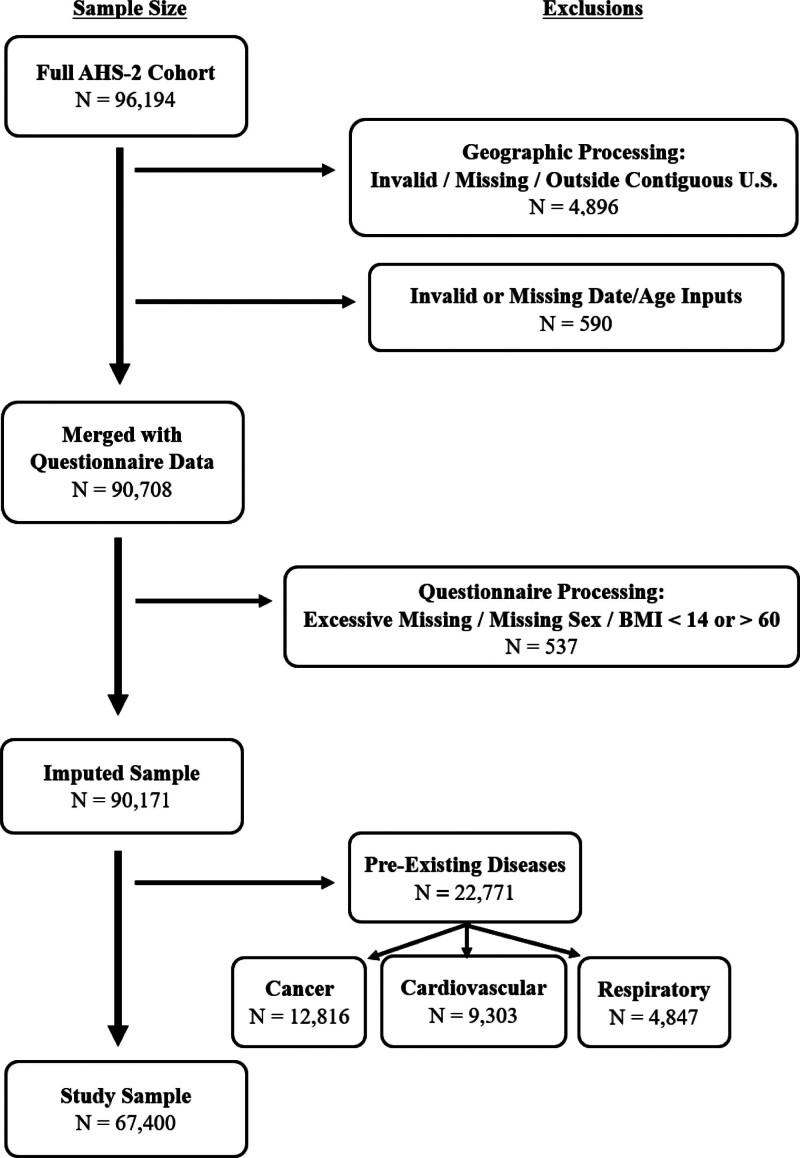
This study looked at the relationship between green space, as measured by the Normalized Difference Vegetation Index, and mortality adjusted by key confounders in the Adventist Health Study-2, a longitudinal cohort study from 2002 to 2015, across the contiguous United States (N = 67,400). We used Cox proportional hazard regression models to assess the risk of nonaccidental, cardiovascular disease (CVD), ischemic heart disease (IHD), and respiratory disease mortality from green space around subjects' home address under multiple covariate and pollutant adjustments.
RESULTS
We found a 0.1 unit increase in the Normalized Difference Vegetation Index was associated with nonaccidental (hazard ratio [HR]: 0.96 [95% confidence interval (CI): 0.93, 0.99]), CVD (HR: 0.94 [95% CI: 0.90, 0.98]), and IHD (HR: 0.87 [95% CI: 0.81, 0.94]) mortality, with the greatest precision in fully adjusted three-pollutant models using the 1000-m buffer. Effect estimates were strengthened in urban areas, when incorporating seasons, and for females. However, all associations between green space and respiratory mortality were null.
CONCLUSION
This study supports evidence that increased neighborhood green space is inversely associated with nonaccidental, CVD, and IHD mortality, where the inclusion of multiple environmental covariates had a greater impact on effect estimate magnitude and precision than adjustment by individual lifestyle and health factors.
背景
评估邻里环境,尤其是绿地对长期健康的影响,正受到越来越多的关注。然而,进一步纳入多种环境空气污染物的研究却很有限。
方法
本研究考察了归一化植被指数所衡量的绿地与非意外死亡率、心血管疾病(CVD)死亡率、缺血性心脏病(IHD)死亡率以及呼吸系统疾病死亡率之间的关系。该研究基于基督复临安息日会健康研究2,这是一项从2002年至2015年在美国本土开展的纵向队列研究(N = 67,400)。我们使用Cox比例风险回归模型,在多种协变量和污染物调整的情况下,评估受试者家庭住址周围绿地与上述各类死亡率之间的风险。
结果
我们发现,归一化植被指数每增加0.1个单位,与非意外死亡率(风险比[HR]:0.96 [95%置信区间(CI):0.93, 0.99])、心血管疾病死亡率(HR:0.94 [95% CI:0.90, 0.98])以及缺血性心脏病死亡率(HR:0.87 [95% CI:0.81, 0.94])相关,在使用1000米缓冲区的完全调整三污染物模型中,关联最为精确。在纳入季节因素以及针对女性进行分析时,城市地区的效应估计值得到增强。然而,绿地与呼吸系统疾病死亡率之间的所有关联均无统计学意义。
结论
本研究支持以下证据,即邻里绿地增加与非意外死亡率、心血管疾病死亡率和缺血性心脏病死亡率呈负相关,其中纳入多种环境协变量比个体生活方式和健康因素调整对效应估计值的大小和精度影响更大。
 Zotero 插件