
基于医院的多学科与基于全科医疗的糖尿病视网膜病变筛查比较:来自意大利一项区域研究的见解
Comparison of diabetic retinopathy screening between hospital-based multidisciplinary and general practice-based settings: insights from a regional study in Italy.
作者信息
Olivieri Chiara, Salato Mattia, Campanella Alessandra, Marolo Paola, Parisi Guglielmo, Neri Giovanni, Toro Mario Damiano, Scarmozzino Antonio, Broglio Fabio, Borrelli Enrico, Reibaldi Michele
机构信息
Department of Surgical Sciences, University of Turin, Turin, Italy.
Department of Ophthalmology, "City of Health and Science" Hospital, Turin, Italy.
出版信息
Acta Diabetol. 2025 Feb;62(2):263-269. doi: 10.1007/s00592-024-02354-6. Epub 2024 Aug 19.
PURPOSE
To compare diabetic retinopathy screening among patients with type 1 or type 2 diabetes under care in two distinct setups: hospital-based multidisciplinary and general practice-based.
MATERIALS AND METHODS
In this retrospective observational case series, we collected data from a total of 133 diabetic patients: subjects from the hospital-based multidisciplinary setting were referred by the diabetologist and screened by an ophthalmologist using the Optomed Aurora IQ fundus camera. These patients were compared with those who underwent DR screening arranged through a general practice-based setting.
RESULTS
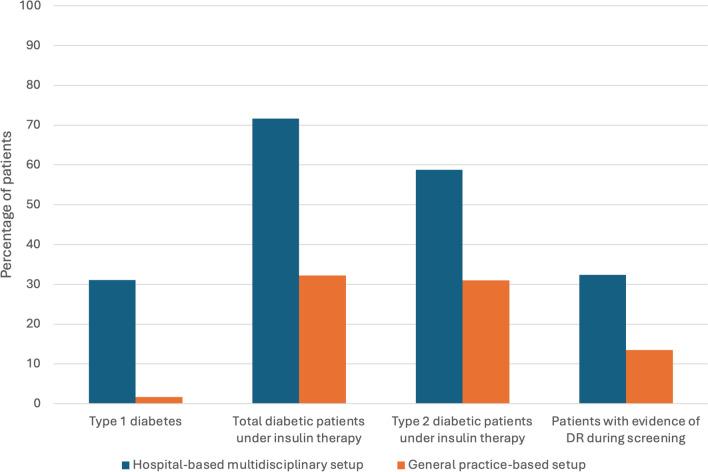
The proportion of patients treated with insulin was higher in the hospital-based multidisciplinary group, both considering the totality patients and those affected by type 2 diabetes (71.6% vs. 32.2%; p < 0.001, and 58.8% vs. 31.0%; p = 0.004 respectively). Patients from the hospital-based multidisciplinary group had a longer mean diabetes duration (19.6 vs 14.9 years, p < 0.001), underwent DR screening more frequently in the previous three years (2.9 vs 1.4, p < 0.001), the mean time between two DR screenings was shorter (14.6 vs 77.9 weeks, p < 0.001), and DR was detected more frequently (32,4% vs 13.5%; p = 0.011).
CONCLUSION
We were able to demonstrate that patients screened in the multidisciplinary center, which had characteristics predisposing to a higher risk of DR, were more likely to be diagnosed with DR on time, with a higher mean number of DR screenings and a shorted interval between diabetic and ophthalmological assessments.
目的
比较在两种不同环境下接受治疗的1型或2型糖尿病患者的糖尿病视网膜病变筛查情况,这两种环境分别是基于医院的多学科环境和基于全科医疗的环境。
材料与方法
在这个回顾性观察病例系列中,我们总共收集了133例糖尿病患者的数据:来自基于医院的多学科环境的受试者由糖尿病专家转诊,并由眼科医生使用Optomed Aurora IQ眼底相机进行筛查。将这些患者与通过基于全科医疗的环境进行糖尿病视网膜病变(DR)筛查的患者进行比较。
结果
基于医院的多学科组中接受胰岛素治疗的患者比例更高,无论是总体患者还是2型糖尿病患者(分别为71.6%对32.2%;p<0.001,以及58.8%对31.0%;p=0.004)。来自基于医院的多学科组的患者糖尿病平均病程更长(19.6年对14.9年,p<0.001),在过去三年中更频繁地接受DR筛查(2.9次对1.4次,p<0.001),两次DR筛查之间的平均时间更短(14.6周对77.9周,p<0.001),并且DR的检出率更高(32.4%对13.5%;p=0.011)。
结论
我们能够证明,在具有DR高风险易患特征的多学科中心接受筛查的患者,更有可能及时被诊断为DR,DR筛查的平均次数更多,糖尿病评估和眼科评估之间的间隔更短。

 Zotero 插件