
基于治疗后事件和反应的维奈托克与阿扎胞苷或7+3方案治疗急性髓系白血病患者长期生存的预测模型:回顾性队列研究
Predictive Models for Long Term Survival of AML Patients Treated with Venetoclax and Azacitidine or 7+3 Based on Post Treatment Events and Responses: Retrospective Cohort Study.
作者信息
Islam Nazmul, Reuben Jamie S, Dale Justin, Coates James W, Sapiah Karan, Markson Frank R, Jordan Craig T, Smith Clay
机构信息
RefinedScience, Aurora, CO, United States.
Division of Hematology, University of Colorado Anschutz, Aurora, CO, United States.
出版信息
JMIR Cancer. 2024 Aug 21;10:e54740. doi: 10.2196/54740.
BACKGROUND
The treatment of acute myeloid leukemia (AML) in older or unfit patients typically involves a regimen of venetoclax plus azacitidine (ven/aza). Toxicity and treatment responses are highly variable following treatment initiation and clinical decision-making continually evolves in response to these as treatment progresses. To improve clinical decision support (CDS) following treatment initiation, predictive models based on evolving and dynamic toxicities, disease responses, and other features should be developed.
OBJECTIVE
This study aims to generate machine learning (ML)-based predictive models that incorporate individual predictors of overall survival (OS) for patients with AML, based on clinical events occurring after the initiation of ven/aza or 7+3 regimen.
METHODS
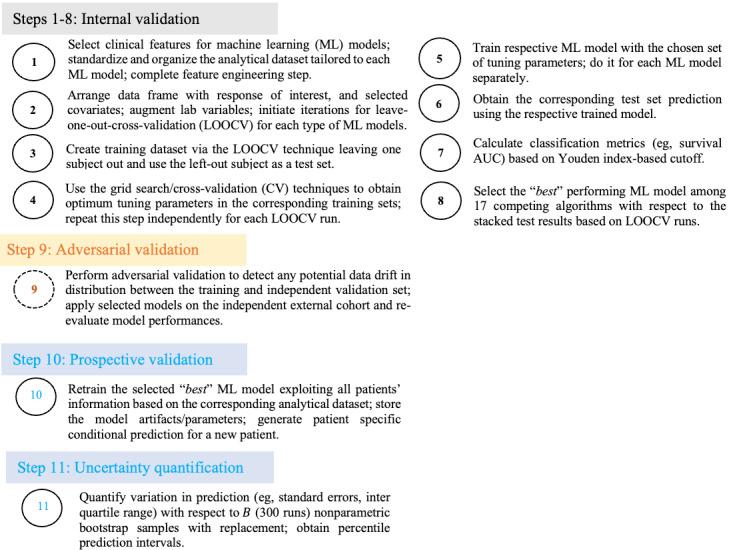
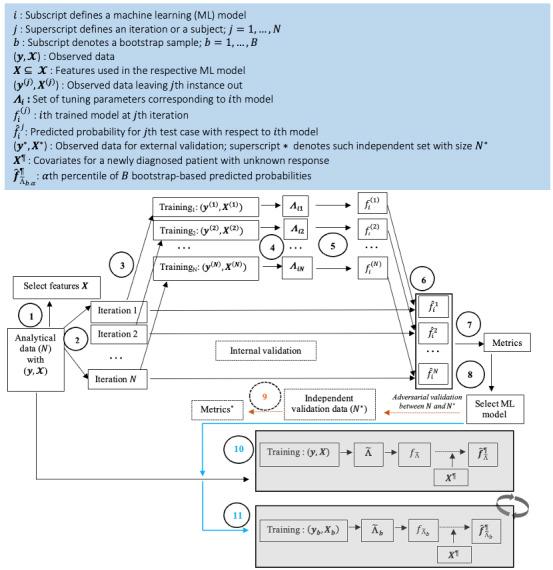
Data from 221 patients with AML, who received either the ven/aza (n=101 patients) or 7+3 regimen (n=120 patients) as their initial induction therapy, were retrospectively analyzed. We performed stratified univariate and multivariate analyses to quantify the association between toxicities, hospital events, and short-term disease responses and OS for the 7+3 and ven/aza subgroups separately. We compared the estimates of confounders to assess potential effect modifications by treatment. 17 ML-based predictive models were developed. The optimal predictive models were selected based on their predictability and discriminability using cross-validation. Uncertainty in the estimation was assessed through bootstrapping.
RESULTS
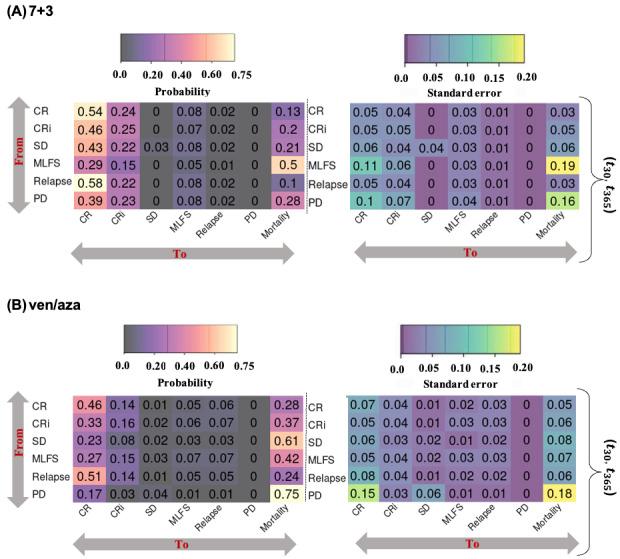
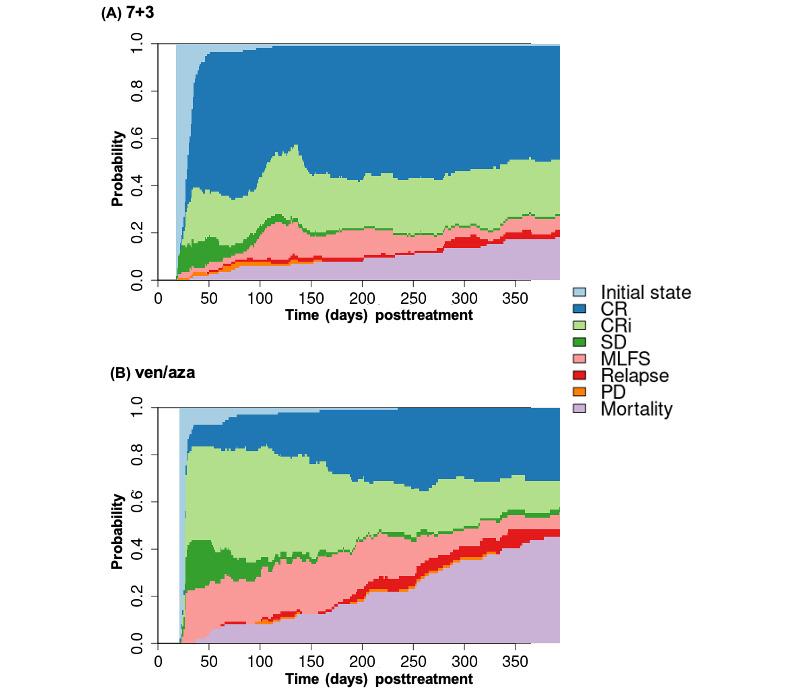
The cumulative incidence of posttreatment toxicities varies between the ven/aza and 7+3 regimen. A variety of laboratory features and clinical events during the first 30 days were differentially associated with OS for the two treatments. An initial transfer to intensive care unit (ICU) worsened OS for 7+3 patients (aHR 1.18, 95% CI 1.10-1.28), while ICU readmission adversely affected OS for those on ven/aza (aHR 1.24, 95% CI 1.12-1.37). At the initial follow-up, achieving a morphologic leukemia free state (MLFS) did not affect OS for ven/aza (aHR 0.99, 95% CI 0.94-1.05), but worsened OS following 7+3 (aHR 1.16, 95% CI 1.01-1.31) compared to that of complete remission (CR). Having blasts over 5% at the initial follow-up negatively impacted OS for both 7+3 (P<.001) and ven/aza (P<.001) treated patients. A best response of CR and CR with incomplete recovery (CRi) was superior to MLFS and refractory disease after ven/aza (P<.001), whereas for 7+3, CR was superior to CRi, MLFS, and refractory disease (P<.001), indicating unequal outcomes. Treatment-specific predictive models, trained on 120 7+3 and 101 ven/aza patients using over 114 features, achieved survival AUCs over 0.70.
CONCLUSIONS
Our findings indicate that toxicities, clinical events, and responses evolve differently in patients receiving ven/aza compared with that of 7+3 regimen. ML-based predictive models were shown to be a feasible strategy for CDS in both forms of AML treatment. If validated with larger and more diverse data sets, these findings could offer valuable insights for developing AML-CDS tools that leverage posttreatment clinical data.
背景
老年或身体状况不佳的急性髓系白血病(AML)患者的治疗通常采用维奈克拉联合阿扎胞苷(ven/aza)方案。治疗开始后,毒性和治疗反应差异很大,随着治疗进展,临床决策也在不断演变以应对这些情况。为了改善治疗开始后的临床决策支持(CDS),应开发基于不断变化的动态毒性、疾病反应和其他特征的预测模型。
目的
本研究旨在生成基于机器学习(ML)的预测模型,该模型基于ven/aza或7+3方案开始后发生的临床事件,纳入AML患者总生存期(OS)的个体预测因素。
方法
回顾性分析221例接受ven/aza(n=101例)或7+3方案(n=120例)作为初始诱导治疗的AML患者的数据。我们分别对7+3和ven/aza亚组进行分层单因素和多因素分析,以量化毒性、医院事件、短期疾病反应与OS之间的关联。我们比较了混杂因素的估计值,以评估治疗的潜在效应修正。开发了17个基于ML的预测模型。使用交叉验证,根据预测性和区分性选择最佳预测模型。通过自抽样评估估计中的不确定性。
结果
ven/aza和7+3方案治疗后毒性的累积发生率有所不同。两种治疗方法在最初30天内的各种实验室特征和临床事件与OS的关联存在差异。对于7+3方案治疗的患者,最初转入重症监护病房(ICU)会使OS恶化(调整后风险比[aHR]1.18,95%置信区间[CI]1.10-1.28),而ICU再次入院对接受ven/aza治疗的患者的OS有不利影响(aHR 1.24,95%CI 1.12-1.37)。在初始随访时,达到形态学无白血病状态(MLFS)对接受ven/aza治疗的患者的OS没有影响(aHR 0.99,95%CI 0.94-1.05),但与完全缓解(CR)相比,7+3方案治疗后OS恶化(aHR 1.16,95%CI 1.01-1.31)。初始随访时原始细胞比例超过5%对接受7+3方案(P<.001)和ven/aza方案(P<.001)治疗的患者的OS均有负面影响。ven/aza方案治疗后,最佳反应为CR和伴有不完全恢复的CR(CRi)优于MLFS和难治性疾病(P<.001),而对于7+3方案治疗,CR优于CRi、MLFS和难治性疾病(P<.001),表明结果存在差异。使用超过114个特征,在120例接受7+3方案治疗的患者和101例接受ven/aza方案治疗的患者中训练的特定治疗预测模型,其生存曲线下面积(AUC)超过0.70。
结论
我们的研究结果表明,与7+3方案相比,接受ven/aza治疗的患者的毒性、临床事件和反应的演变有所不同。基于ML的预测模型被证明是两种AML治疗形式中CDS的可行策略。如果用更大、更多样化的数据集进行验证,这些发现可为开发利用治疗后临床数据的AML-CDS工具提供有价值的见解。


 Zotero 插件